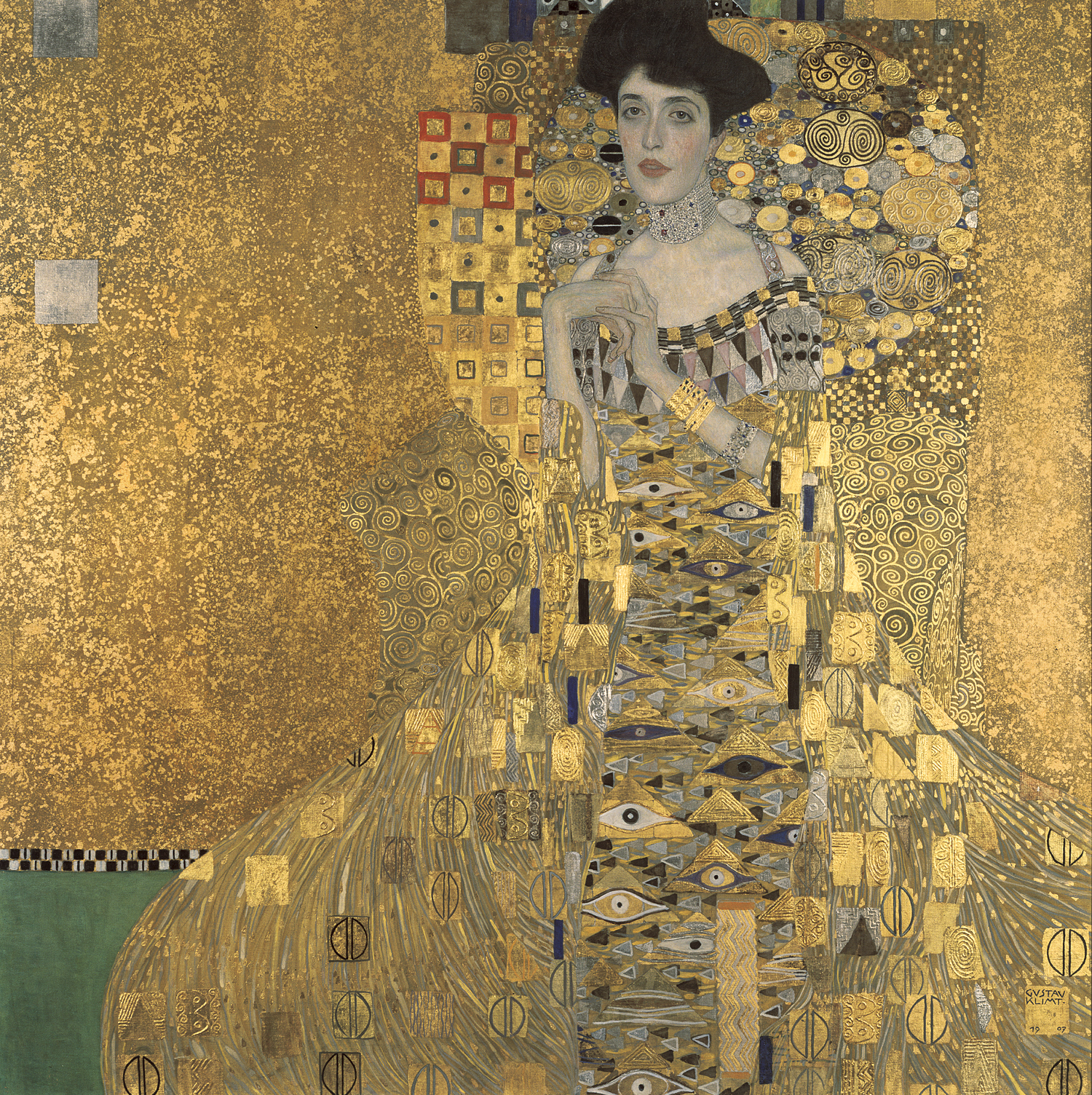
Neue Galerie, New York
The Matriarch, Grandma Dorothy dressed in a gold lamé housecoat each year for Thanksgiving dinner. The table, set with rose china, was laid out long in her small basement apartment. Poised and gracious in her kingdom, she sat at the head of the table and smiled at each child and grandchild as we voiced gratitude for our blessings. She, in turn, gave thanks for “all of you.”
Regal, despite the crippling arthritis which attacked her bony sylph of a body, she held herself with an aristocratic air. Her back stayed straight with practiced posture through two total knee replacements, three husbands, four births, and five decades of single motherhood. Her studied gait had slowed, but still kept its polished flow from her days at the Presbyterian Girls School in Missoula, Montana, where Bertha Harriett, her mother, had insisted her only daughter be enrolled.
Dorothy’s hands gave one clue to her impatient internal pace; slender, knuckley, and nubbed, they were never still whether fluttering in her lap, tapping the tabletop, or brushing out a rhythm on her thigh. Another clue to her core came from her eyes. Bright and clear, her hazel eyes couldn’t hide all her knowing. They blinked and batted, magnified behind her glasses which earned her the nickname Granny-Bird. Beyond the constant pain of fibromyalgia which inflamed all her soft tissue, my grandmother carried the wit and wisdom that only a lifetime of studied learning can teach and only a sage can repeat.
“I just ache all over,” she explained.
When I was twenty-three and she was seventy-nine, she was diagnosed with lupus. In near-constant pain, I drove her an hour to her primary care physician. She said to the doctor seriously, “Fix me.” Holding her hands outstretched as if in child’s pose, palms up, in release and submission to the pain, in hope for healing. Then looked him piercingly in the eye until he admitted with a stutter that none of her ailments had a cure, a salve.
There was no fix, no hope. Regaining his composure, he whispered to her quietly, “We are a horse and we are a rider. The horse grows old, tired and pained; the rider is young forever.” So, she continued to wince and sigh in her sleep and persisted in walking slowly, majestically enough so the burden wouldn’t show much.
—–
Question
by May SwensonBody my house
my horse my hound
what will I do
when you are fallen
Where will I sleep
How will I ride
What will I hunt
Where can I go
without my mount
all eager and quick
How will I know
in thicket ahead
is danger or treasure
when Body my good
bright dog is dead
How will it be
to lie in the sky
without roof or door
and wind for an eye
Without cloud for a shift
how will I hide?
—–
No longer seven, Holland America Line Westours brought me back to Alaska in 2000 as a nineteen-year-old tour director. My job was to guide tour groups ranging in size from twenty to fifty people on nine-day land tours between Anchorage and Skagway, Alaska. The distance covered on each tour was somewhere around 812 miles, 1,624 round trip.
During the second week in May, the tour director trainees converged on the Anchorage Hilton. I’d never been a room with so many extroverts. The uniform for that year was khakis and red shirts, and the majority of our training as tour directors consisted not of classroom instruction, but taking the actual tours that our guests would take when they arrived in Alaska.
A typical first day in a Holland America cruise-tour package included a stop at the Alaska Native Heritage Center, a brief city tour, followed by a trip out to Portage Glacier. Our fifty-five-passenger motor coach ferried the group the forty-five miles or so to the Visitor’s Center. There is no better way to see Alaska than from the windows of a motor coach. Greyline, Holland America, claimed the window had been engineered by Kodak, and I thrilled as I gazed on Alaska for the second time.
Twelve years of nostalgia struck as we reached the Visitor’s Center, and I hurried off the bus into the building without a glance toward Portage Lake. Though I was now nineteen, it was as if I was there for the first time. With the other tour directors, I took a seat in the theater for Voices from the Ice. I was excited for my companions; I thought I knew the finale.
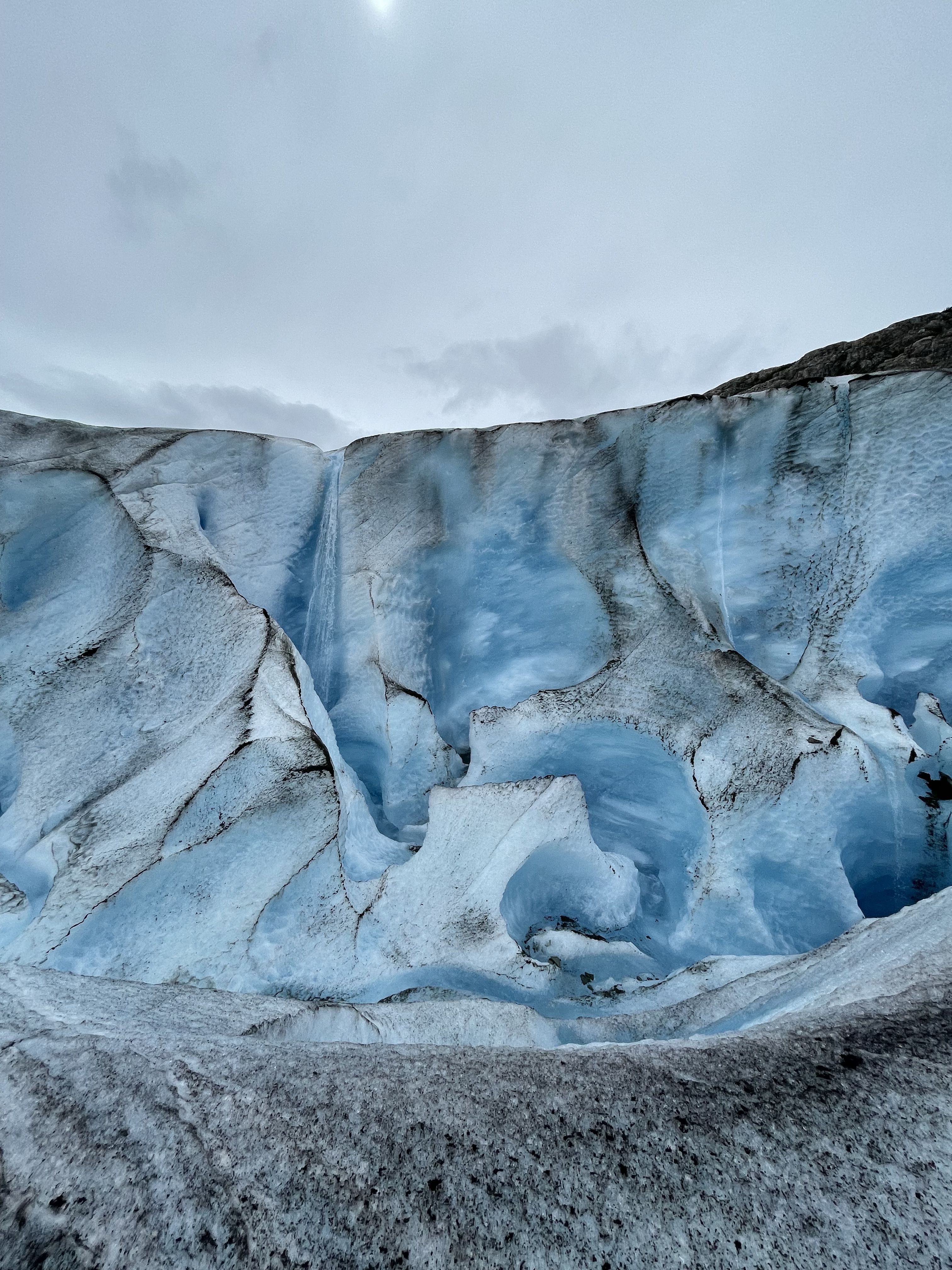
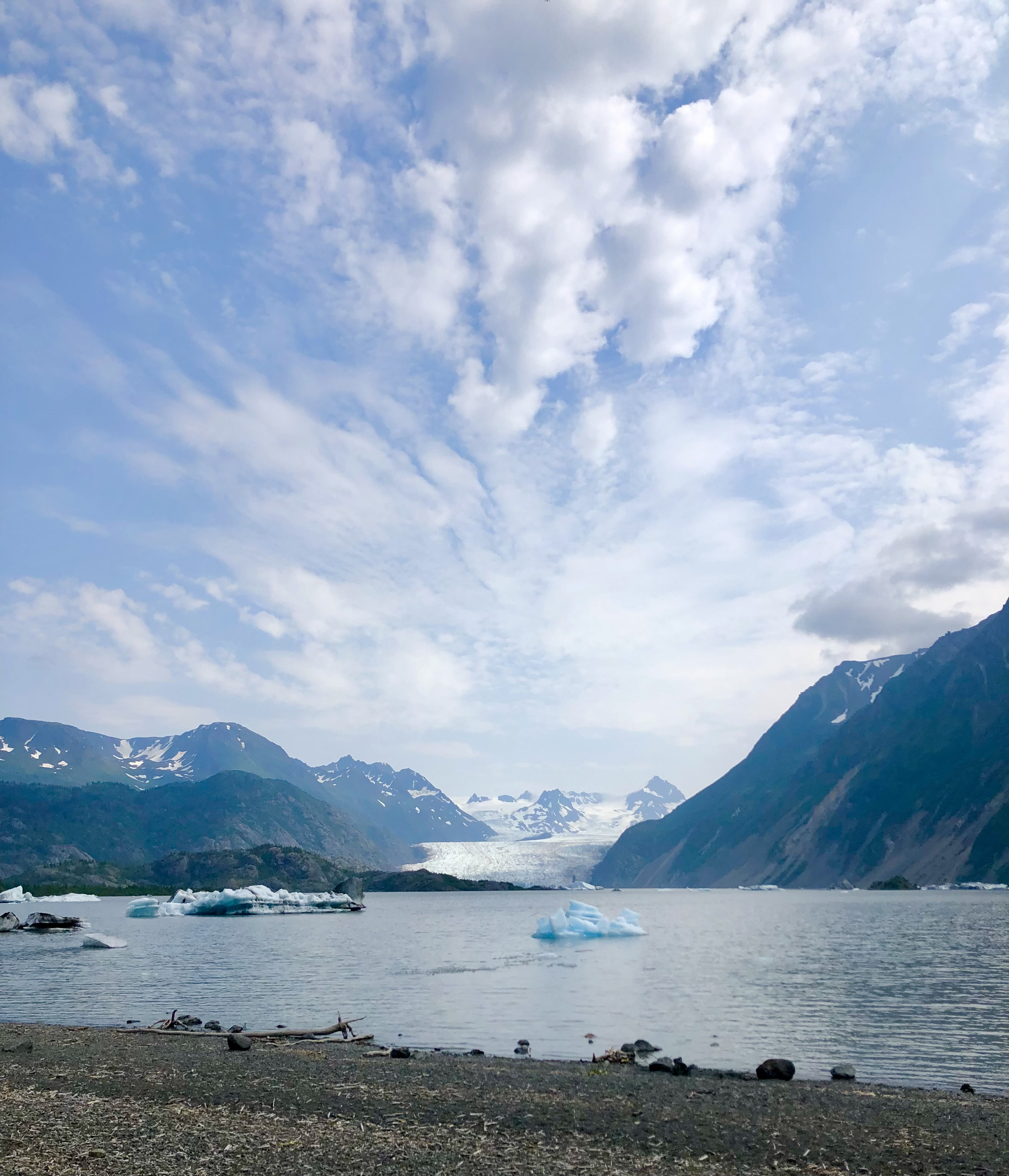
The movie ended, the screen rose, the curtain parted, and behold… a lake. There was no glacial face, no snout. No grand finale. No blue terminus of ice to awe at. Nothing but a dingy, mud-gray, motionless lake, dotted with giant melting ice cubes.
—–
ICE
by C.K Williams
(excerpt)
That astonishing thing that happens when you crack a needle-awl into a block of ice:
the way a perfect section through it crazes into gleaming fault-lines, fractures, facets;
dazzling silvery deltas that in one too-quick-to-capture instant madly complicate the cosmos of its innards.
Radiant now with spines and spikes, aggressive barbs of glittering light, a treasure horde of light,
when you stab it with the awl again it comes apart in nearly equal segments, both faces sadly grainy, gnawed at, dull.…
Imagine then how even if it shattered and began to liquefy,
the hope would still remain that if you acted quickly, gathering up the slithery, perversely skittish ovals,
they might be refrozen and the mass reconstituted, with precious little of its brilliance lost,
just this lucent shimmer on the rough, raised grain of water-rotten floor,
just this drop as sweet and warm as blood evaporating on your tongue.
—–
Skagway became Alaska’s first incorporated city on June 28, 1900, boasting 3,117 residents. The population has fallen steadily ever since, and the 862 year round residents remain set at sea level at the mouth of the Lynn Canal, the deepest fjord in North America. The “Gateway to the goldfields!” continues to be Skagway’s modern claim to renown. The famous picture of gold miners and fortune finders treacherously clambering over the “Golden Staircase”, grand piano included, is set right outside of Skagway in the now non-existent town of Dyea.
The land surrounding Skagway rises abruptly from the ocean with White Pass Summit hitting 3,292 feet just 37 miles North of town into sub-arctic alpine tundra, think scrawny, wind and ice-bitten trees and tiny kettle lakes. But Skagway City’s climate is temperate coastal rain forest, think lush top-soil and muskeg, thick fern foliage, and dense forests just outside city limits.
I run. Chugging South down the Klondike Highway into the town of Skagway, I keep my eyes trained on Harding Glacier. This small hanging glacier, nestled in the armpit of Harding peak across Taiya Inlet from Skagway, has almost melted out of existence over my five summers in Alaska. Alarms sound off through my senses, as my feet scud over old glacial silt which lies alongside the road, “Fire!” Watching the midnight sun rise hotter and hotter in the Northern sky each summer has fueled my fear.
Finishing my run, I stand sweating, in ninety-degree heat on Broadway’s boardwalk, the main drag in downtown Skagway. This heat just isn’t quite right. A mere four blocks wide twenty-three blocks long, tourists clog every artery of Skagway’s downtown district, weaving in and out of open store doors, gawking through shop windows. Down at the docks there’s only parallel parking for mammoth cruise ships that pull-in and drop their load of 3,200 passengers per boat, per day.
With five berths, the math is easy, these ships can release 16,000 people or more into town on any given summer day. None of them seem too concerned about the fate of Harding Glacier or the Juneau Ice Field. I see the signs of glacial recession everywhere. What should we do? Imagination plays a “what if” video clip: I turn to the man in the green fishing vest and dockers khaki shorts standing next to me on the boardwalk. He’s quickly licking the myriad of drips from a pecan praline double cone he just purchased from Kone Kompany, held tightly in his fist.
In my imagination, I unload, “Sir, I know you’re on vacation” I pull out my imaginary microphone, begin diplomatically, “but does this heat scare you? You know, we’re in Alaska, the North country? Do you believe in global warming? Does it look to you as if this blue ice is a bit uncomfortable in this unbearable heat? Look, everything is melting, you, me, your ice cream cone, the glacial ice. Which boat did you come in on, the Diamond Princess, Empress of the Seas, the Volendam, Carnival Spirit? Did you enjoy awing all the way up the Lynn Canal this morning from your deck chair at the blue ice hung across the shoulders of the Chilkat and Coast Mountains? Nature dressed up just for you, sir. Do you want your grandchildren to be able to see what you saw? I really want my children to experience Alaska the way I did, glaciers and all. What should we do?”
There it is. Even though the scene played out in my mind instead of in real-time, I feel better. Sounding the global warming alarm. It’s not a him thing, or a me thing, it’s a we thing. Which doesn’t make the situation of Arctic warming any better, but it sure does make me feel a whole lot better to pass the blame on to the guy in the flop-backed fishing hat, or at least share it with him.
—–
Grandma was with me, lying on the purple silk bedspread in her room like a queen. I, her five-year-old courtier, heard the tiny tinkling tick of each bead hanging over her lavender pillows as my head parted them to rest on her shoulder. Opening a worn copy of The Tales of Old Mother West Wind, Grandma flipped to “The Tale of Johnny Fox.” We read for what seemed like days in a world where the wind had a name, and her animated baby breezes played tricks on the rabbits, beaver, and foxes who always seemed to get caught in the bluster.
At age six, I watched her morning routine. A garish multi-colored silk mu-mu, draped loosely over her small shoulders, got pinched under the little bulge of her belly then fell long to the floor. A tall glass of skim milk, burned buttered toast, bowl of soggy mini-wheats, all crumbed and dripped over a crossword puzzle. After breakfast, she’d shower and then stand naked and wrinkled, puffing loose folds of skin with talcum powder while listening to the tenor whine of the Bible on her old black tape recorder.
Even when I was eight, long after my parents were sleeping, I’d tip-toe into her bedroom and watch late-night reruns of MASH, The Love Boat, Star Trek the Next Generation, and eat bread-in-milk from mugs with spoons. She too was a night owl, and she’d sit next to me on her water bed, smelling of vitamin E oil and half-dry finger nail polish, her gray curls preserved for the night in a paisley scarf. I’m too young to understand that one day, I’ll lose her forever.
*(This is the second in a series of braided essays and poems about love, loss, ice, life, and what our world faces as we experience climate change at the human level. Here’s the first essay: Hope (Alaska). Thanks for reading!)





 Refined + Rugged