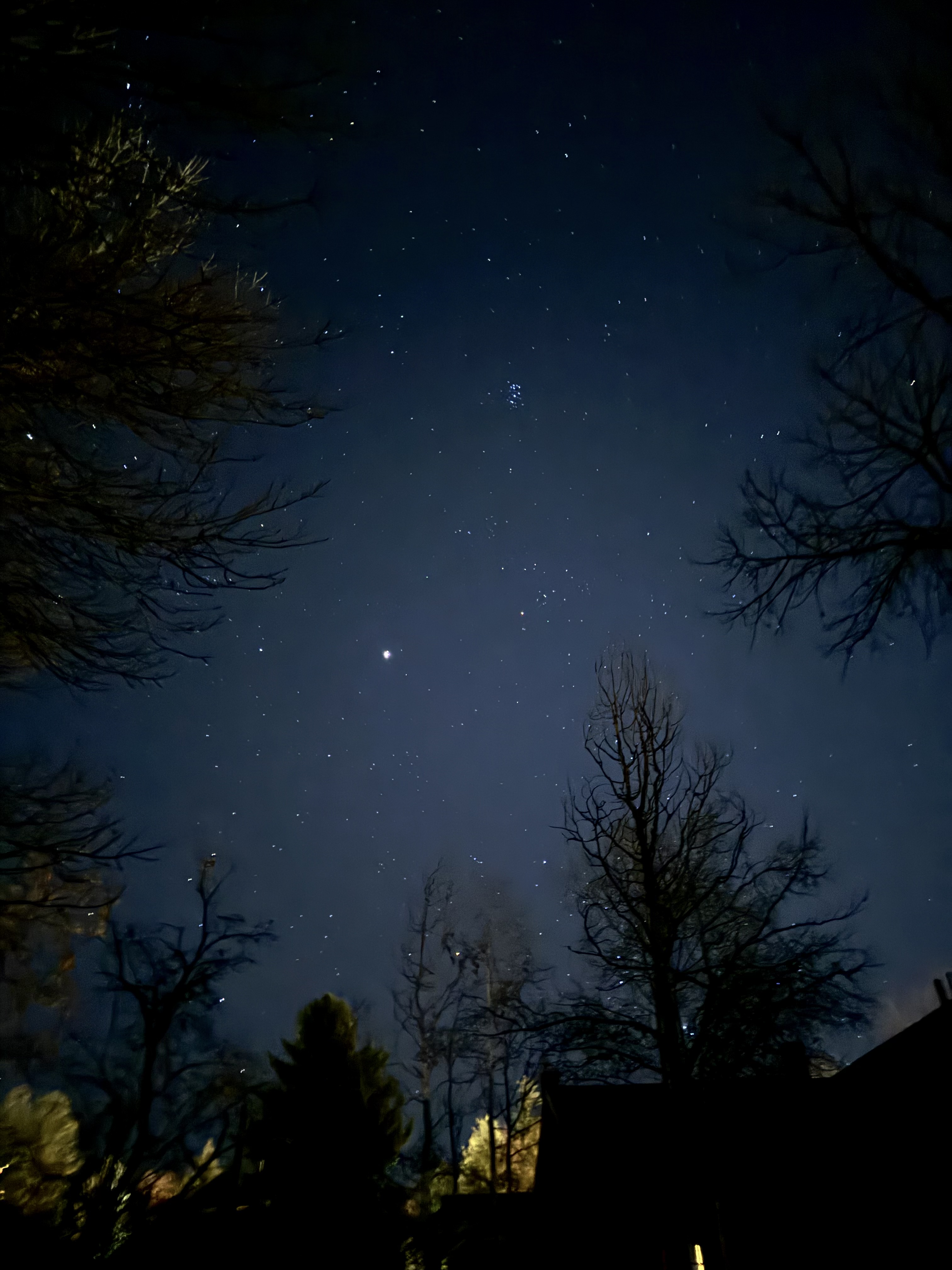
Jupiter and the Pleiades. November. Northern Hemisphere. Image, my own.
Holocene
When the sky lifts, so lapis and milky blue, Your ocular senses are overwhelmed The owl calls out, into and through the pencil- Sketched branches of the cottonwood, then Down from the neighbor’s roof, as the golden
Sky continues to lift into day, a flat aquamarine The stark lines of leafless branches against The air stand beckoning, the promise and Possibility of new– growth, change, revivification Glittering diamonds of momentary snow still
Hold winter’s mystery. We do not know what We will be when the new buds come, but only What is– this moment, this tree, this Possibility of everything, anything Makes our heads spin and swim
Bounded by our humanness, mortality Consequence, but dazzled by all that is In us– the roads we’ve wandered, mountains We’ve scaled, journeys taken and joyed over And travailed. So much unknown
It still feels like the owl is a good omen Round white face, deep open amber eyes, wide And night-visioned, all the flecks and freckled feather patterns of each wing spread against dawn and dusk Gifts that portent deaths and lives to come
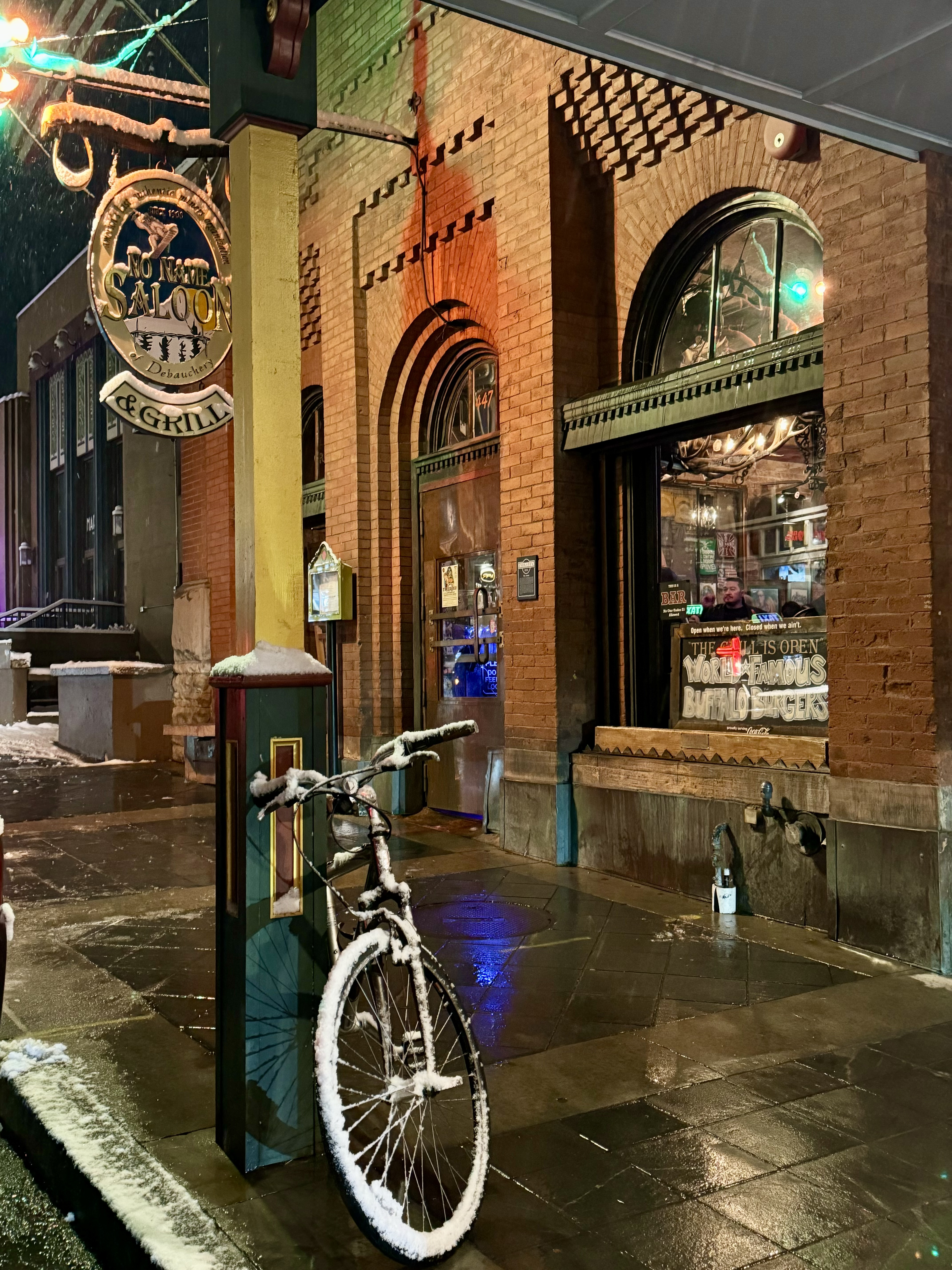
No Name Saloon. Park City. Image, my own.
Shoes
When your shoes wear out run like hell through tulip fields Take off to the mountains Climb every geologic Formation Just to Prove You’re alive You can You’re not dead… yet You still want To spend that moment with the crickets under night’s blackness only the stars know you’re there
When your shoes are worn out you take your daughter to the gravel pit and train your camera lens on the North Star tripod so still to prove you know where you are going even though you Don’t you depress the shutter let the sky bleed in for hours and all you are left with is time
No time left But you have those Shoes to remind you to keep you on your journey Home– Through– Around– To– To that time When the cosmos smudged its glory across the lens of your camera Film Still the most sure sign that the stars will fall in to center North Balance bringing these stars to you
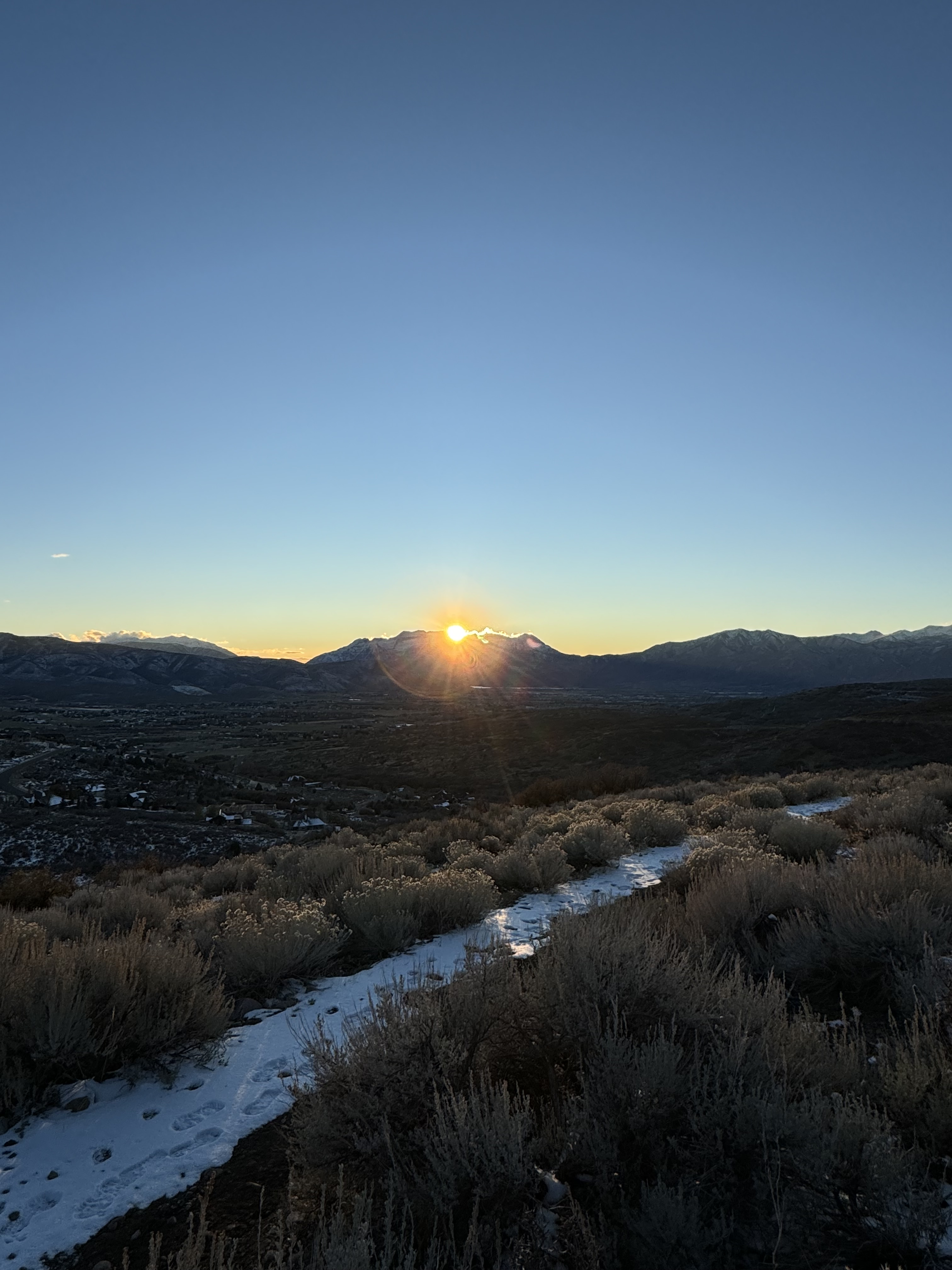
Autumn Sunset. November 2024. Image, my own.
Question(s)
For all those who question: Borders Boundaries Countries Alliances Allies Friends Enemies Economies Lovers Children Fools Frauds Race Place Faith
I love you
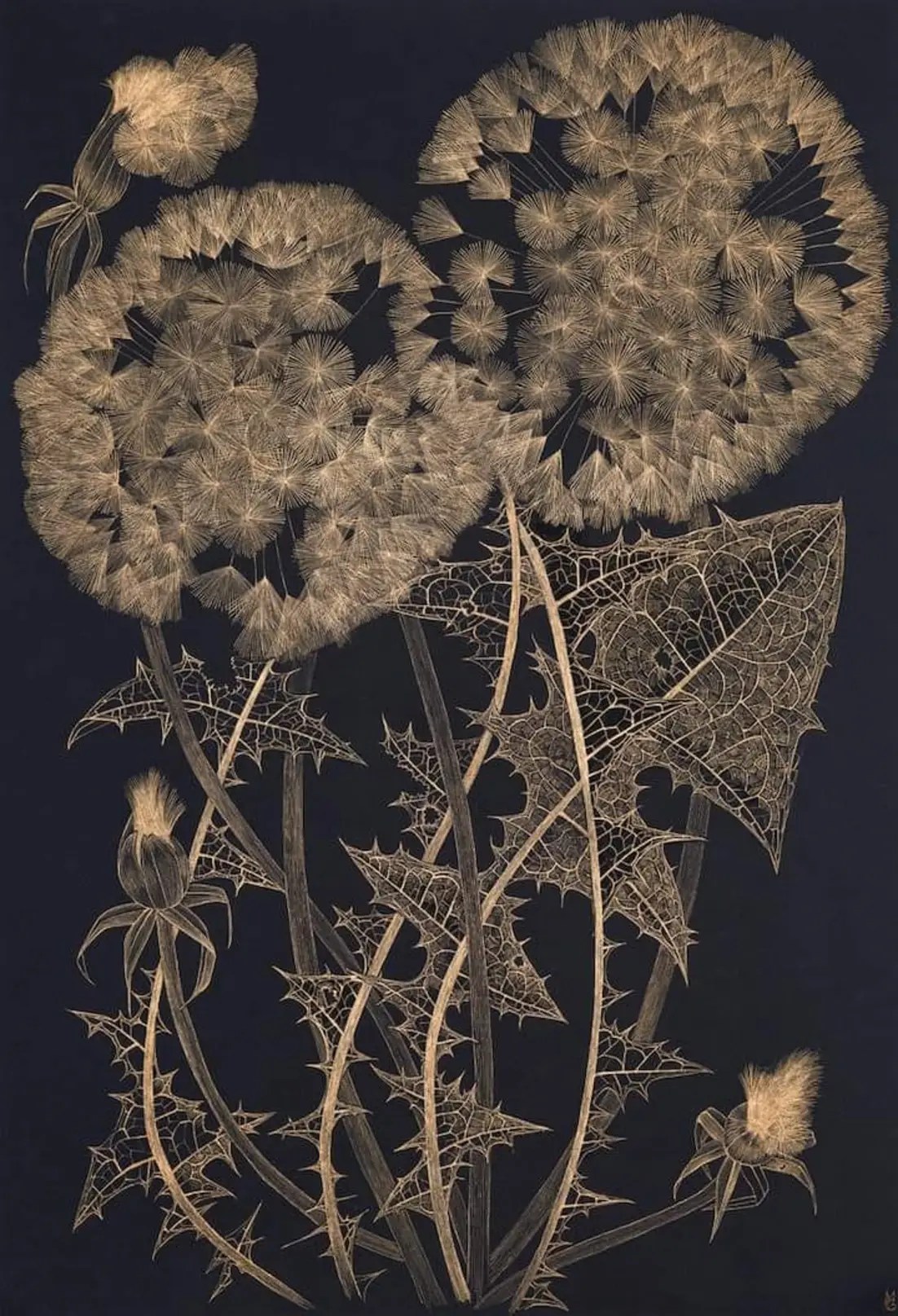
Winter Dandelion. Acrylic on heavyweight cotton paper. Margo Elizabeth Glass. 2024
Night Guide
When Ursa Major dips so low In the Northern Hemisphere that Only her two guiding stars are Visible in the deep of darkness Black, the seven sisters start to rise Pleiades, in silent winter’s night as Cassiopeia, queen, stands out above The calm chill also pointing her way to our Closest cosmic simulacrum Andromeda The stars are there, uncaring and seemingly Cold, distant even impossibly far, and yet Known, seen, perceived though the crickets Haven’t made a sound, the air, nearly Incorporeal breaths of rest, sleep, A thousand dreams take flight
i. Vivace The Body and Brain create a near-constant concerto, Orchestral ensemble that one piece of the body May be tasked with– the soloist, for a moment– The violin of your legs stands in the spotlight Lifting the bow back, striking the perfect legato When you lift each leg to strike the pedal: rising, falling, Rising, falling, in perfect détaché, the synchrony, Breathtaking, a veritable martelé, up and down, Crescendoing, up and down, faster and faster, Staccatos building as you climb that little kicker, Beast of a hill, every note separate and distinct and Purposeful and achingly beautiful, melody in movement
ii. Largo The reality is that the soloist, The part of the brain or body that is on display, is Accompanied by an orchestra of other reactions, Symphony, an entire production of body-brain actors Breath increasing as you crest the top of the climb Then wide, expansive sucks of air through your lungs as you Descend, behind the soloist your legged String instrument, a complex array of bodily musical Tools, exchanges of sensory information via energy, chemicals, Afferent and efferent neural fibers, we know this But to experience it is so much more vivid, vibrant, Actual art an afferent neuron gathering signals from
iii. Adagio The skin like the finely tuned drumhead of the timpani You’re pedaling along at a rapid pace and your Neurons are sending each breeze that crests your Quadricep, each flexion of your fingers as you Reposition your palm to the vibration of your handlebars You begin to really circle, pushing, leaning into the Pedals with more and more force, lifting your Foot up to keep time and pace with the peloton This is where the sensory experience really Begins to take off, you’re in the pace line driving Your muscles pumping with blood, efferent signals, Through the femoral profunda, spiccato of oxygen
iv. Finale Feeding the whole quadricepal system: vastus medialis, Vastus lateralis, vastus intermedius, and rectus femoris Don’t forget the glutes, rich, ringing riot of brain-body orchestration, molto crescendo Coming in hot… finish line, and stop!
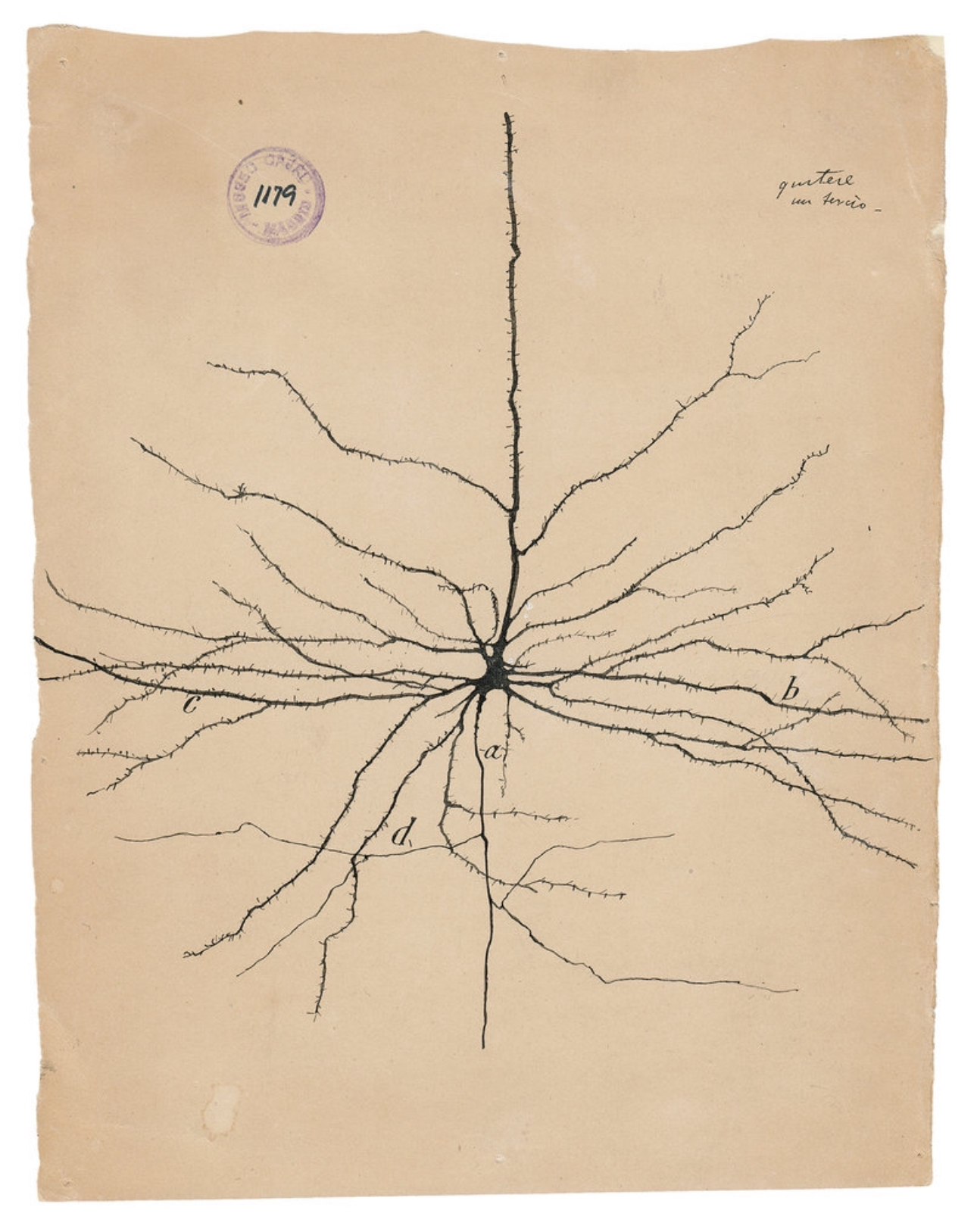
Ramón u Cajal, Neuron, Museo Nacional de Ciencias Naturales
Polyphonic Technicolor Synesthesia
this is how it feels to be in an autumn wood at sunset, the entire mountain set ablaze, a conflagration of color in that warm waning light, each leaf in stark relief to something visually near– brittle topaz bark, white aspen trunk, every
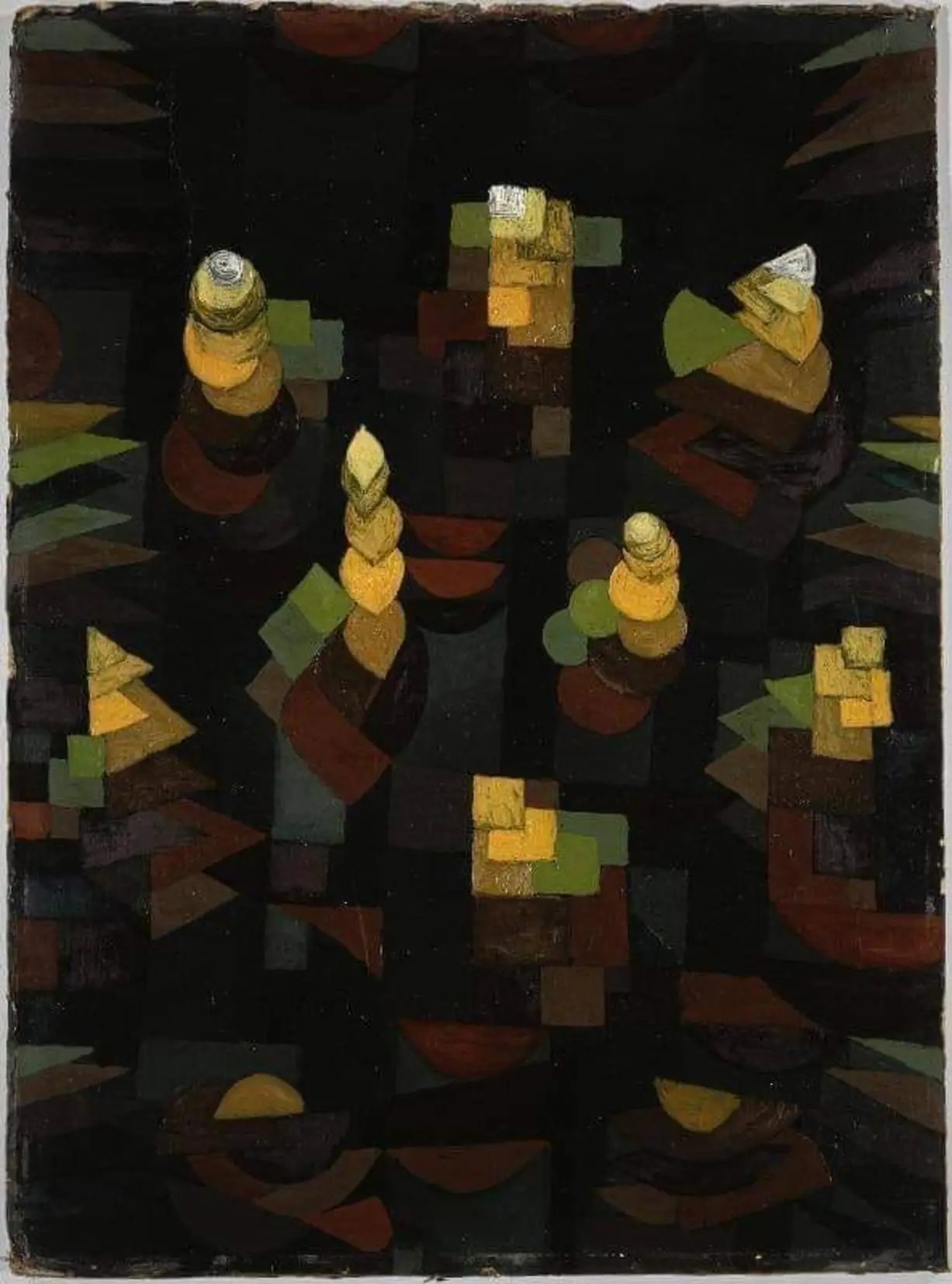
sense housed in neon-rich sculptural portals a magpie cackles from a scrub oak turning amber its wings that look so black in flight reflect a deep maxixe beryl, oceanic opalescent contrast Paul Klee’s Polyphic Setting for White
poets, mostly, long for synesthesia so that they can produce that contrast that catch of the craw between all worlds– senses coming undone in an autumn wood or at the very least they’d like to produce it on the page, certainly the experience
might be so disconcerting as to be horrible but if you could see autumn lanced by a sunset or a taste a technicolor leaf as it fell in a stream of wild wind, maybe if you’re there long enough in the woods, the colors begin to have
a particular flavor, like the brown dry leaves of wyethia amplexicaulis, mule-ears become tiramisu in the mushroom undergrowth they take on a shape in your psyche like a rhombus with the sun setting above the far angle, always forty-five degrees
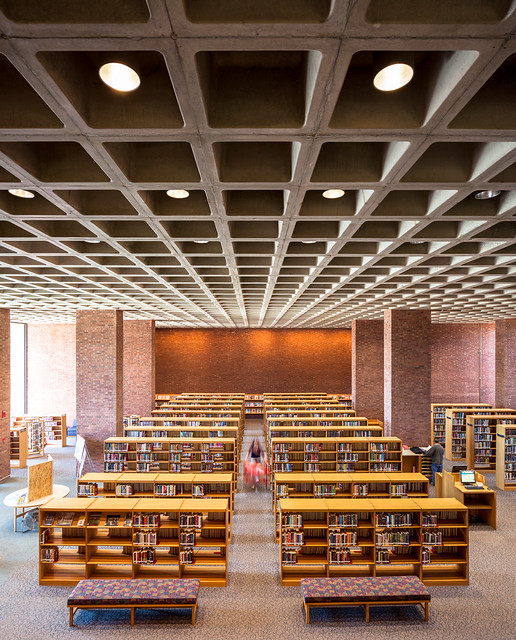
Michigan City Public Libaray, Michigan City, Illinois. Architect Helmut Jahn, 1977.
Thin
i do not know what it is about now, every- thing just feels papery a little thin around the edges, a little dry and flat
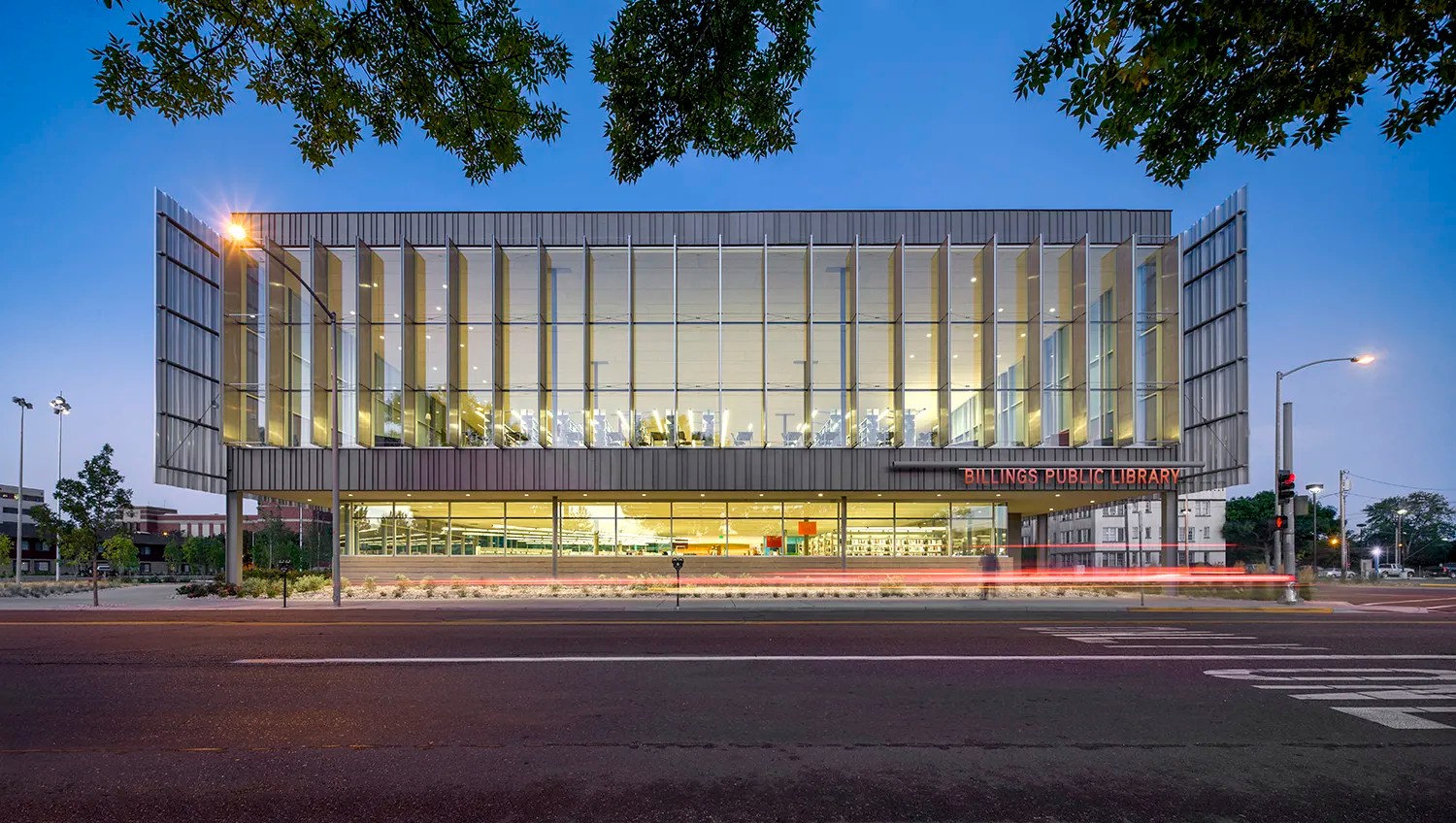
Billings Public Library, Billings, Montana. Will Bruder Architects, 2013.
To Write a Poem
to write a poem is a lot of staring out of eyes through windows
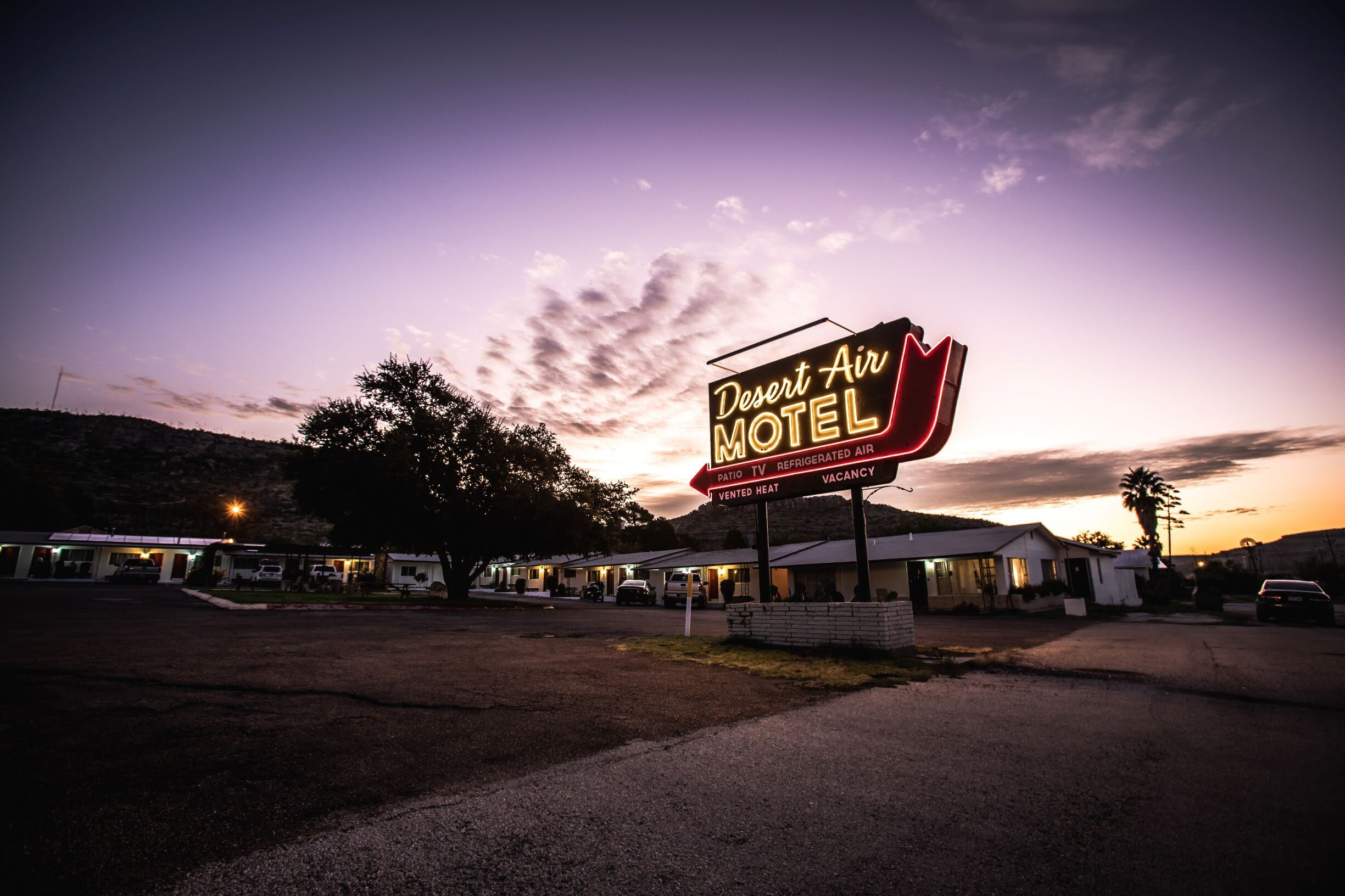
Desert Air Motel, Sanderson, Texas. Built in 1960, restored, 2022.
Send Your Kids Weird Texts
Send your kids weird texts Tell them that you’ll Give them lunch money If, when you are really Old, almost gone, they Will let you run your Papery, age-spotted hand Through the thicket Of their hair Make them pause Question the sanity Of your replies Make them promise So that your five bucks Is paid forward in your Elder years, it’ll be worth it To give them a future Imagination of how Much you will Always love them
Synesthesia as an Image, Public Domain.
Abandon All Solutions
One of my good friends Heard this in a dream Or in a wakened state Where she was contacted By the Universe, So the advice wasn’t really Given directly to me, But it has come to mean Everything
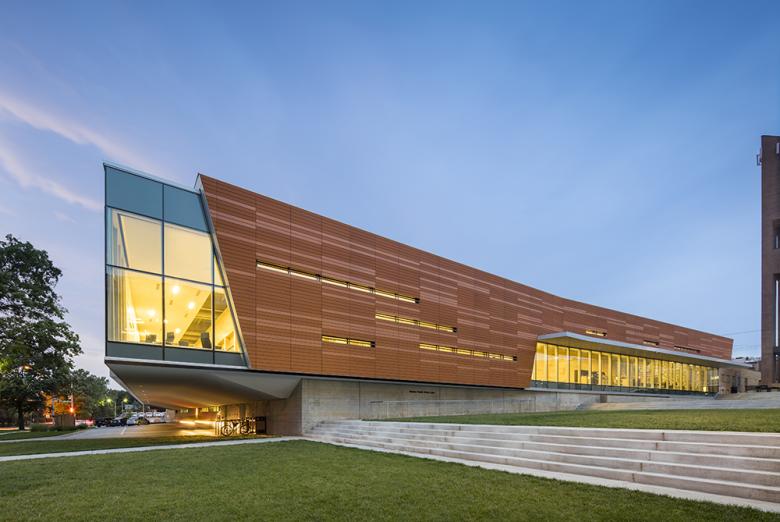
Lawrence Public Library, Lawrence, Kansas. Gould Evans Architects, design John Wilkins, 2014.
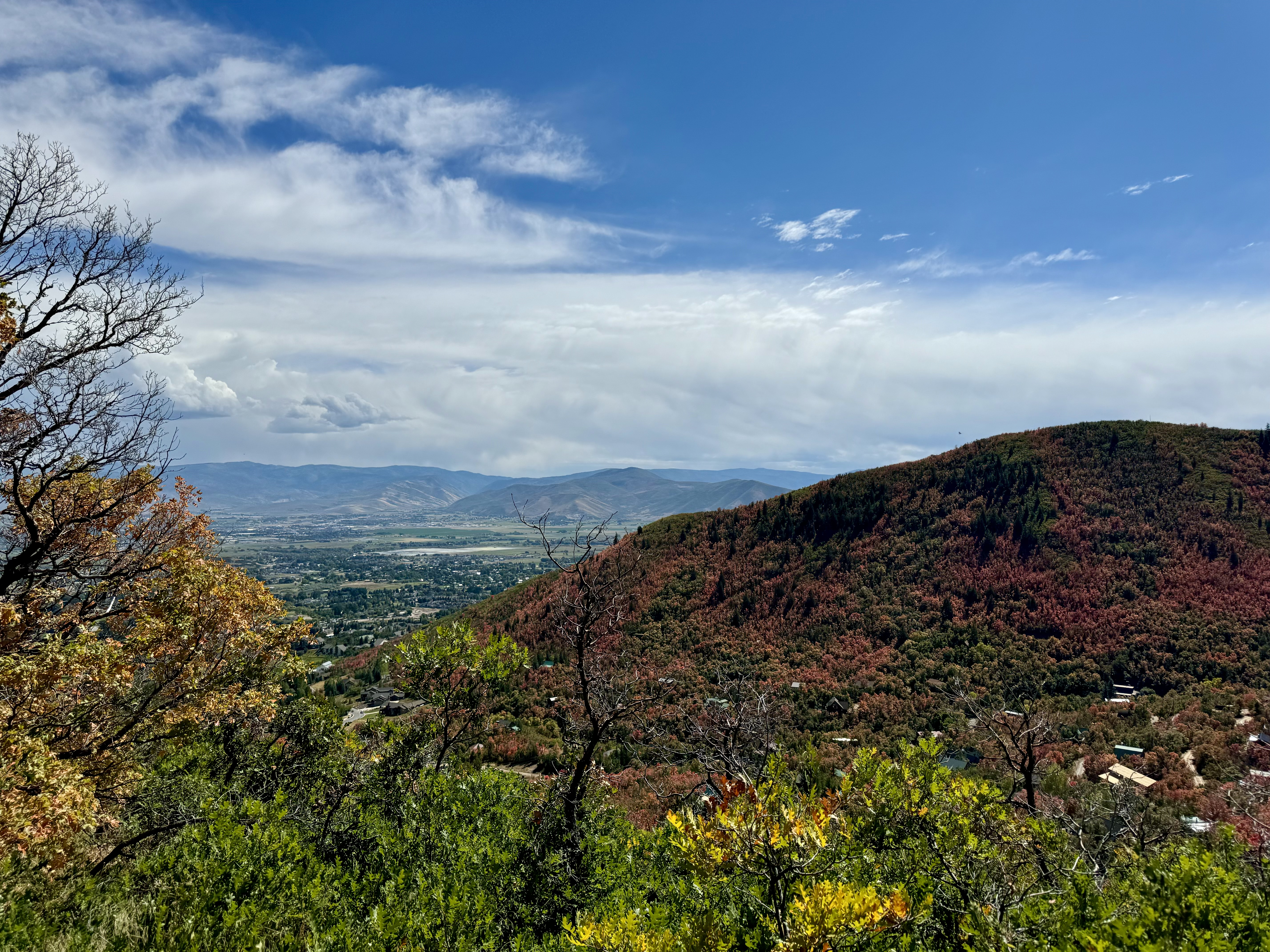
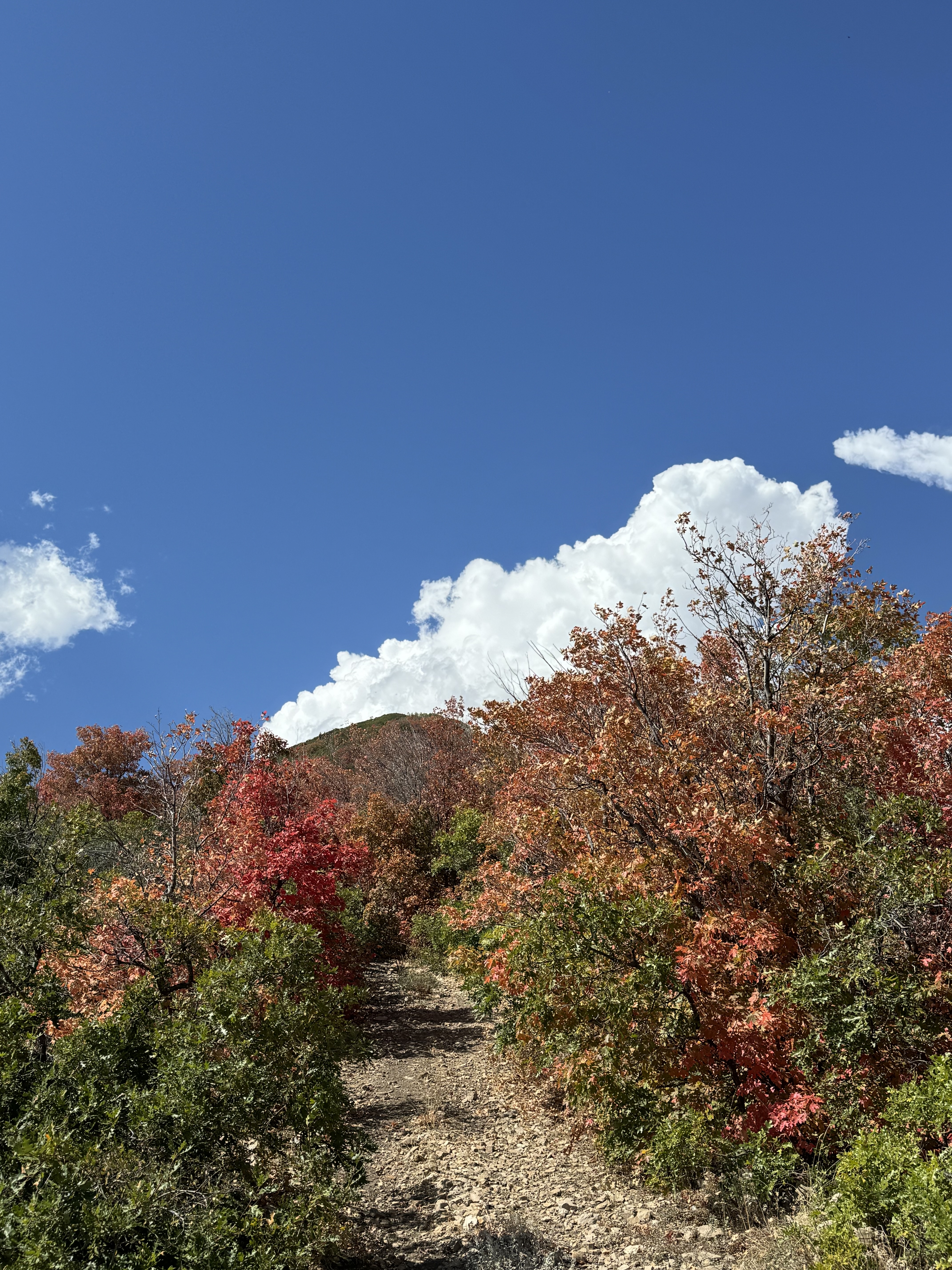
Autumn, overlooking Midway, Utah. Image, my own. September 2024.
Respiration
autumn of last year, I found myself watching my babies breath, in sleep, in dream
deep, cadenced pulls of oxygen fueling all parts of their frames, their beautiful hearts keeping time
children’s eyelashes soft, curled the color of milk chocolate, individuated so perfectly against the
delicate skin of their cheeks, I wept as their chests rose and fell at the joy of watching them breath
constant, paced, churning, these fist-sized hearts, muscling, pushing life-giving nutrients through their precious, peaceful forms
at night, it gave me peace, the assurance that everything was alright, the play of pulmonary veins filling
with nitrogen, argon, all mixed in with O2 being sent to the heart from the lungs hearts filling the upper left atrium
the heart, house of refreshment, dispersing the blood rich with food back into the body through the lower left ventricle
this circle saved me, literally, again and again imagining how the autonomic, metronomic rhythms of the heart allowed them to rest
into dream, into sleep, into measured breaths, into the rising of the inner oceans, breathing peace
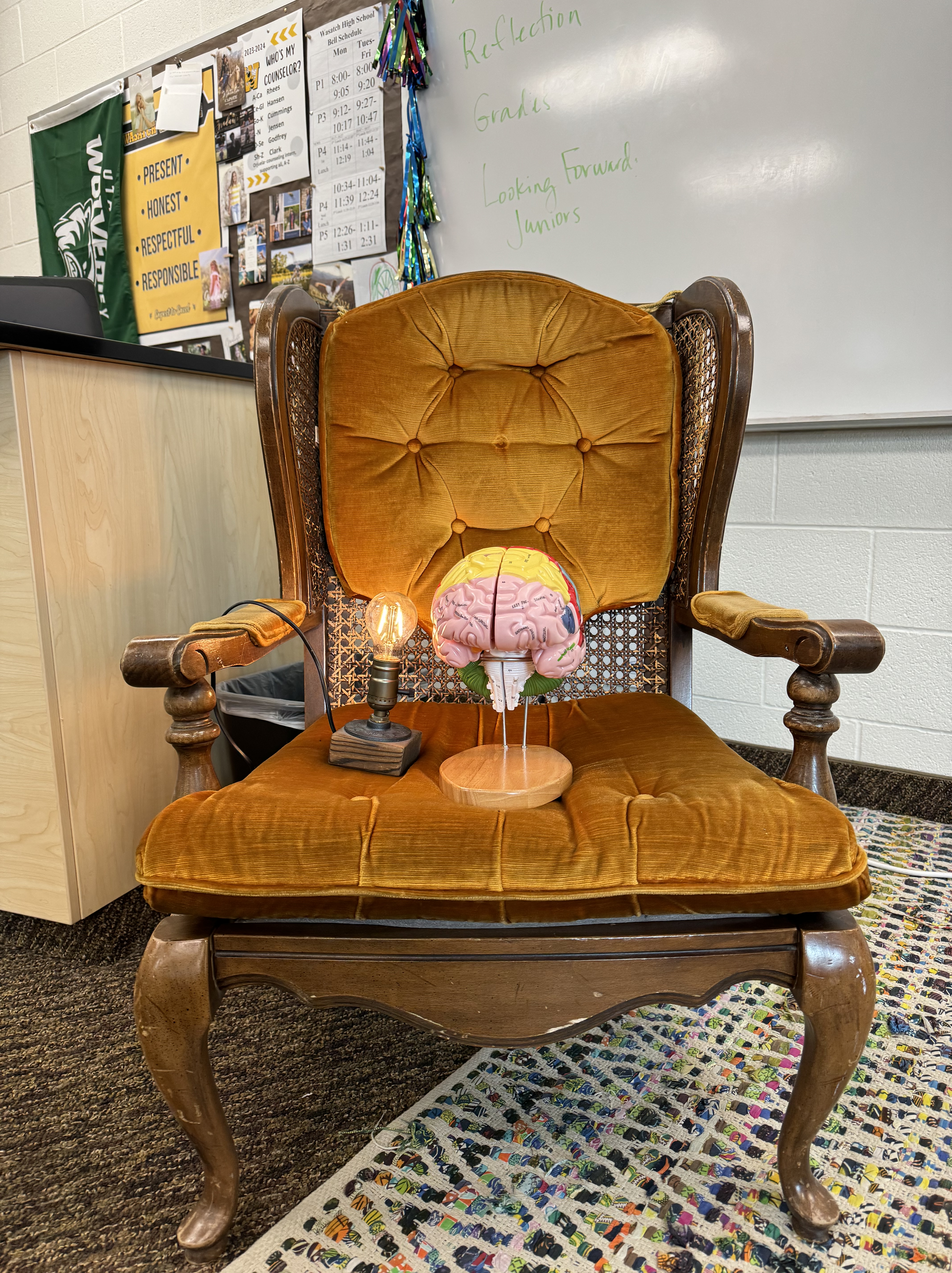
Brain, Lightbulb, Plush Chair. Image, my own. May 2024.
Hippocampus
When my students check out a book from the library I often encourage them to make a bookmark Any ratty scrap of paper will do, a plus if it is neon pink We use this slip of paper to mark where we have Read, where we are reading, where we have been, Where we are going. The brilliant thing is that having A placeholder, having a signpost, having a demarcation To show how far you have come and how far you must go Is another kind of marker. It is a memory marker. In print, In pulpy bound cellulose and black ink, hold in your hand, Sniff with your nose, the real goodness of paper is that The brain creates even more memory pins for this Medium. So now, you are reading a book, but your Brain even remembers, memorizes, the geography Of the page. Where did you see that perfect sentence, At the top of page 67, How far into the book was the Rising action, the falling sequence, your brain takes in the Terrain of the page—the paragraph, the thickness of the Pages you’ve consumed thus far, becomes another kind of Topography. So intricately is our existence connected– Touch, sight, smell, taste—all being remembered Brain cells, neurons, communicating with each other Regarding the climax of the story, through an elegant Electrochemical system. A change in the electrical charge of One cell as you read and integrate the signs and symbols On the page into a larger story, triggers the release of Chemicals called neurotransmitters across synapses. The neurotransmitters are then taken up by dendrites of the Neuron on the other side of the synapse where they Trigger electrical changes in that cell. The geography that print books, and bookmarks represent only strengthens This circuit, a story arc sweeping into the hippocampus as a Permanent resident in some synapse of your 100 billion neurons
Crane House Stained Glass. Image, my own. August 2024.
Heart “So much held in a heart in a lifetime.” -Brian Doyle
I won’t ever be a surgeon But sometimes I imagine a heart beating in a human under the purposeful glare of a surgical lamp. And I have a moment to inspect this beautiful organ with my own eyes as it pushes blood throughout the body I can visualize the thick membrane of the ventricular septum– lengthening and shortening in precise time, the casing which divides the right and left heart, the chambers, the heart walls, muscles, really, that send the blood coursing through your body with constant contract-relax reflexes a miracle with every beat
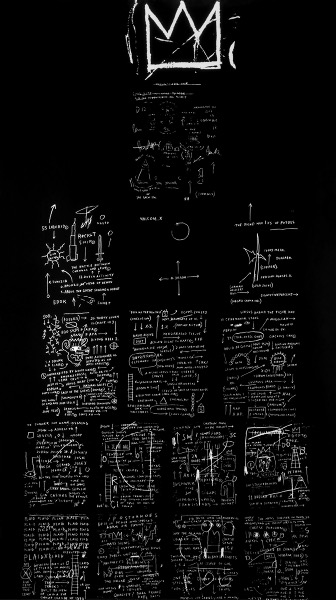
Jean-Michel Basquait, Tuxedo, 1983
Nervous System
I am trying to get my words wrapped around my autonomic nervous system I am trying to describe how it feels to see a photo where I once existed and have been erased I am trying to describe the pang, the thousand natural shocks that flesh is heir to As Hamlet intoned, unlike Hamlet, I’m not trying to leave this life. Here’s my stab.
When I’m in fight or flight, it is harder for me to wrap my words around my nervous system. It’s those moments when I could really just use a hug– skin to skin, arms enclosing my body, keeping me safe and calm, a quilt. Instead, in flight I feel as though the part of my body that is involved in the flying or fighting is nearly numbed, gone, absent
For example, if a man walks in on his wife making love to someone else, his brain, right behind His eyes may become so activated that it feels as though a horse bucked his skull from the Inside, like eating far too much pea-colored wasabi paste in one bite, which actually happened to me, I’m sorry to return to sushi, but it was my first time, and BAM!
Right between the eyes, if I believe that I am being abandoned, left, discarded, my entire lower gut is activated with one million energy worms, I crawl with that nearly breathless, tingle that radiates Through the rest of my body as I try to wrap my words around my nervous system for safety But, in fact, I should probably lean in. Accept. Sit with it. Just the other day, when a pang really
Struck me, took me by surprise, in my solar plexus, and then the breath catching, the spin, And the whole system, consciousness, in shock, straight from the amygdala, I thought, well good, I think this gives me the chance to decide what comes next. The brain through the body gets first dibs on the experience, but I am learning to quiet my reaction, trace the source
Of the shock, I am trying to get my words wrapped around my autonomic nervous system And what I am telling you is that I am trying to describe how it feels, so that I can hijack my hypothalamus, but that is impossibly ridiculous, that my wish is that no will ever have to feel this way again, which might be the end of our species, so let’s keep flying out of our bodies
Autumn, Wasatch Mountains, Image, my own. September 2024.
See
Have you ever watched someone learn something closely? With your raw, open eyes, irises spiked wide with color, this is where miracles lie. In my classroom, students flow in and out of the physical space all day. Water. But there are moments that transcend the quirky ephemera we plaster the walls to increase engagement. Air. Like the quiet that falls on the room when you discuss the concept that maybe Thomas Aquinas was right, and you could come face-to-face with the divine on the pages of an essay you read in English class. Mountain. Perhaps you witness the that burst of energy come across someone’s being when they lift the palm sander at the finish of the final face of the joinery for their rustic bureau in woods class, when the firing is finished in the pottery studio, when the piece of silver has been hammered to perfection. Fire. Those words and worlds and ways will always be part of your fiber, your sinew, your resilience, your learning in a sorrowful, beautiful world.
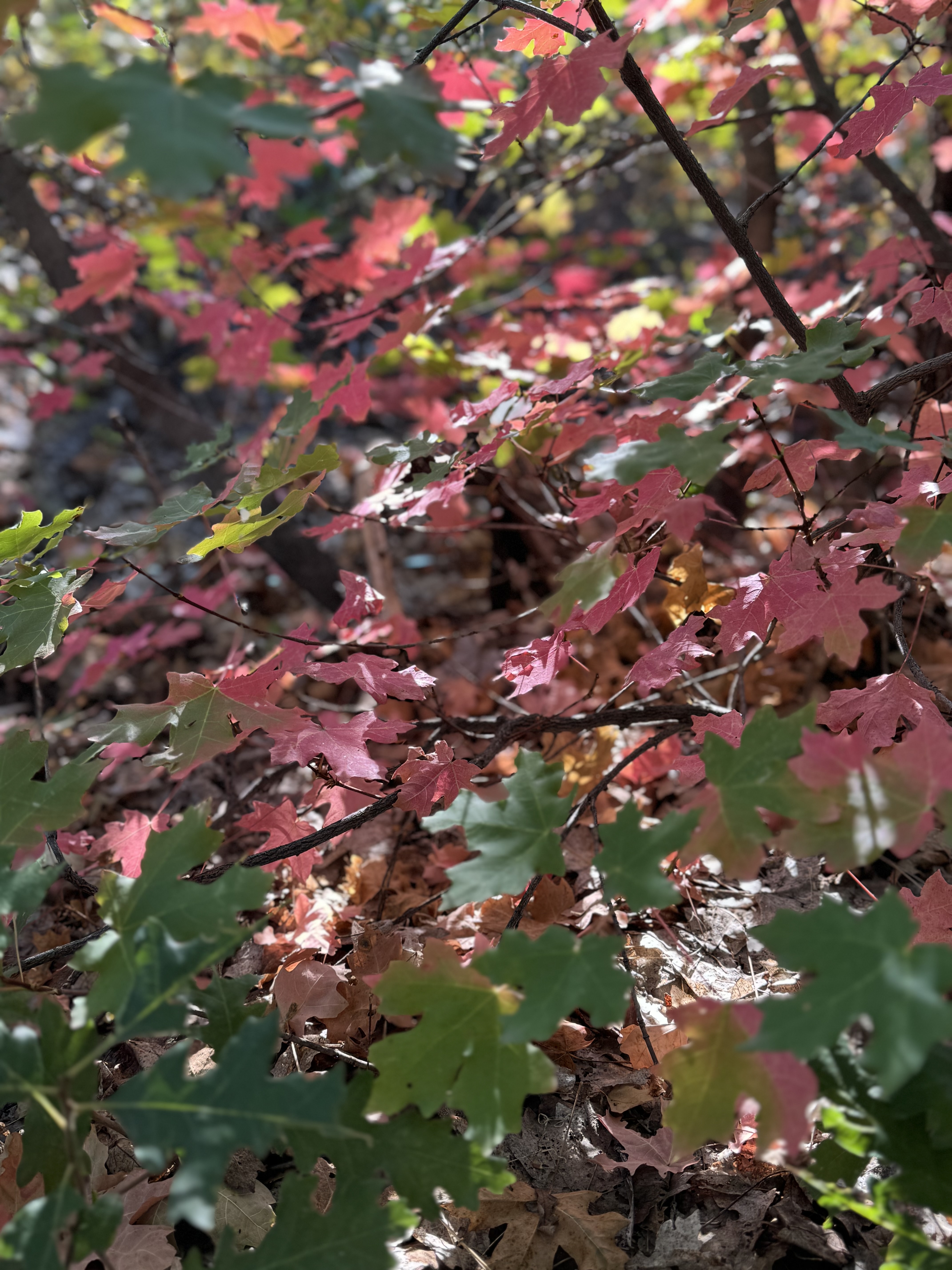
Scrub Oak in Transition, September 2024. Image, my own.
Autumn Equinox
there is this balance, this even-keeled consciousness, an equanimity of the breath in the air this time of year, the night and the day coming into equilibrium, living and dying reflected in the vegetation, the need for both action and rest, moving and pause, all things in their time and space
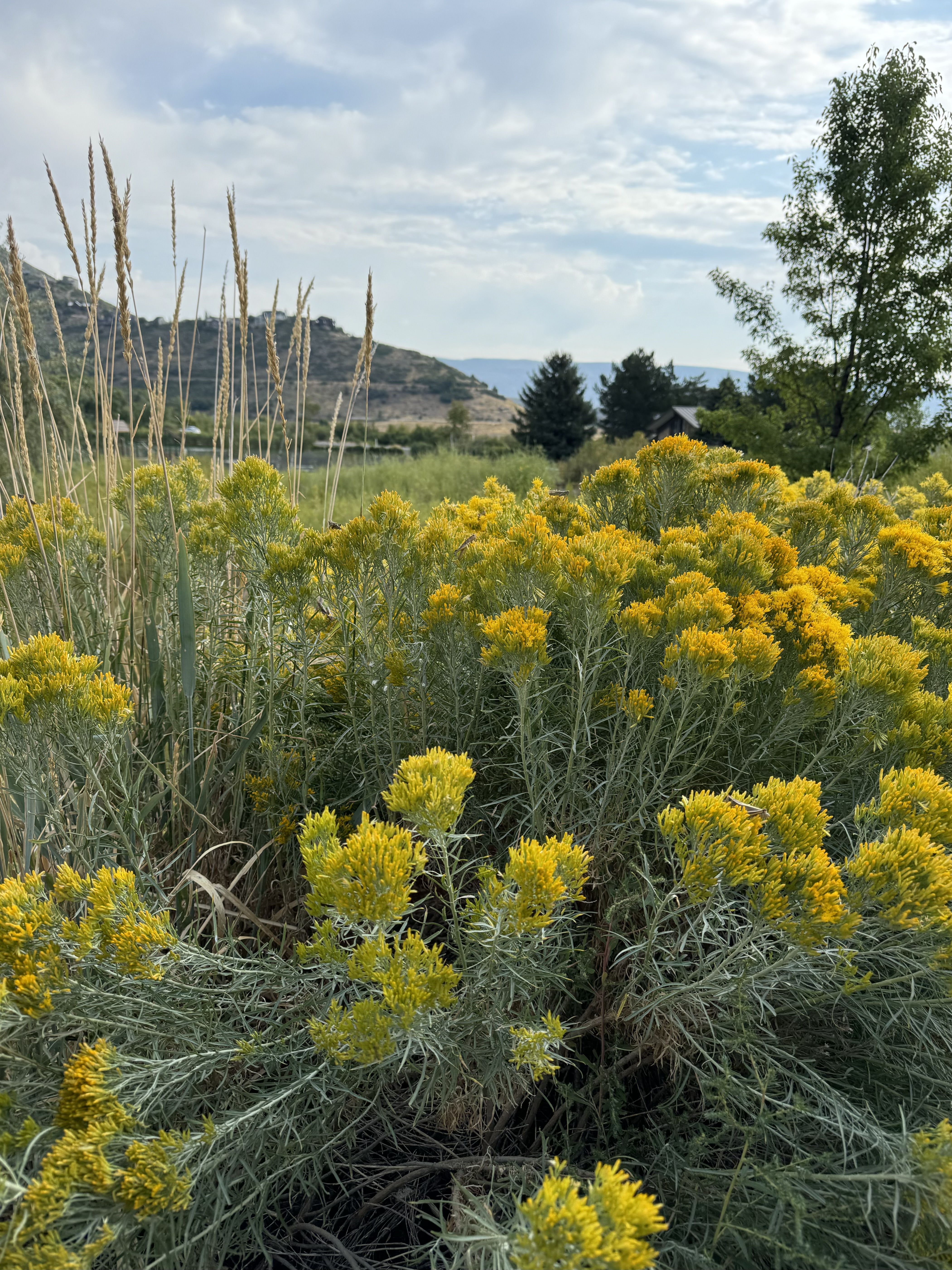
Rubber Rabbitbrush, September 2024. Image, my own.
Evolve -for the elders who’ve shone a light along the way
I’ve been watching the course of Life more closely as I’ve neared ‘halfway’
I’m totally clear, I may die tomorrow of a fungal infection brought on by an errant hang nail
This year, I started to see and understand some parts about this journey called life,
Facets that had never been open to me before, that had never been revealed
In youth. I began to witness the power of personal human evolution.
I’m sure I’ve seen it displayed previously, but now, it seemed closer, more raw and real
The strength, the peace, the solidarity, and grounding that some humans
Offer themselves and others when they choose to live with their arms stretched
Up to the divine, when they’re moving forward in purpose while trusting the
Siren song of the universe to guide them to good ends, and over hard roads, too, don’t
Mistake. I don’t think that living this evolution is simple in any way. To allow the
Lessons that life has offered you to be inculcated into your core, this isn’t a flat
Path, rather peaks and valleys, I see my mother who pursues her passions like watercolor and arts
Grant writing without prompting or celebration, and steadily understands
what she loves, what she holds dear and then lifts up those elements of her
Life, tending to her own garden of desire, she invests her best self in her and us.
All I’m saying is that for a very long time I felt completely perplexed with the recipe of this
thing I was witnessing– evolution– my septuagenarian friends, were practicing this
Art of living with purpose, too, with love and with a fair dose of spicy ironic interjection
Swimming every day, hiking all over the hills and valleys of our home
They were another of my sign-posts. And my uncle, who spoke the eulogy at
My aunt’s celebration of life, a woman who also lived and gave her life over to joy,
He has also chosen to live in the miracle of the era of man, to let life
Be the ocean, the teacher, and he became the student, he’s allowed those learnings
To become part of him in the way he loves his children, the way he acts
In community, the way he carries the knowing that life will always be a question, a universal
Query that we can only answer by living more truly, more soundly, more surely in verity
To that Flame that was lit within us at our birth, the miracle of existence realized, we evolve
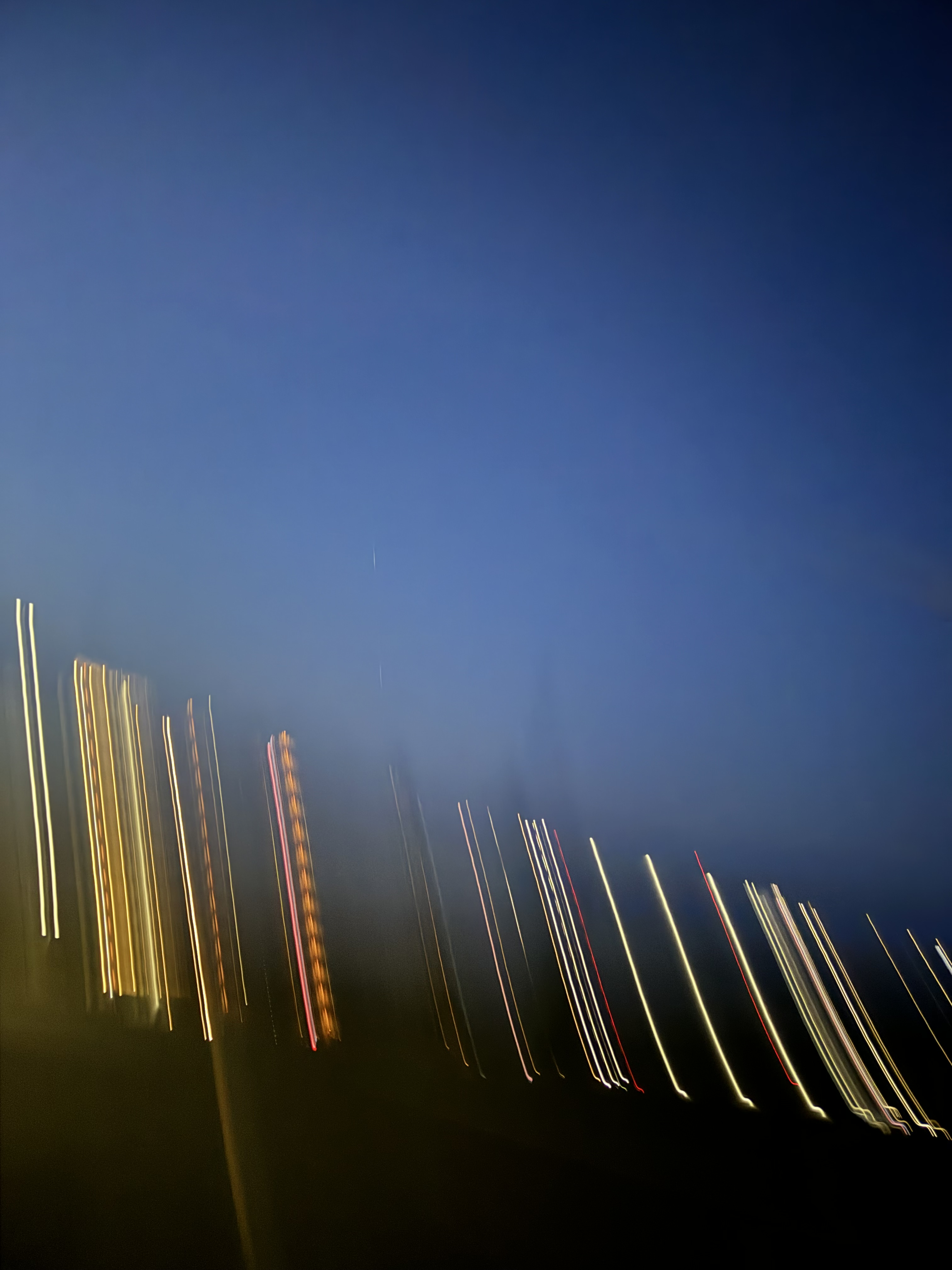
Lights. September 2024. Image, my own.
On Being
be who you are and who you can be, and meet those two verities inside yourself with loving kindness and compassion and let it be enough to experience the joy of living as you see fit as you love yourself
Andrew Wyeth Grasses, September, 2024. Image, my own.
Steady in the Fall
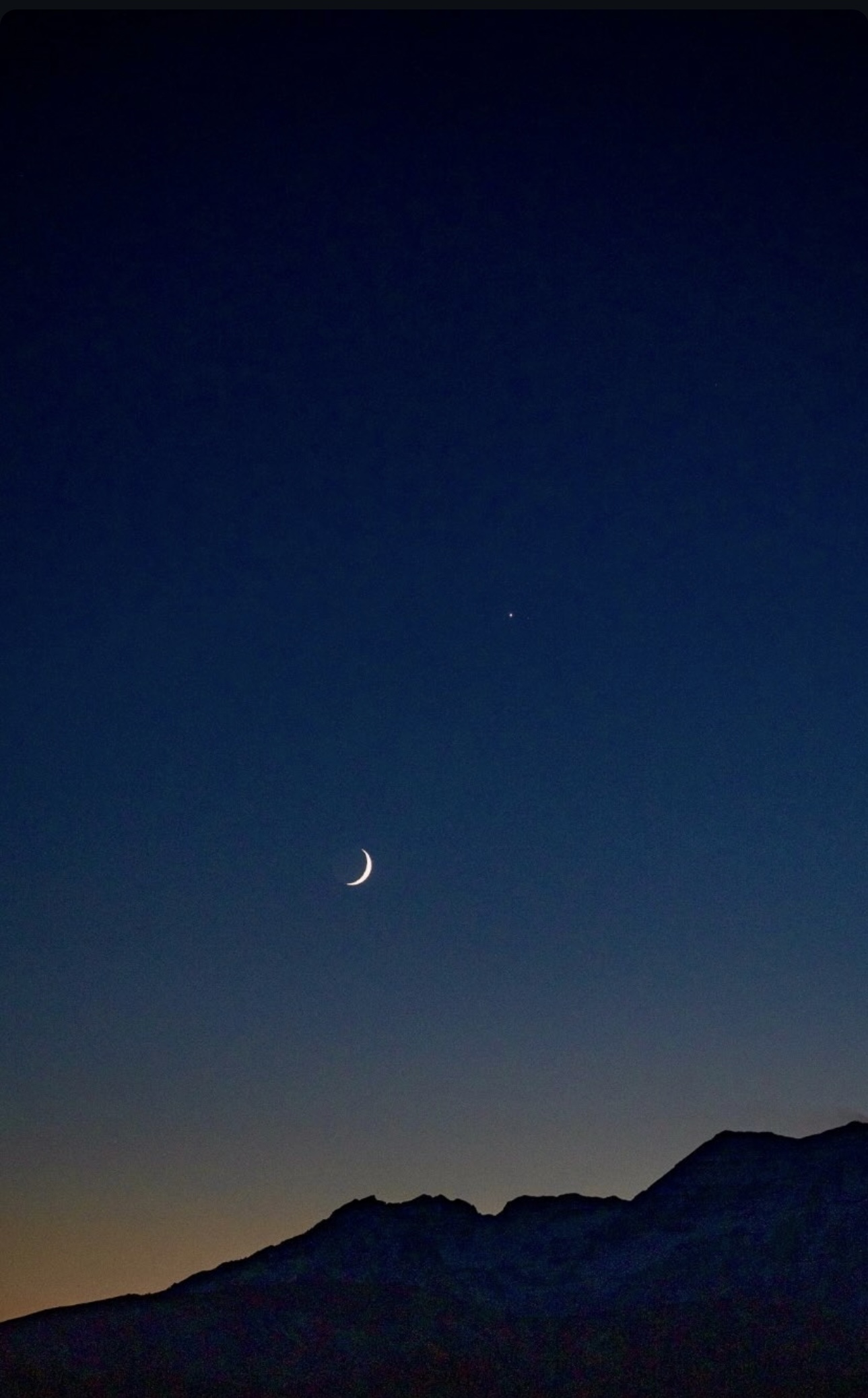
the sun and moon move into equilibrium waxing crescent to quarter
peloton of geese ride high in the wide blue sky, calling and answering back, headed south
flowers still bloom, delicate violet saturated yellow, vibrant magenta, as grass fades, sepia to umber
fully bronze dragon fly the size of a silver dollar flickers past in the sun chased by a saxe blue fly the same size
grasshoppers bunch on mustard rabbitbrush in the sway of breeze next to dark-chocolate velvet cattails, stalks steeped in pond-water
cooper’s hawk cries from the brush high and free like an alter ego finding the next rodent in the undergrowth
the air takes on the rush and pulse of crisp wind as the sun’s rays angle longer, cooling field, flower, and fly
No. 3/13 Mark Rothko, image courtesy of the MOMA, taken by me (2024).
I let the receiver drop onto the cradle with a clatter. 2,642 miles from home, I was working in Skagway, Alaska, my fourth summer up North. The bright smell of May air mingled with the reality of Dorothy’s near-end. Silence engulfed me, swallowed me whole. Memory overcame me, overflowed me. I lay fetal on the hotel bed, waiting for tears to stop running over the bridge of my nose. The universe forgot me.
The phone conversation had yielded spare details. Grandma had been in the bathroom, when she had passed out. Aunt Jan heard her moan as she sunk onto the floor. Finding Grandma unconscious in the bathroom, Jan and my youngest brother Alex had helped to carry her into her bedroom and tried to revive her. After a 911 call, she had been taken to Ashley Valley Medical clinic in Vernal, Utah. Discovering she’d had a stroke, her doctor recommended that she be transported one hundred and seventy-two miles west to the University of Utah Medical Center, in Salt Lake City. She was there now in intensive care.
——-
Dying by Megan Dickson
it was the time of dying yet color still held, sunflowers paused grass, variegated green rest was coming the fall, the browning leaves and roots stems bore that truth the mountain, dusty gray yesterday was dressed in snow again today pinking wreaths of clouds and icy indigo striations of oncoming dusk some death is good the power of it real and raw, and magic turning over seasons the smell of fires, newly burning
——
The retreat of Portage Glacier is not an isolated event as anyone who follows climate science know. But it feels different when you are a first-hand witness as I have been witness to it all over Alaska and Canada. I rattle off a list of the names of retreating glaciers I can remember in my head: Exit Glacier- Seward; Portage Glacier, Goodwin Glacier- Anchorage; Matanuska Glacier- Palmer; Harding Glacier, Denver Glacier- Skagway; Douglas Glacier- Haines; Mendenhall Glacier- Juneau; Hubbard Glacier- Glacier Bay; Grewingk Glacier- Homer. All of them melting at an increasingly alarming rate, some as much as fifty-five feet per year. I want them to stop, halt, pause.
The scene in Alaska is not simply a norm, it is the global glacial rule– melt, recede, retreat. To reach the face of Portage Glacier now, versus the literal “Nature in Situ: A Still Life Display” that I saw at the Visitor’s center in 1988 when I was seven, guests of the park must take a boat around the far side of Portage Lake. Piles of natural gravel called push moraine often stagnate the gray glacial melt water, apostrophized with small bergs and the shrinking face of a rapidly receding glacier. Elizabeth Kolbert, in her article for the New Yorker, 2005, “The Climate Of Man”, in three parts, details a similar experience in Iceland.
Kolbert writes of seeing Svinafellsjökull, in southern Iceland, for the first time, “In the gloomy light, the glacier looked forlorn. Much of it was gray– covered in a film of dark grit.” I could picture Kolbert’s lone form, a small human staccato on the dark sweep of the barren silt field. Her body bent before the ice wall of Svinafellsjökull trying shelter her face from gusts of rain driven by the railing, merciless wind. She continued, “If I returned in another decade, the glacier would probably no longer even be visible from the ridge where I was standing. I climbed back up to take a second look.” Her heaviness met and mixed with my own.
The scientists that Kolbert interviewed regarding climate change don’t simply survey glacial surface ice, they study its core. She synthesizes, “Ice cores from Antarctica contain a record of the atmosphere stretching back more than four glacial cycles—minute samples of air get trapped in tiny bubbles—and researchers who have studied these cores have concluded that fully half the temperature differences between cold periods and warm ones can be attributed to changes in the concentrations of greenhouse gases. Antarctic ice cores also show that carbon-dioxide levels today are significantly higher than they have been at any other point in the last four hundred and twenty thousand years.” Kolbert details that evidence of the climate crisis is irrefutable.
Hope left me. Portage Glacier continued to melt, retreating into the seam in the valley it created between the Chugach and Kenai mountains. If earth’s glaciers continue to melt away at their current rate, roughly half of them could be gone worldwide by 2100. As ice melts, sea levels will rise and Hope, Alaska, may swim and then be swallowed up in the rising tide. Alaska, indeed the whole world, is emerging from the ice.
——-
The last week of May 2005 dragged by. Waiting, waiting, waiting. I listened to hear the phone call of her death. Each day her retreating spirit pressed more heavily on my reality. I couldn’t breathe. I felt like an extra in a cheesy episode of one of her favorite science fiction television shows. I could see myself turning to Star Trek’s Data, the emotionless android and saying, “Her life-force is ebbing away.” Deadpan and emotionless, he would look back at me without reply and blink twice.
I could understand Data’s blank stare. The actuality that she was dying drew a disconnect between the picture in my head and the reports that I heard over the phone from family members, Mom and Dad mostly. Mom related to how Uncle Bob sat quietly playing hymns on his harmonica on a chair next to her bed, and when he had stopped for several seconds Grandma’s hand had shot out to touch his knee. Startled, he asked, “Do you want me to keep playing?” Her fingers had lightly pressed again against his leg. He picked up the harmonica and continued on with renewed vibrato.
But the next phone call, the family would be planning the funeral service as if she were already dead. “We picked out the casket.” “We got a copy of her will.” “We talked to the funeral home.” Those weren’t things you did for the living. I could picture her body-shell lying peaked, motionless on the all-white hospital sheets, could hear the blips of monitors and her shallow, rasping breath, could smell the faint odor of purchased-in-bulk antiseptic cleanser vainly trying to cover the stench of urine and bile– dying. My stomach churned as my mother described the care center that they were planning to move her body to so that she could live out her final days in “peace.”
I desperately wanted to know what was going on in my Grandmother’s core. Was she in pain? Did she need help? Did she feel peace? Though they were with her every minute, my family had no answers for these questions. I became angry, exploded, “What the hell! Why does everyone talk about her as if she is already dead if she is still alive?! It’s gotta be one or the other. She’s either dead, or she’s alive. Which is it?” The words fell too fast for thought and traveled dead-weight across the wire. “Here. Talk to your father,” Mom said.
——-
One Art by Elizabeth Bishop
The art of losing isn’t hard to master; so many things seem filled with the intent to be lost that their loss is no disaster.
Lose something every day. Accept the fluster of lost door keys, the hour badly spent. The art of losing isn’t hard to master.
Then practice losing farther, losing faster: places, and names, and where it was you meant to travel. None of these will bring disaster.
I lost my mother’s watch. And look! my last, or next-to-last, of three loved houses went. The art of losing isn’t hard to master.
I lost two cities, lovely ones. And, vaster, some realms I owned, two rivers, a continent. I miss them, but it wasn’t a disaster.
—Even losing you (the joking voice, a gesture I love) I shan’t have lied. It’s evident the art of losing’s not too hard to master though it may look like (Write it!) like disaster.
——-
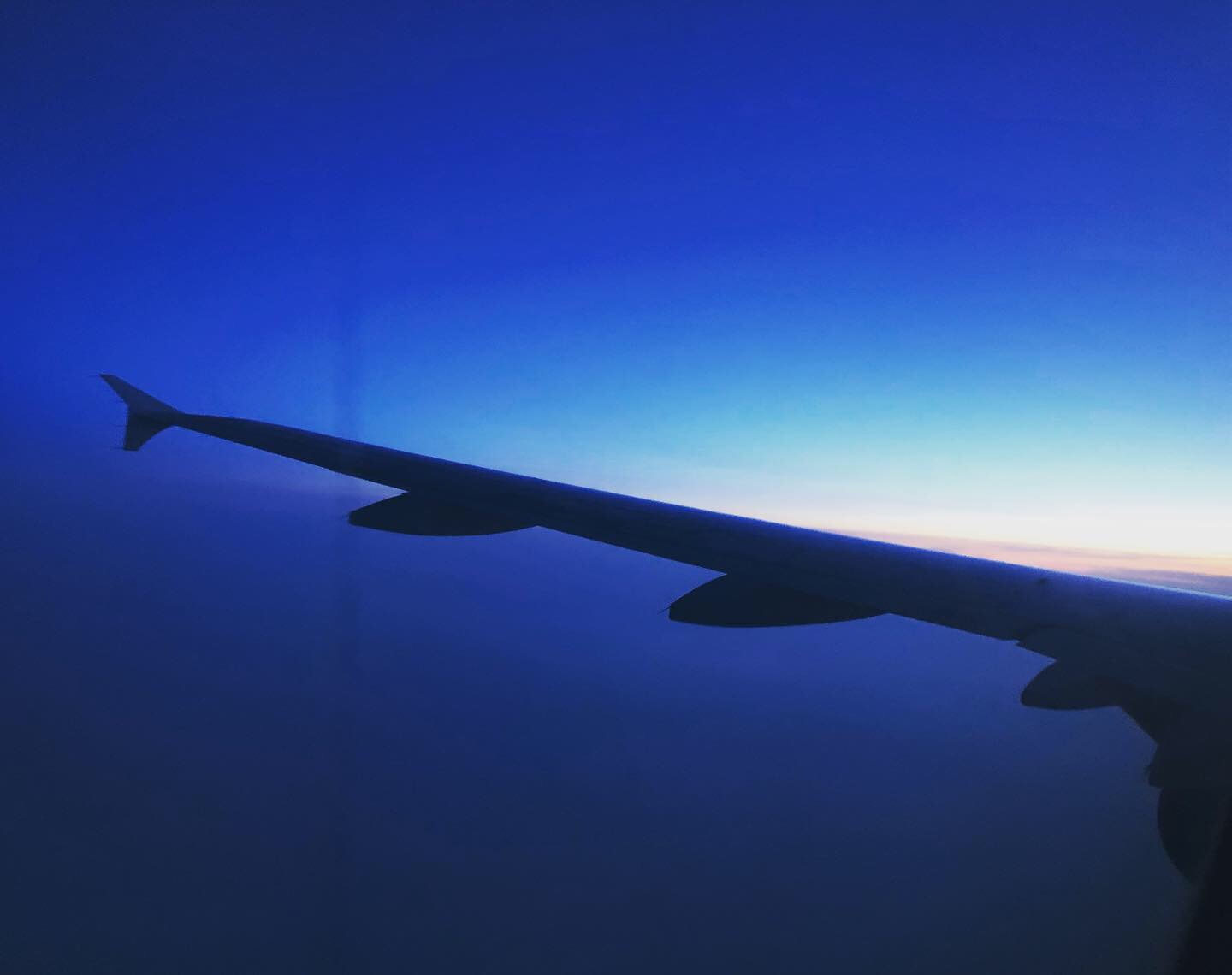
And then she was gone. I caught the red-eye, departing Ted Stevens International Airport, Anchorage, Alaska at 12:30 am, May 31, 2005. Destination, Salt Lake City, Utah. My small window framed a cobalt crown of deepening blue sky. Underscored by dying red the sunset bled into arms of outstretched orange, the purple horizon blurred the line between land and sky. The light died as I flew home to say goodbye.
*(This essay is part of a series of essay about love, loss, climate change, and what shape those experiences take on the human level. You can read my previous essays, poems, and reflections here: Hope (Alaska), Hope (and Ice), Hope (and Earth). Thank you for reading, commenting, liking, and sharing.)
Flight from ANC Anchorage, Alaska, Ted Stevens International Airport to SLC Salt Lake City, Utah (2019) image, my own.






 Refined + Rugged