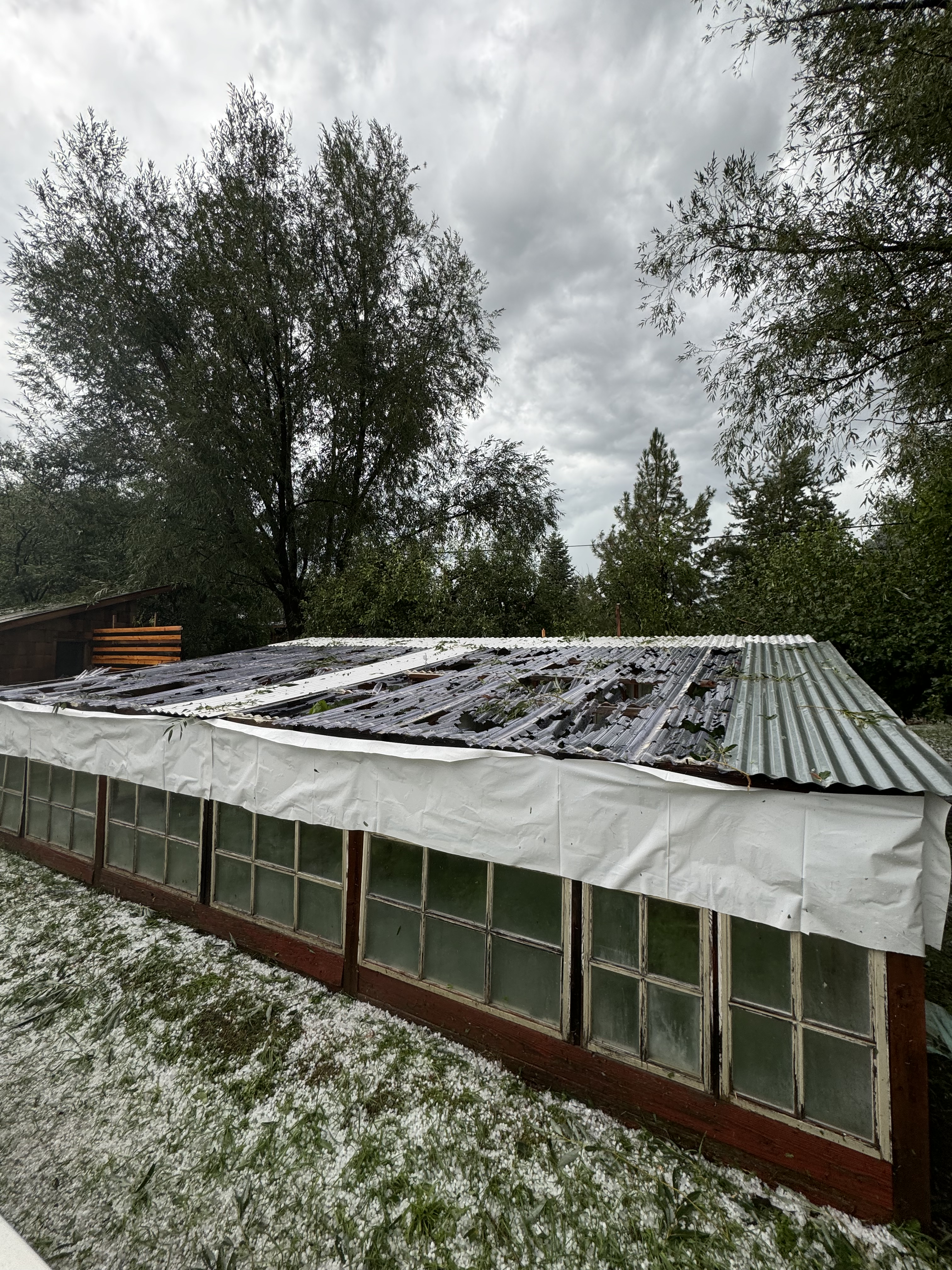
Greenhouse Damage, Hail Storm August 2024. Image, my own
Bill Murray
I remember the day I became Bill My heart was breaking and I wanted To save it, so I pulled it out through The intercostal space between my ribs, Right through the cage, Careful not to catch it on my sternum And I put my heart into a glass jar Which I affixed around my neck with A piece of twine, and I clamped the Lid on tight and proceeded to live To take baby steps To walk around town To ride the bus Because I knew that if I could preserve My heart In that jar I would make it I would survive My love would last And others could see and understand What heartbreak looks like And how one lives through it Now I understand about Bob, “There are two types of people In this world, those who love Neil Diamond, and those who don’t”
Composition with Double Line [unfinished], Piet Mondrian
August
Something about August is begging to be paid attention. Be here as the gray storm gathers strength, the dark cumulonimbus clouds billow up to twenty-seven thousand feet, the hail batters the roof like an alien ice machine. Deluge. White pellets of rime nearly round and cuttingly hard tear through verdant gardens and iron city drains, pinking flower beds and translucent greenhouse roofs, pocking every possible piece of outdoor furniture and uncovered car hood.
Splatters of rain signal the reclamation of autumn as the scud clouds break from the shelf of the tumult over Mt. Wilson, tumbling as if they may make contact with the grocery store parking lot lines before turning into a fog that dissipates over the asphalt. The gale winds signal the return of fall in the rising apple-crisp air. Time asks if we’ll watch for a moment from the porch as another wind rollicks, racing through the pumpkin fields, wracking the sticky green vines against each other.
August asks if we can move so much more carefully, thoughtful of each precious moment through transition– lightning strike, cloud fall, thunder call. Glorious weathervanes snapping erratically this way then that, trying to keep up with the on-rushing squall. Can we pause and take in the smell of electricity like ozone and h2o, the brouhaha of late summer air. Drink it in.
Vøringfossen, Norway. July 2024. Image, Carrie Madsen
(Re)claim
the girl who ran in dark canyons and dry riverbeds when she was young she’s there crunching gravel and sagebrush under her feet, up this next steep incline to the plains, the meadow there in the stillness a tiny creek burbles, and a garden shed appears with a low wind chime, that girl, she’s deep as a well wide as an ocean visceral and powerful even then, in her vulnerability, her desire to love, she’ll find that no one can do that for her love her like she must love herself, take that last sprint of the trail right back home reside inside herself
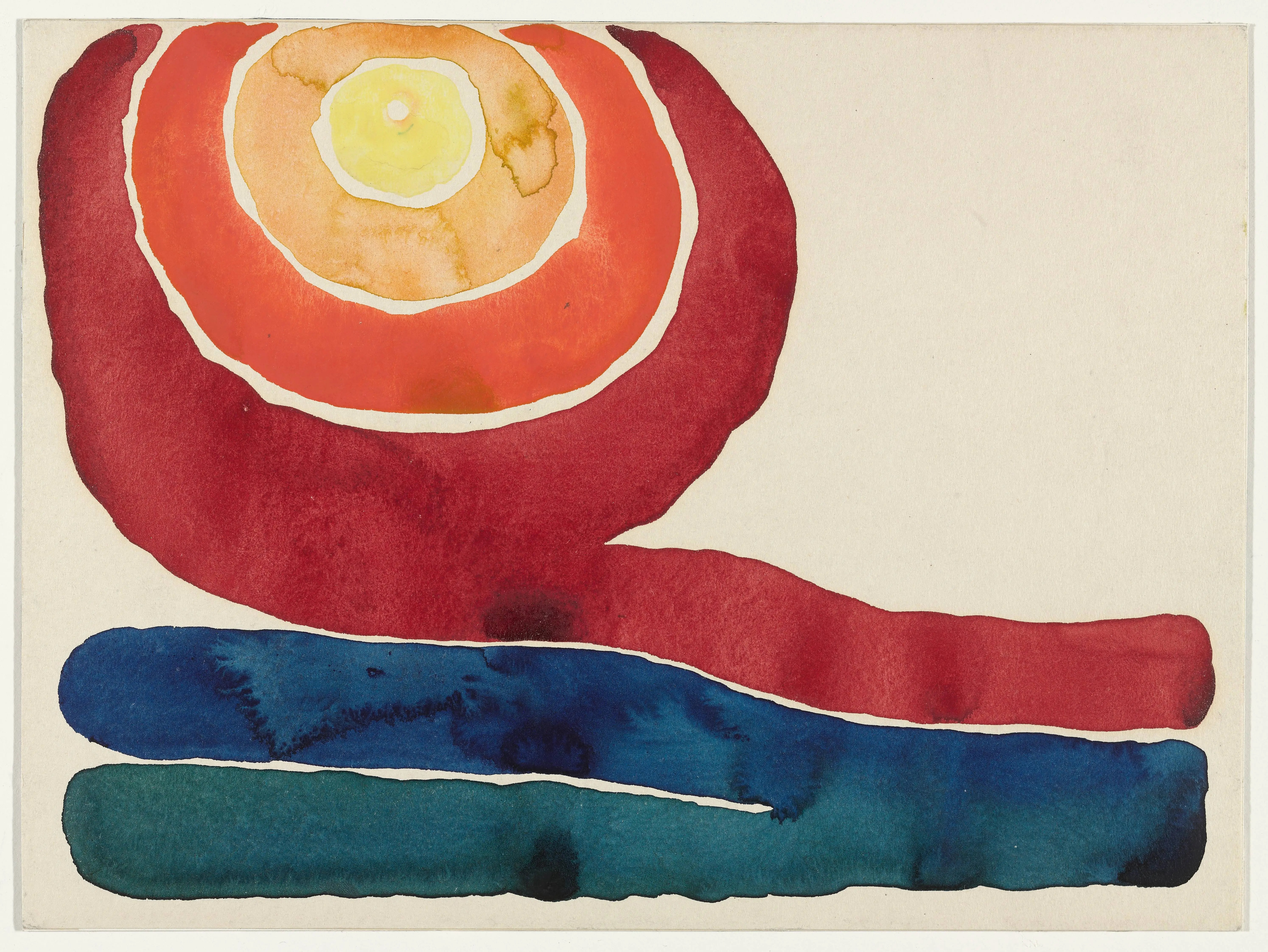
Evening Star, Georgia O’Keefe,
You Know
You know, sometimes as that little girl bucktoothed and freckled you wanted the come-up cause you believed you deserved it
You know, sometimes you’re aware that if you get what you ask for everything will change again. Like Alaska
you won’t be able to return to the halcyon days You know, sometimes you get caught between your growing and your fragility
and, god, the pain of it can crush, squeeze, burn, You know, sometimes everything gets unstitched, unpicked by the universe
and you’re reminded that the old woman at the end of the world must have needed to tend her soup before it scalded she still needed
food, herself, she still knew she would be called upon to (re)stich the tapestry of earth the raven unraveled to feed the world, to tend the soup, we are her magic and stories, too
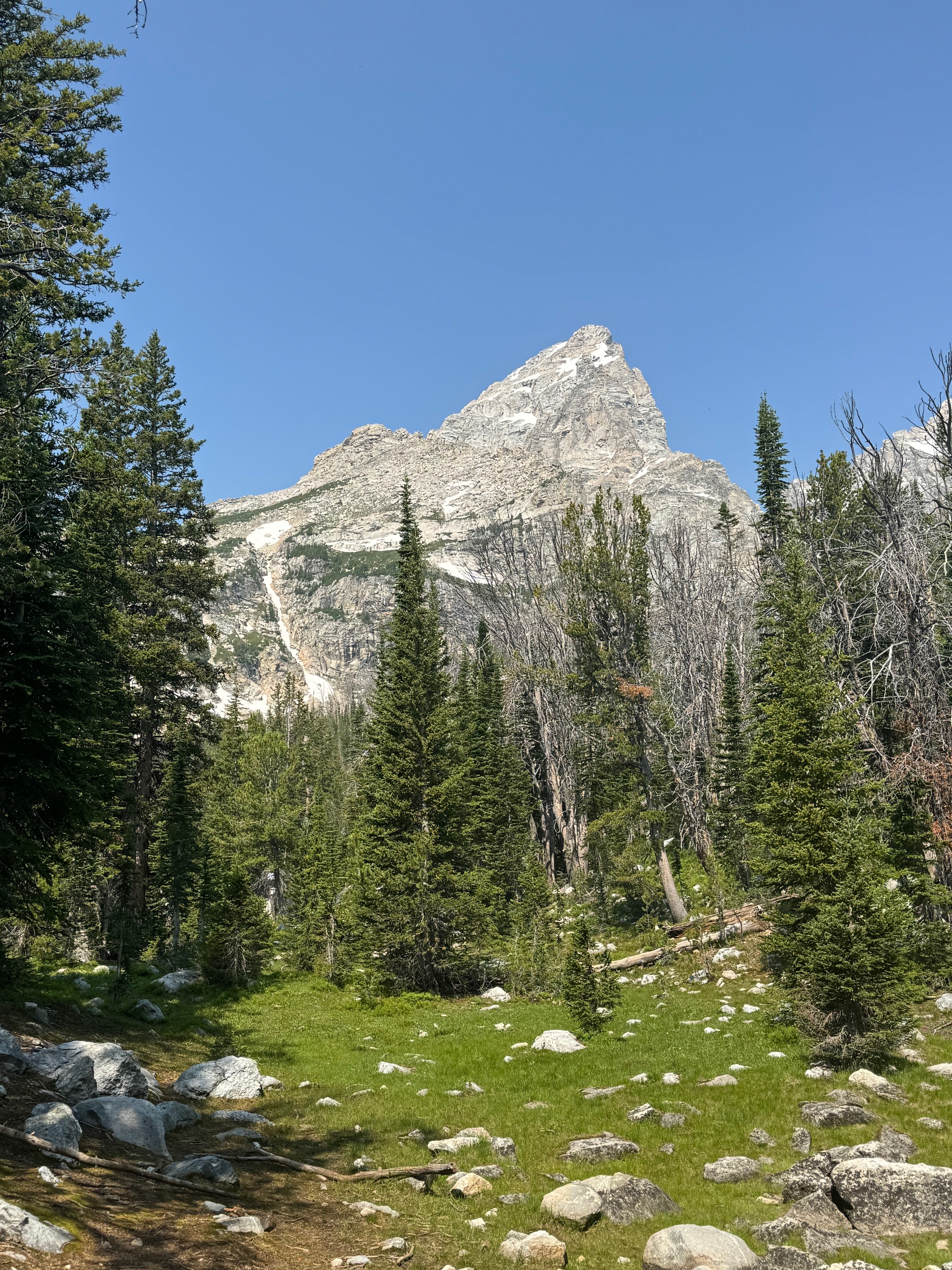
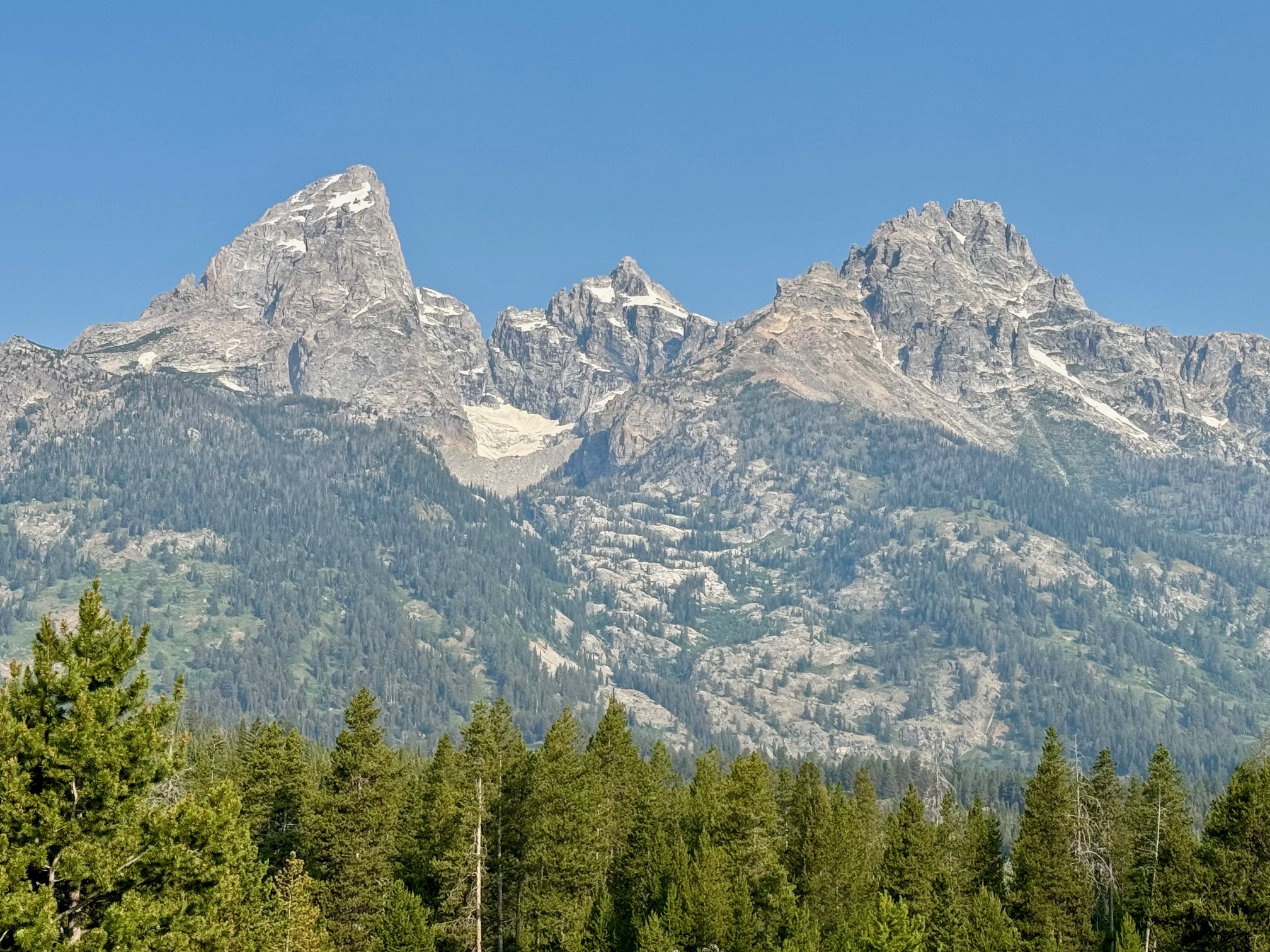
Middle Teton, from the meadow before Surprise Lake, 2024. Image, my own.
—–
Redolent waves of raw, hot pine tannin coursed across my senses in each trough of the trail. My bike and I undulated, at times, from below the root systems to the top of the bole of the Douglas Fir growing along most of the track. Pseudotsuga mensiesii, countless needles seemed to breath in unison in the softly rushing air from bark scabbed boughs to the tip of the tiny glimmering twigs into the understory all around me.
The loamy dirt still held some of the rain that had smattered over us just minutes ago, and then passed just as quickly as it had fallen. As we rode, I could see the soil was darkly composted with old leaves, myriad fir and pine needles. Light filtered through the blackened jade of each needle, twig, bough, and trunk, making shadows long and variegated across the trail.
The moment caught and held, pausing for a breath—one, two, three—sky, trees, breeze, light, earth, leaves. My gaze panned down the next switchback. I reminded myself to attend to the trail ahead of me rather than losing myself in the trees which might end in a disastrous fall. I trained all my focus again on my body, my rhythm, my flow. The rise and fall of the pedals, my eyes focusing two or three feet in front of me, intake of breath and exhalation, gear up for the rise, baby crest then pedal, pedal, gear down for the descent, flatten out my stance.
Churning out the miles I couldn’t help but repeat in my mind—here it is, this is it. It’s this kind of presence that makes human life palpable, enjoyable, full. But it may also be what keeps us from tackling major storms and stumbling on challenges that we face in life’s broader contexts. I am lucky. I can escape to the mountains whenever I please– cooler air, summer rains, mountain lakes, trails and more miles of trails. But so many humans do not have that luxury.
I thought of my boys at home. Thirty or so miles on the back side of the mountain I was ribboning down. They might be jumping on the trampoline, reading on the back patio, watching a Tik Tok on their beds. Their existence is often the perfect burr to return me to why I find climate change action important. In her article, “The Global Temperature Just Went Bump,” dated July 25, 2024, Zoë Schlanger explains that Sunday, July 21st was bested for “hottest day ever recorded on Earth” by the following twenty-four hours, Monday, July 22nd. The hottest day in 1,000 years… “since the peak of the last interglacial period, about 125,000 years ago.”1 Can you believe it? You, I, and my boys just lived it. Let’ s not hold our breath, kids, I’m certain we may see another record breaker this summer. Again, wild.
Maybe we, humanity, feels as though we’re ready to experience a warming period on earth that has been sped up to three times the last warming period. You know, like listening to an audio book on unintelligible chipmunk speed. Maybe we feel that we’re ready for hotter temperatures, more severe storms and weather patterns, shifting moisture bands, and a world that has very little Arctic or Antarctic ice. The impact that we have made on Earth’s climate have created climate shifts over 150 years that are closer to those that warmed the interglacial period Neanderthals experienced over several thousand years.
These scientific observations are mirrored in the human experience my boys and I are living, real-time in our quaint and un-airconditioned 1913 settler’s cabin (renovated, perhaps three different times). Our little home loves to rest in the heat at seventy-eight degrees. I can now tell you from a summer of experience that this ambient temperature is quite tolerable. For me, preferable to an office space frozen to 65 degrees while the outside temps tip towards the 100s. But still twenty or so degrees cooler than the ninety-eight to one hundred and six-degree days outside.
The boys and I are thick into the summer of a system of open windows, open blind louvers at night, queue the fans, open the whole house wide for the cooler nighttime air. Then reverse the process in the morning, at 7:30 a.m.—close the windows, shut the louvers on the blinds, keep the fans running, front porch full-sun in the morning, back porch a lovely ten degree drop at dusk. I think about the folks living in places like Phoenix, Tucson, Jacksonville, Charlottesville, New Orleans, Dallas, Houston, Death Valley, to name just a microcosm of the American cities that have experienced unprecedented heat waves this year.
What if I lived in a climate that never saw cool? What would I do if I were eighty and my air conditioner crapped out in this heat wave? From many folks’ perspectives, it doesn’t look good. George Packer, in a sweeping prospectus of Phoenix, one of America’s fastest growing cities, in his article titled “What Will Become of American Civilization?,” details the heat that killed 644 people last summer in Maricopa county for The Atlantic. Packer explains that those who pay the price for the heat really are the elderly, the mentally ill, the homeless, and “those too poor to own or fix or pay for air-conditioning, without which a dwelling can become unlivable within an hour.” I think of my boys trapped in a little house without AC in a desert without a way to cool down. What a tragedy.
The picture only appears more grim as Packer projects forward, “A scientific study published in May 2023 projected that a blackout during a five-day heat wave would kill nearly 1 percent of Phoenix’s population– about 13,000 people– and send 800,000 to emergency rooms.”2 Nearly one million heat stroked humans? Staggering. The situation even brings Packer a sense of shame that there is a 4,000 person waiting list for homeless persons who desperately want housing vouchers to get off of the street and out of the heat. Literally.
I’ve experienced my own micro shame at the warmth of my little house. Just yesterday I heard my youngest son speaking to his father on the phone, “Yeah, my room’s pretty warm. I’m okay.” I cringe a little and recognize that I’m also lucky enough to be able to install AC in my new-old abode if I were to choose to do so. It appears that from my children’s report, we may be contacting an air-conditioning company soon though my wish is to wait until next summer. I guess I’m willing to see what the next record breaking day feels like. Will my little home break 78 degrees? I may soon know. I’m certain if my boys get hot enough, they’ll also let me know. I’ll hear it from them.
—–
March 19, 2006. Many yesterdays ago, Logan, Utah. It’s early evening, one day before the official calendar date of Spring Equinox. Outside, snow falls through the dim blue haze of twilight. All across Cache Valley’s floor, the heavy wet flakes form standing pools with the slushy consistency of a 7-11 Slurpee. I’m inside writing. When things stop flowing on the page, I sink from the couch to the living room floor and piece together silk quilt squares from Grandma’s shirts, skirts, bathrobes, and mu-mu’s. Remembering is reflexive.
It’s a hard reality to face the fact that humans really have so little knowledge, perspective, or understanding of the future along their linear time-continuums. I didn’t know that the drive Grandma and I took in April 2005 would be our last. I look up from a neon square filled with exotic flowers that look like they’ve been bathed in black light and think back.
The sun’s spring angles were beginning to lengthen the days as I helped her into the passenger’s seat. Settling into the driver’s seat, I eased the car out of ‘park’ and pulled onto Highway 40 traveling Northeast. Warm breezes gently bent the tops of sage brush, bunch grass, paint brush, and river tamarisk.
Grandma asked me to roll down the windows even though she was dressed in long pants and a wool sweater to keep her shrinking frame from getting too cold. The wind flayed her gray curls like fingers, and my own hair whipped, unruly, this way and that. The smell of the baked red earth and burning sage made my teeth almost ache with the sweet biting iron odor. I didn’t know during that drive we were actually going to find hope. I was too young to understand.
Grandma carried an extra air of tired and confined energy about her. Eighty-one years and she was thin and ever thinner each time I’d visit. She had stopped working at the Mormon temple in Vernal each week, and she relied upon meals on wheels for lunch each day. She complained that she really couldn’t even taste the food that she ate. All this was portent of the end. But I returned my attention to the winding road, to the swell of the muddy Green River as it poured out into the sunshine through Split Mountain and the flicker of the leaves and the breeze in the trees around Josie’s cabin where we stopped to have lunch that day.
Once we were ready to leave, Grandma turned to me with an angelic smile and said simply, “Thank you. Today was lovely.” Loss is a funny thing. Often we lose things we love without warning. Standing at the passenger car door, helping Dorothy carefully out of her seat, her sweet hand in mine, I could never know it was the last time I would see her alive.
—–
OCEAN VUONG:
Oh, you know, you realize that grief is perhaps the last and final translation of love. And I think, you know, this is the last act of loving someone. And you realize that it will never end. You get to do this to translate this last act of love for the rest of your life. And so, you know, it’s– really, her absence is felt every day. But because I’m becoming an author again in another book, it is double felt.
And ever since I lost her. I felt that my life has been lived in only two days, if that makes any sense. You know, there’s the today, where she is not here, and then the vast and endless yesterday where she was, even though it’s been three years since. How many months and days? But I only see it in – with one demarcation. Two days– today without my mother, and yesterday, when she was alive. That’s all I see. That’s how I see my life now.
—–
Grand Teton and Mount Owen, Teton Glacier, a tiny little blue striated sandwich in between, 2024. Image, my own.
—-
To reach the cemetery, I drive west across limestone plateaus which rise in graduated benches as Utah’s Great Basin climbs to meet the Uinta Mountains. The Mountain Home cemetery sits atop a ridge in the middle of farms of cattle and fields of alfalfa which are gradually greening on Easter Sunday 2006 as wheel lines rhythmically pulse water across field after field. When I am there, I hope she feels that she is home.
Grandma has two headstones. One slab of stone sits in the Manti, Utah cemetery, the other rests in Mountain Home, Utah. Her bones weren’t laid beside those of her third husband in Manti. Instead, her name, the short version– Dorothy A. Mickelson, is etched into the granite next to his– Clifton Christian Mickelson. I don’t think that her dates- birth or death- were blasted into Cliff’s headstone after she died. Her bones are buried here in Mountain Home. She said once, “I want to wake up among the gentle Farnsworths.” Her second husband’s people. How long will her bones lie there? One hundred years? Two? A millennia? More? I can’t tell.
There’s a kind of hope inked in Grandma’s big black scriptures. Maybe I will see it the way that Ezekiel describes, “there was a noise, and behold a shaking and the bones came together, bone to his [her] bone… lo, the sinews and the flesh came upon them, and the skin covered them… and the breath came into them, and they lived, and stood up upon their feet…” Like, holy shit, an entire human being reconstituted, recombined, resurrected. Incredible. The description of resurrection from an ancient prophet once filled me with joy. But maybe her essence is already carried through the world on dust, atoms, mycelium, and pollen from the flowers and grasses that grow through the graveyard. Now Earth will boast Grandma’s stuff, the simulacra of her life carried on the wind through Mountain Home and the Uinta Mountains.
—-
Reverberation by Megan Dickson
It’s impossible to feel alone soaking in the reverberation of humanity ringing through the great halls of civilization. The echo. The sound. The deconstructed interplay of all those expressions and explications bouncing and bounding around in the domed, arched architecture. Dancing over the simulacra, art, massive and tiny, representative of nothing and everything. The absolute alacrity the beatific joy of each repercussive utterance. Jazz. A fusion of improvisational auditory stimuli. The resounding transcendence of humanity in the envelope of a space. Astonishing.
—-
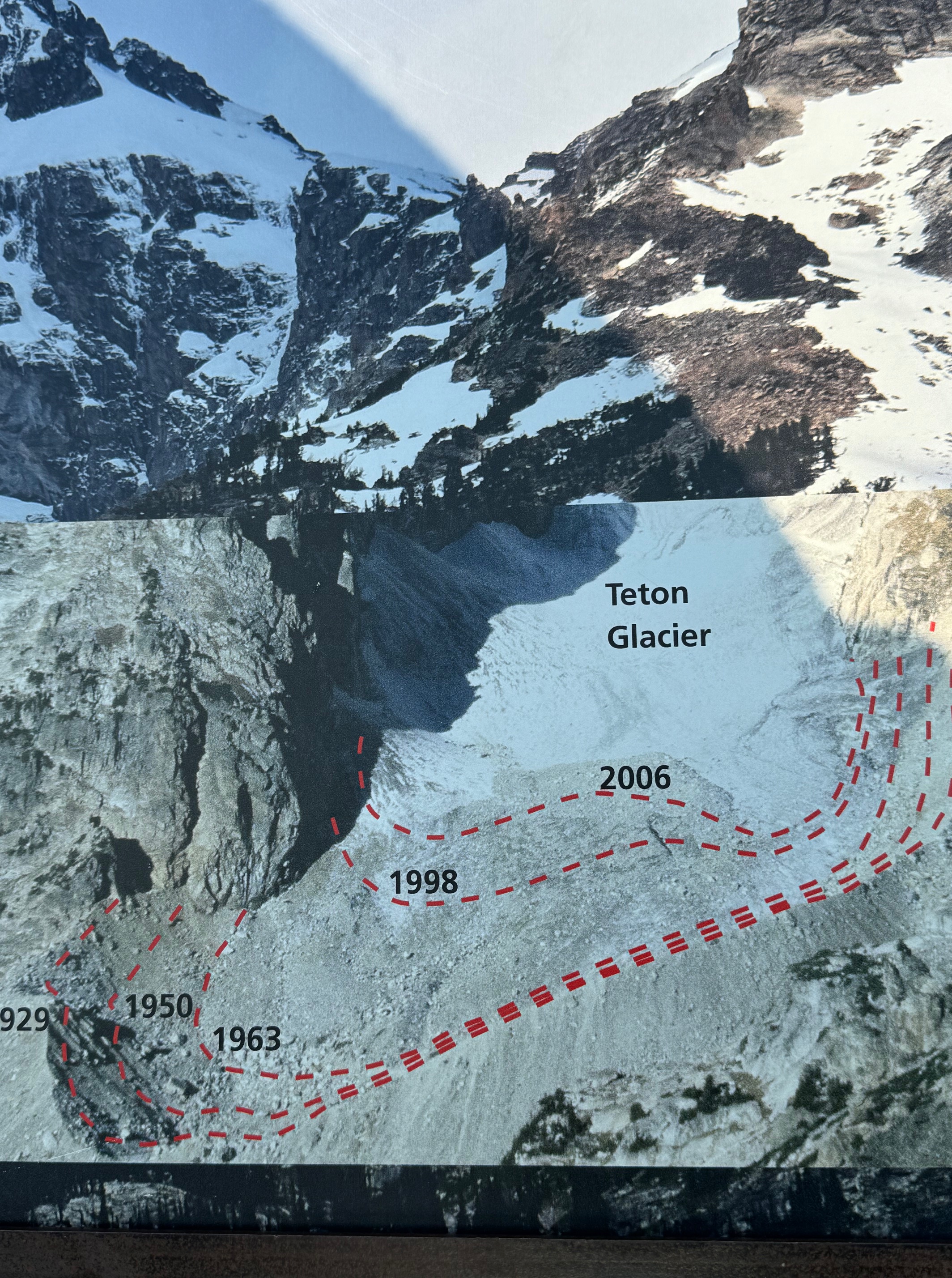
Grand Teton National Park placard showing Teton Glacier’s retreat, 2024. Image, my own.
—-
Glacial recession obviously isn’t confined to Alaska or the poles. Even in Grand Teton National Park, the glacial retreat has been relatively well documented in the 19th century. It simply reminds me that no place on Earth will remain untouched by climate change. To our current understanding, there is no location where humans won’t experience the changes of the ever-warming earth. After hiking up some incredibly steep terrain with my sister a weekend ago, I can attest to how the heat affects humans in outdoor environments that used to be much cooler, even in the summer.
The hike itself up to Amphitheater Lake at 9, 850 some odd feet, is around 2,900 feet of elevation gain overall from the Teton Valley floor. The going is tough. Even for me, and I’m accustomed to life above 7-8,000 feet. I’ve go the lungs and legs for it, but this grade is brutal. The thing that drives you on when you hike is the peak. To reach the top. To look out over the many horizons you’ve melted. Up, up, and up we climbed. Not only did we want to reach the top, the gift was knowing that an icy glacier and snow-melt fed lake awaited us at our destination.
Up, up, and up the mountain. Jaw-droped and wide-eyed at the incredible crags, cliffs, arêtes, and sheer walls at the tipy-top of this incredible range. Mermaid–jump, dive, cool, swim. Down, down, down the mountain to a parking lot so hot that the waves of heat rise from the white gravel rocks making the horizon look like a circus mirror mirage. What does it all mean? The other reason to climb, hike, bike, or generally get outside is to leave the rush and pressure and unanswered questions of humanity behind.
To sync back into the rhythms of the Earth that have kept, housed, harbored, and nourished all life on this glorious planet for thousands upon thousands of years. Except this time, like a broken record, I can’t get the image of the recession of Teton Glacier out of my head. The reality is really ruining my vibe. Thought ridden, and wanting to focus on the moment, I pull off the narrow trail onto a rough patch of mountain meadow. I take deep cleansing breaths and remind myself that the answers humans need and seek from science, from sociology, from art, from politics, and from each other must be reached together– as a collective. When my personal understandings of how I can help to limit or roll back climate change become more clear, I will pivot. The simple wish is that humanity will have enough time to make changes in a world that seems perched on the precipice of climate disaster. Right now, all I can do is hope.
*This is the final essay in a series about climate change from one humble human perspective. The losses we stand to face in the future feel more real, more palpable each heated day of this record breaking climate summer– 2024. To my people: thank you for reading, liking commenting, and sharing. I am so grateful for the journey that writing creates– writer and reader in community together. You can read my other essays here on my website. Hope (Alaska), Hope (and Ice), Hope (and Earth), Hope (and Loss), Hope (and Love), Hope (and Fire), Hope (and Now).
—-
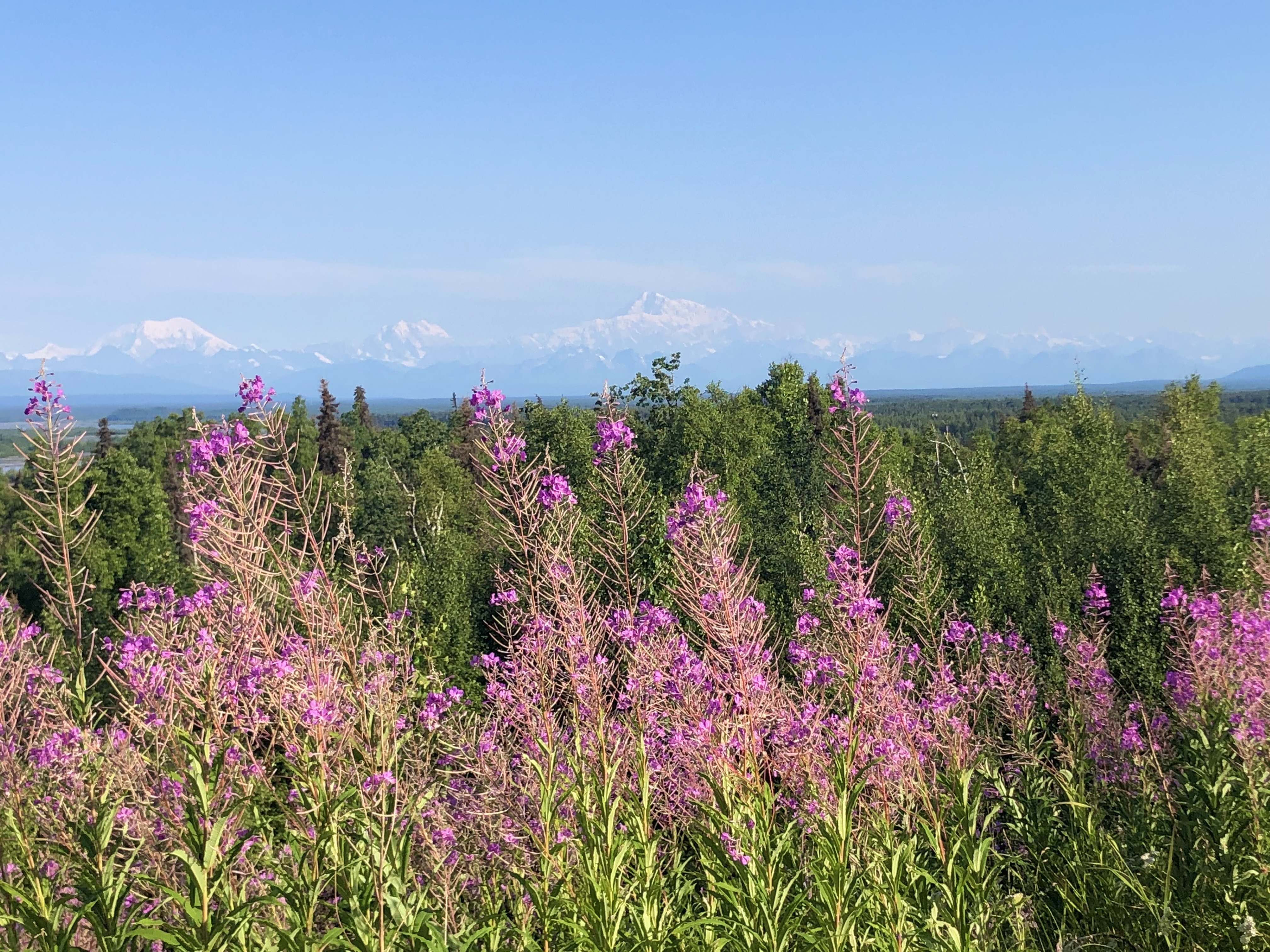
Denali, the Great One, and Fireweed. Taken from Talkeetna, Alaska, 2019. Image, my own.
Scientists used white plumes of steam like these to track lava from the 2010 Eyjafjallajökull eruption as it melted the glacier. Credit: Boaworm, CC BY 3.0
——-
Eschatology by Megan Dickson
Life took us to the edge of the known universe
this brink, this precipice, on a red dirt plateau, all rust-verged and jagged, like a tear in heart tissue, like broken bone projecting through soft skin.
skin, bone, sinew often don’t break cleanly so there, on that terrifying cliff, we looked out into the blackness and saw that it was our own
dotted with infinite, swirling stars, nebulous arms of our galaxy, folded across that night, that nothing. we realized the instant we stepped to the fathomless limit
all the light we carried in our core could somehow save us, from this end. So into the starry, inky ebony we leapt, being careful to be sure that we crossed over the boundary between
everything we’d known, into every night we’d ever feverishly dreamed. this jump, this real act of self-preservation flung us into
the heart of the unknown cosmos and there we were to greet ourselves at the gates of our unknowing. we opened the tiny, golden latch on the
impossibly large, swinging metalwork gate, stepped slowly, quietly over the threshold of revelation, everything open and waiting for us in that pitchy gloam still had
to be sensed– felt, touched, tasted, smelled– not physically, but by the fingers of the formerly known soul that now bore this greater knowing. this
was not the end but the beginning. a larger excursus on the limitless infinite than we had previously known. we’ll never know if there
was only one way to this beginning– the ledge, the leap, the jump– our tiny, finite, blink of a guess gives us the idea that, no, there are
many precipices, many pinnacles, many paths to the infinite edges of the unknown into new reaches of galactic consciousness– seeing and knowing more than we
could possibly have imagined yesterday
——-
What will happen when there is no ice left in our house? What will the warming Earth mean for humans and animals? Now, nearly twenty years from some of my most intense life experiences, travel, and living in Alaska, I finally realize that the difficulty with this moment of continuing glacial recession is that it is so very difficult for humans to push past their one-hundred-year lifespans to see beyond to the systems that shape not only our now, but our future.
I’m the first to raise my hand and express that this kind of complex information is difficult for the lay-person to process. So how do we make science, scientific facts, and continued scientific hypothesis and discovery on climate change more bite sized, more commonplace, more palatable. The ignorant me doesn’t have a ready answer for this.
Will we overheat and roast as the seas engulf us before we grasp the stunning reality that we need to move from believing that humans can harness Earth and her resources rather than humanity taking more careful notes on how Earth regulates her own systems?
Are we at the 911 phase of this journey? I scarcely think anyone knows. This summer, 2024, has felt hotter than ever. However, feelings don’t really translate into hard scientific evidence. But my “feeling” is backed up by science. July 21, 2024 was the hottest day ever recorded on planet Earth.1
——-
Fanning the yellowed pages under my thumb, the book fell open easily in my hands to the front inside cover. Plastered under a handwritten note was a sticker of a galaxy spiraling in a sea of black, and under its outstretched arms were printed the words, “Ex Libris Kenneth A. Farnsworth.” From the library of my father. He had been the one who scrawled the message above the sticker, “Mom, with love and gratitude for turning me on to this ‘good stuff’.”
Tenderly, I traced the edges of the sticker, and drew my fingers across the fading ink. This small volume was an important relic from my grandmother’s life, a testament to her love of the written word, to the way she not only relished poetry and prose but had also passed this love on to her children and grandchildren. I thought that the book looked centuries old, an age cracked spine and what looked like a hand stitched binding were beginning to peel apart leaving bits of cheese cloth, paste, and leather showing in between. The worn leather exterior bore the title, stamped in gold ink, One Hundred and One Famous Poems. The copyright read Riely & Lee 1958. I guess relic, old, and antique were relative terms.
For instance, I had mistakenly assumed that ideas surrounding the greenhouse effect, and global warming were part of “new science,” or discoveries made recently relative to my lifetime. The reverse is true. Some of these calculations dated back over a century which makes them almost archaic in my humble perspective. Some of the poets in Grandma’s book– Dickinson, Browing, Emerson, Whitman, Longfellow, Wordsworth– had lived during the time when the first scientific theories about what is now termed the “natural greenhouse effect” were being developed. Englishman John Tyndall is credited with the discovery of greenhouse gases in 1859. He drew a simple comparison, “Just as a dam causes a local deepening of the stream, so our atmosphere, thrown as a barrier across the terrestrial rays, produces a local heightening of the temperature at the earth’s surface.” This wasn’t new science it was old news.
On page 81, Lucy Larcom’s poem titled, “Plant A Tree,” sounded like a worthy credo for an early American environmentalist. She had died just one year before Swedish chemist Svante Arrhenius began testing his theories that coal burning was changing the character of earth’s atmosphere. Larcom wrote, “He who plants a tree… Plants a hope.” In 1894, a year after Larcom’s death, Arrhenius hoped to determine the effect on earth’s climate in the unlikely event that greenhouse gases like carbon dioxide emitted from coal burning ever doubled. His conclusion: if the greenhouse gases doubled, earth’s temperature would rise.
So if basic climate science isn’t new, why has it taken such a long time for humans to perceive, address, or pay attention to these warnings from scientists? The answers are certainly multi-layered: the relatively short time-span of human life, the heated politicization of climate change, the fact that scientific knowledge is not based on speed but on thoughtful interrogation, the fact that we know that Earth has experienced many climate epochs and mass extinctions in its deep past. Climate scientists including glaciologists, often ask very specific questions of climatic change in very narrow systems. Another reason may be that it can be very difficult to determine when humans should intervene in their environment.
In fact, an article in The Atlantic2 this July, offers some insight and ideas about human intervention into glacial preservation, in short, geoengineering. Ross Anderson interviews Slawek Tulaczyk about his projects on Thwaites glacier in Greenland and on the Western Antarctic ice sheet where he has come to believe that one of the only ways that ice, and perhaps Earth, can be saved from ‘catastrophic’ sea-level rise is to give humans more time to grapple with climate change; therefore, Tulaczyk proposes that humans attempt to stop ice sheet from floeing. His hypothesis and process go well beyond all geoengineering feats that have been attempted on Earth this far. In lay terms, Tulaczyk suggests that we pump water out from underneath large glacial ice sheets in hopes that they will readhere to the underlying bedrock. Tulaczyk believes that humans could keep massive ice shelves intact, and in essence, keep them from separating, melting, and causing sea-level rise.
There on my bed, a weird quantum meeting took place. I imagined Robert Frost listening to these glaciologists, then returning home to send the Intergovernmental Panel on Climate Change (IPCC), President Jim Skea, these famous lines,
SOME say the world will end in fire,
Some say in Ice.
From what I’ve tasted of desire
I hold with those who favor fire.
But if it had to perish twice,
I think I know enough of hate
To know that for destruction ice
Is also great
And would suffice.
Fire, ice, ice, fire. From first-hand Northern climate immersion, I would still have to go with the first. I’d say fire.
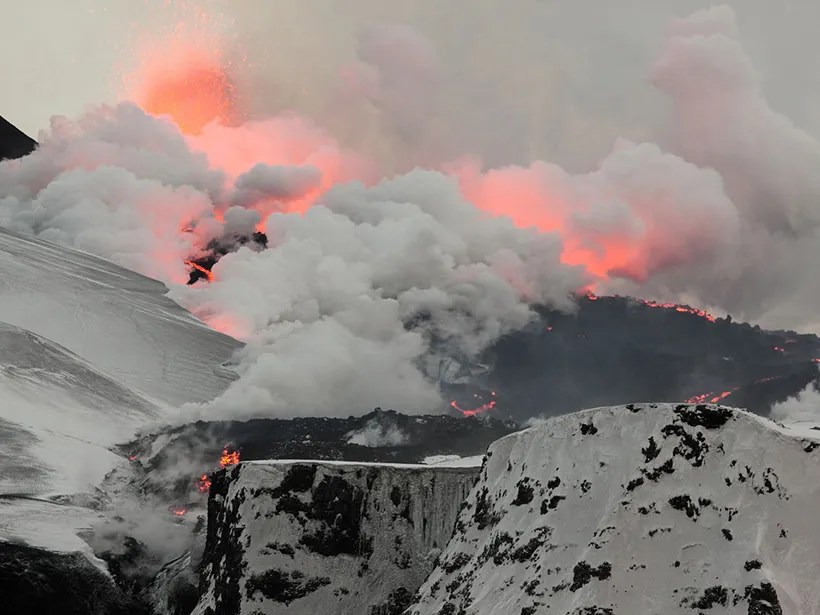
Geldingadalagos, Eruption at Geldingadalir Iceland, 2006, credit: Mangus Johannsson
——
Two days after my grandmother’s funeral, my fingers brushed the soft sheen of one silk square of quilt. Bright mauve lilacs, butter daffodils, and blush sweet peas undulated across the small cubes of fabric. I drew a cubed piece of leopard print fabric to my nose, hoping to catch even a faint breath of her. A gaudy half-moon of colorful Klein blue silk shone in front of me masking the neutral brown tones of the living room carpet in my parents’ home in Duchesne, Utah.
She would have worn any one of these silk creations anywhere. That was the best part. Sure grandma had the shirts that were reserved for church, but it was just as common to find her out behind the house in the garden sweating under a wide blue sky, a broad brimmed straw hat, and a silk shirt splashed with brazen colors clashing in contrast to the hue of her pants. Perfectly garish.
My sisters and I quietly continued our work. Grabbing a shirt from the silky mound behind me, this one a deep emerald green I remembered how at Christmas she had once worn it with a pair earrings stuck through the collar her idea of “jazzing up” an ensemble. Ostentatious octogenarian that she was, we were cutting all of her shirts into quilt squares, though no one in the family, children or grandchildren, had ever made a quilt.
There were plenty of decisions surrounding her death that caused familial disagreement– her obituary, her headstone, her viewing. Most of these squabbles came from the amalgam of contrasting beliefs, values, views, and lifestyles manifest in her posterity. But everyone seemed to want to hold on to these shirts and other articles of clothing sometimes so threadbare, frayed, unraveling that only a few small quilt squares could be saved.
*(This is the latest in a series of essays here on Refined + Rugged. They include: Hope (Alaska), Hope (and Ice), Hope (and Earth), Hope (and Loss), Hope (and Love). I’m exploring what it means to be human in a time of unprecedented climate change. As the world warms, and humans begin and continue to adapt to these massive climate changes in our lifetime, what will this mean for our environment, our Earth, our children, and our grandchildren. As always, thank you for reading, commenting, liking, sharing, and generally pondering these questions with me. Love, Megan)
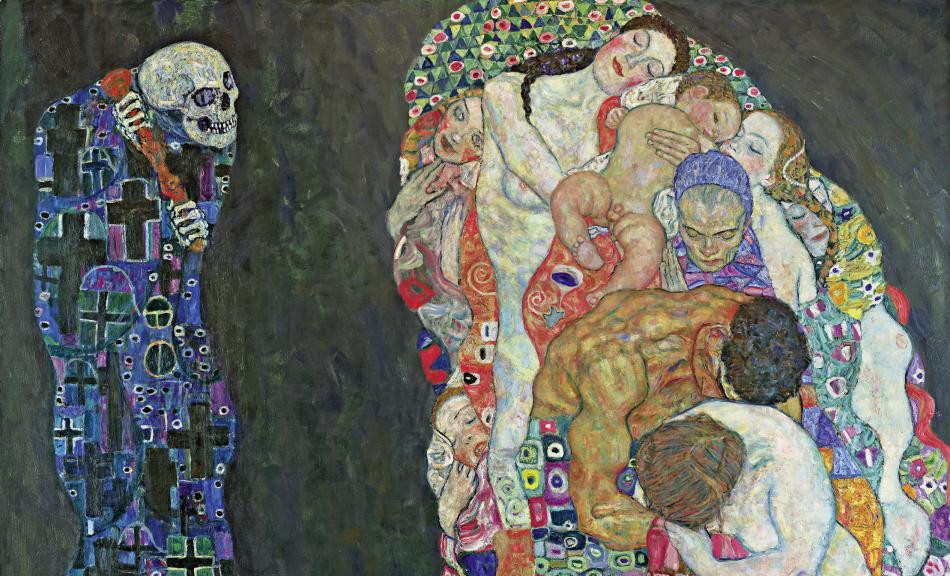
Death and Life, Gustav Klimt, 1910, Leopold Museum, Vienna, Austria. This “life” is comprised of all generations: every age group is represented, from the baby to the grandmother, in this depiction of the never-ending circle of life. The solitary, darkly dressed figure of death stands on the left.
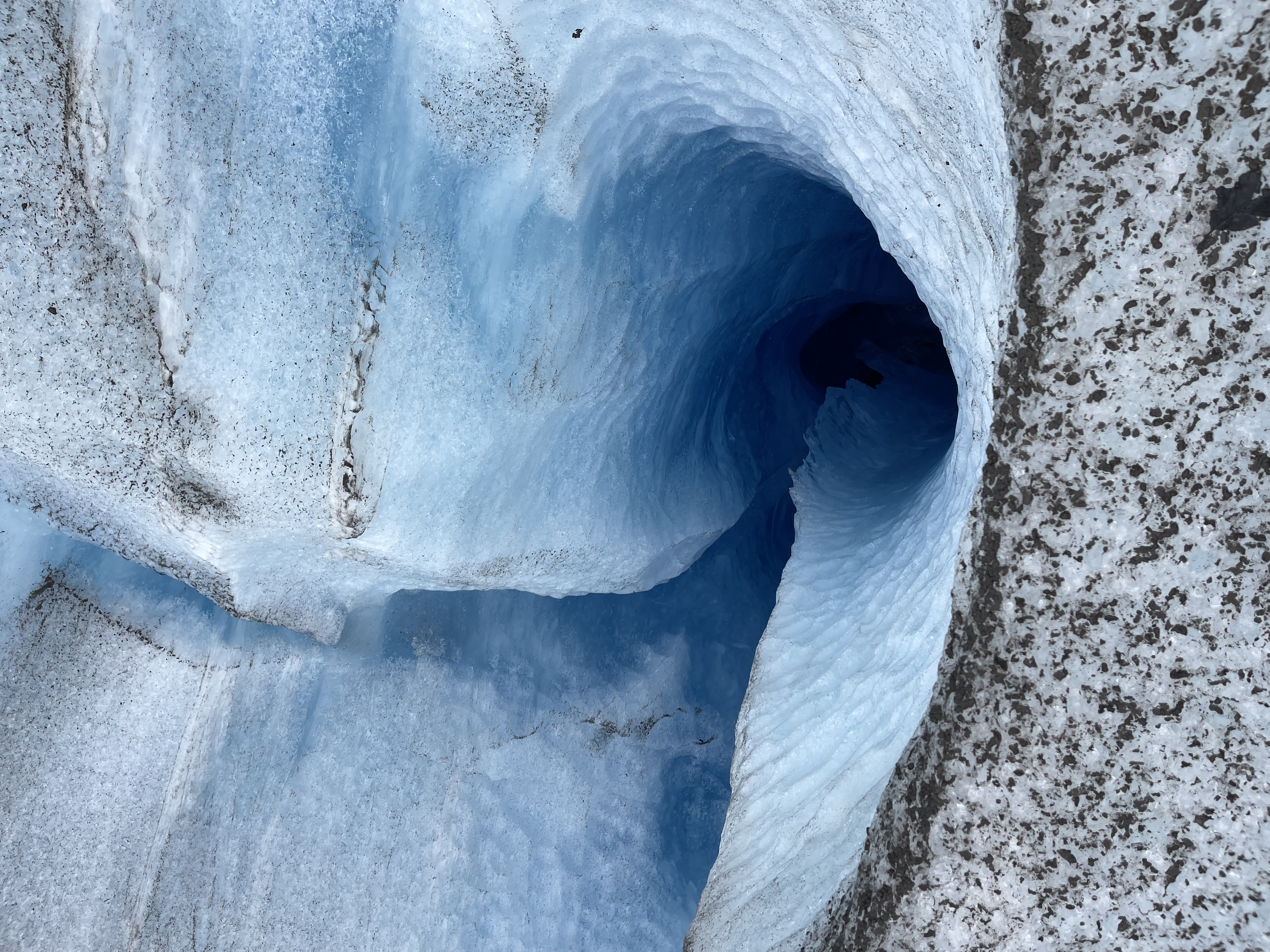
Meade Glacier + Moraine, above terminus, July 2022. Image, my own.
What is the Earth? It depends on who you ask. A geologist might tick off a list of minerals and talk of earth’s molten core and crusty mantle. An astronomer might explain that earth is a heavenly body orbiting around a G class star embedded deep in a spiral arm of the Milky Way Galaxy. A farmer might tip back his hat, squat, and scoop up a measure of fertile brown soil in his calloused hand, “Dirt.” A child might reply, “My home.” Earth.
One answer comes from those who inhabit the second largest ice sheet on earth in Greenland. Greenland Eskimo lore tells of three inquisitive friends who wanted to discover the size, shape, and character of the earth. Setting off, they traveled for several days when they came to a huge ice-house. After some debate they decided to go inside, and to ensure that they didn’t become lost in its cavernous recesses they held on to one another and ran their hands along the seemingly endless stretch of wall.
On and on they walked, now searching to find the entrance through which they had come. Time passed–days, months, years– and they grew weary. Strength waned and they all began to crawl on and on into the ice. Eventually, the last of their strength spent, no longer able to crawl, two of the friends sat down and died. The last boy continued on, and finally found the entrance. He stumbled out of the frozen house and made his way back to the village of his birth. He was now a very old man. He told his people, “The earth is simply a very big ice-house.”
——
Melt by Megan Dickson
things melt like banana popsicles on hot sidewalks
hearts at the cuddle of a tender puppy’s nuzzle
sun as it sherberts into sunset, dreamy scoops of carnelian, fuchsia, crimson
water being sublimated into sediment, becoming sludgy mud
metal silver when heated to one thou- sand seven hundred and sixty-three degrees
falsity as you live in truth in the world as it is, not as you wish it to be
light refracted and gloriously dispersed through water into the entire color spectrum
butter bubbling, sizzling in the fry pan in anticipation of the next repast
bodies into one another, warm with the savior-vivre of desire
——
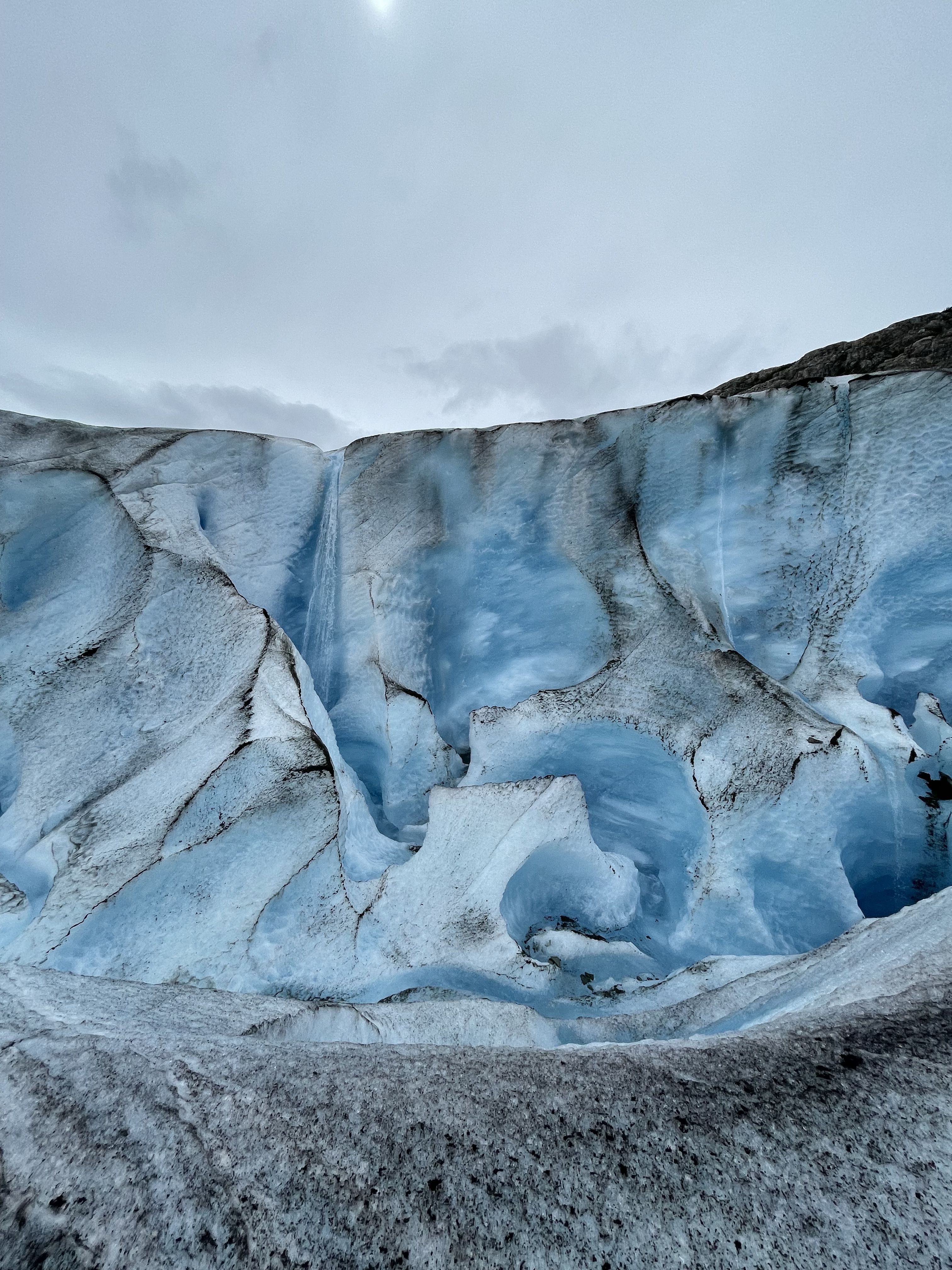
Gerwingk was the first glacier my children ever touched, but I hoped it wouldn’t be their last. Three years later, summer 2022, we drove up through Canada across the Alcan and down into Southeast Alaska. It felt like an in-depth glaciology lesson. “Ways of glaciers 1010 CRN 9110297.” If you had looked at the area from a topographic map that highlighted the icefields we drove through it was clear the route was stippled with thousands of glaciers; consequently, glacial history and present glacial phenomenon were visible from every vantage point– ice sawn peaks, razor-spined arêtes, gorgeous blue and green high lakes, U-shaped valleys, hanging glaciers, mountain glaciers, and larger long sloping glacial plains from epochs of time gone by in Earth’s climate, glacial, and geologic history.
Our destination was once again, Skagway, Alaska. The same tiny town where I’d spent five of my seven summer seasons in AK. Cruising down White Pass in our Sprinter was surreal. It was a cold, spitting, foggy, wind-whipped afternoon. We pulled on our rain jackets and stopped at the Alaska sign as we entered the U.S. again from British Columbia. Entering town an hour later, we set up camp at Pullen Creek Park, a beautiful little camp and RV spot next to Skagway’s small boat harbor. That night, in true Northern fashion we feasted on fresh Lynn Canal shrimp, wild caught crab and halibut at Fish Co. right next to the harbor. Of all the places on Earth I’ve known and loved, Skagway still felt like home.
The next morning, we went in search of adventure. Alaskans do many things well, including subsist in a perpetually harsh environment, and air and water travel are among their specialties. When half of your state population lives in rural communities only accessible by flight or ferry, you get really robust systems for both. So up we went with TEMSCO helicopters to take a walk on the Juneau Ice Field the day after we arrived. The sun shone bright, the ice was blue, and watching my children drinking from a stream straight off the face of a glacier was sublime.
We landed that morning on the Meade glacier. One of 13 outlet glaciers from the interconnected plateau of ice that makes up the Juneau Ice Field. According to researcher Bethan Davies, and her associates, in an article published July 2, 2024 in the science journal, Nature Communications, the Juneau Ice Field boasted 1050 glaciers in 2019 with, “40 topographically confined outlet glaciers, which drain directly from the main plateau. Separate to this plateau are smaller ice bodies; 145 valley glaciers, 584 mountain glaciers, and 281 glacierets.”1 That sounds like a staggering number of glaciers suggesting an incredible volume of ice.
However, the question for Davies and other glaciologists is how long will glacial ice persist as global temperatures rise? What are the implications of accelerated glacial ice melt? Hypothesis aside, these are questions that no one has firm or easy answer for yet. What researchers like Bethan Davies and Mattia Poinelli2 do know is that the changes that have occurred in Arctic and Antarctic ice in the last ten years have been the most substantive positive melt outputs for glacial ice melt than in the previous 100 years combined.
Davies explains, “Work like this is crucial as the world’s glaciers are melting fast – all together they are currently losing more mass than the Greenland or Antarctic ice sheets, and thinning rates of these glaciers worldwide has doubled over the past two decades.”3 This melting has the potential to change many of Earth’s systems including raising sea levels, shifting ocean currents, displacement of animal species, and other changes to the cryosphere that threaten to destabilize earth’s weather patterns, ecology, physical and human geography.
On this warm, July day, standing on the back of the Meade Glacier, none of these realities feel very pertinent. But it’s these kinds of questions which will undoubtedly be passed on to my boys and their children. Generations of humans who will have to work out complex climate shifts if we are unwilling to thoughtfully approach questions of climate change while we, too, are residents of Earth. Truly, we may not have started the fire, to give Billy Joel a worthy nod. Earth’s climate systems have shifted many multiple times before the first humans evolved into the sentient creatures we are today. But running, hiding, and choosing an apathete’s approach to our environment doesn’t strike me as very efficacious, either.
——
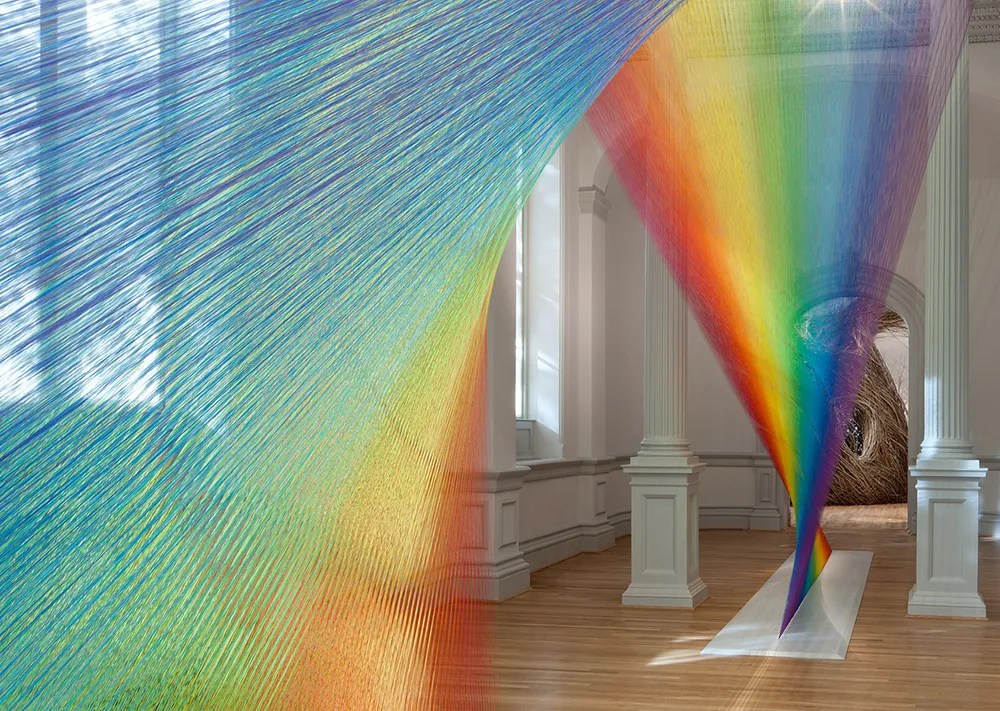
Gabriel Dawe’s work on display at the Renwick with the building’s 19th-century architectural details as a backdrop. Ron Blunt/ Renwick Gallery/ SAAM, Washington, D.C., 2015
——
Locals in Hope are fond of asking, “What’s the best thing about Portage Valley?” Quickly they’ll reply, “Anchorage in your rear-view mirror.” If you happen to leave Anchorage safely behind, you won’t have trouble figuring out which way to go. Just take The Road. The Road runs northeast along Knik Arm of Cook Inlet toward The Great One, Denali, and also escapes to the southeast, along Turnagain Arm of Cook Inlet.
Ironically, the Hope Highway dead ends just past the quaint little restored mining town. This little town has known its share of cataclysmic events. The 1964 earthquake created a tsunami that engulfed part of the town, sloughing it powerfully into an extended tidal basin. Now the still-tiny town really does live by the tourist season boasting a “gold panning experience,” salmon fishing in Resurrection Creek, and during some summers a glass blowing class. Most of the residents live there only part-time or work in Anchorage to make ends meet.
Not only do Alaskans in Hope, and elsewhere, know a thing or two about cataclysmic natural disasters and severe weather, their history is peppered with feats of conquest. Originating in the Bering Sea, the Cook inlet is named for the famous explorer Captain Cook. Not the nemesis of Peter Pan, Captain James Cook FRS, of Hawaiian infamy, had no hook. But like many great explorers of his time, he tirelessly sought the Northwest Passage, which drove him past Hope, not yet a dot on any map in 1778.
Traveling up the inlet toward Portage Valley, Cook and his crew navigated the narrow stretch of sea in dangerously shallow waters. Rather than finding a passage of any kind, the crew quickly realized that Turnagain arm had no outlet. Strange tides, now known to have the second greatest range in the world, caused the stalwart seafarer, Cook, to allegedly yell to his mates, “Turn again! Turn again!” Tacking back and forth out of the waterway, zig-zagging as quickly as they could to return to the larger Gulf of Alaska and back to meet the Bearing Sea, and safety. Can you imagine? Some of the greatest explorers in the world came so close, but they never discovered Hope. And just like the Turnagain arm of Cook Inlet, the road to Hope ends. It dead ends.
*(This is the third essay in a selection of essays, poems, and reflections on ice, glaciers, family, love, loss, and the stunning power of the natural world as it is and also as it functions to support human life. Previous essays include Hope (Alaska), and Hope (and Ice). All words and images unless otherwise noted are my own.)
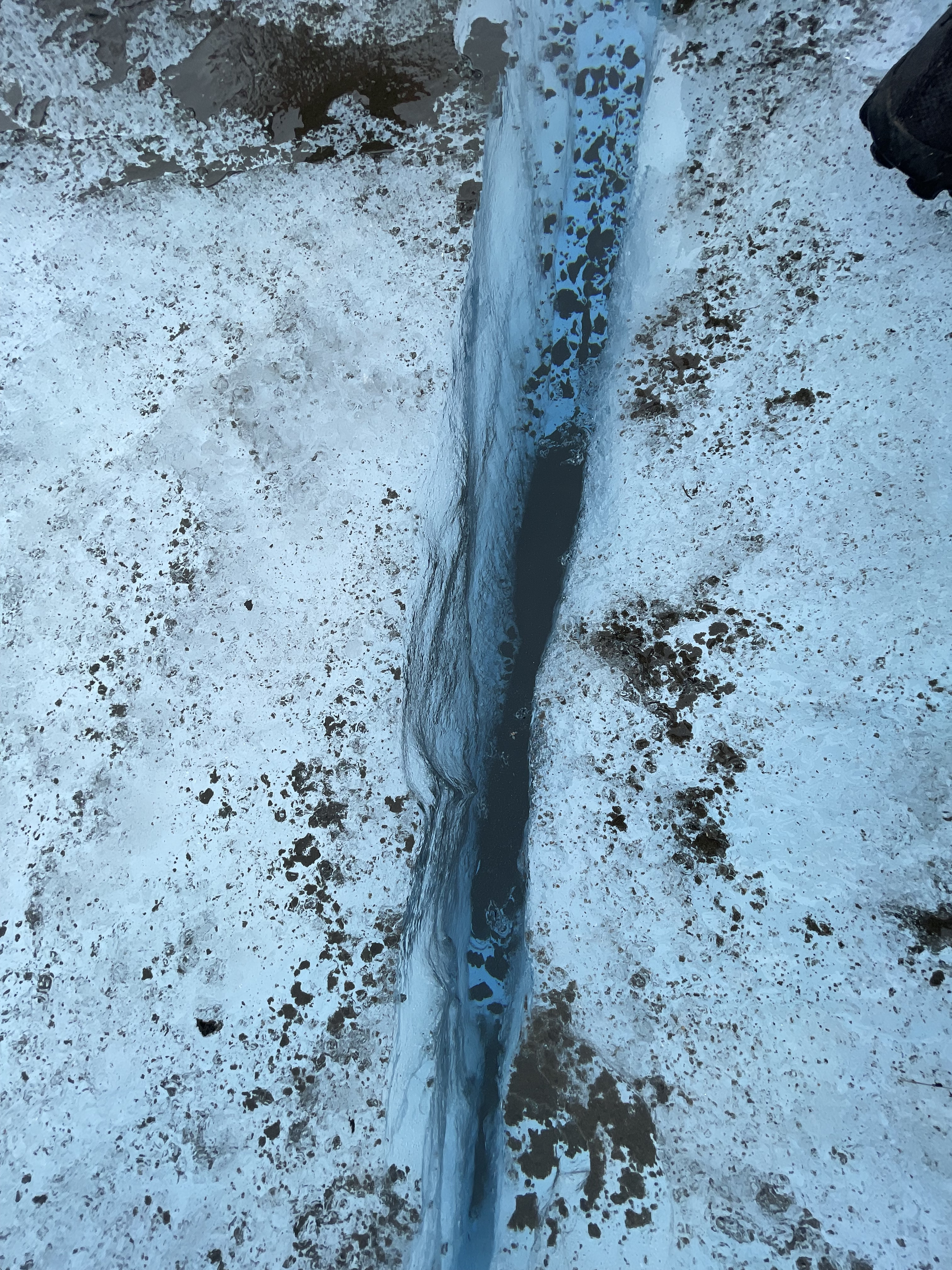
Crevasse on the Meade Glacier, Juneau Ice Field, July 2022. Image, my own.
Portrait of Adele Bloch-Bauer I , 1907; Gustav Klimt; Oil, gold, and silver on canvas Neue Galerie, New York
The Matriarch, Grandma Dorothy dressed in a gold lamé housecoat each year for Thanksgiving dinner. The table, set with rose china, was laid out long in her small basement apartment. Poised and gracious in her kingdom, she sat at the head of the table and smiled at each child and grandchild as we voiced gratitude for our blessings. She, in turn, gave thanks for “all of you.”
Regal, despite the crippling arthritis which attacked her bony sylph of a body, she held herself with an aristocratic air. Her back stayed straight with practiced posture through two total knee replacements, three husbands, four births, and five decades of single motherhood. Her studied gait had slowed, but still kept its polished flow from her days at the Presbyterian Girls School in Missoula, Montana, where Bertha Harriett, her mother, had insisted her only daughter be enrolled.
Dorothy’s hands gave one clue to her impatient internal pace; slender, knuckley, and nubbed, they were never still whether fluttering in her lap, tapping the tabletop, or brushing out a rhythm on her thigh. Another clue to her core came from her eyes. Bright and clear, her hazel eyes couldn’t hide all her knowing. They blinked and batted, magnified behind her glasses which earned her the nickname Granny-Bird. Beyond the constant pain of fibromyalgia which inflamed all her soft tissue, my grandmother carried the wit and wisdom that only a lifetime of studied learning can teach and only a sage can repeat.
“I just ache all over,” she explained.
When I was twenty-three and she was seventy-nine, she was diagnosed with lupus. In near-constant pain, I drove her an hour to her primary care physician. She said to the doctor seriously, “Fix me.” Holding her hands outstretched as if in child’s pose, palms up, in release and submission to the pain, in hope for healing. Then looked him piercingly in the eye until he admitted with a stutter that none of her ailments had a cure, a salve.
There was no fix, no hope. Regaining his composure, he whispered to her quietly, “We are a horse and we are a rider. The horse grows old, tired and pained; the rider is young forever.” So, she continued to wince and sigh in her sleep and persisted in walking slowly, majestically enough so the burden wouldn’t show much.
—–
Question by May Swenson
Body my house my horse my hound what will I do when you are fallen
Where will I sleep How will I ride What will I hunt
Where can I go without my mount all eager and quick How will I know in thicket ahead is danger or treasure when Body my good bright dog is dead
How will it be to lie in the sky without roof or door and wind for an eye
Without cloud for a shift how will I hide?
—–
No longer seven, Holland America Line Westours brought me back to Alaska in 2000 as a nineteen-year-old tour director. My job was to guide tour groups ranging in size from twenty to fifty people on nine-day land tours between Anchorage and Skagway, Alaska. The distance covered on each tour was somewhere around 812 miles, 1,624 round trip.
During the second week in May, the tour director trainees converged on the Anchorage Hilton. I’d never been a room with so many extroverts. The uniform for that year was khakis and red shirts, and the majority of our training as tour directors consisted not of classroom instruction, but taking the actual tours that our guests would take when they arrived in Alaska.
A typical first day in a Holland America cruise-tour package included a stop at the Alaska Native Heritage Center, a brief city tour, followed by a trip out to Portage Glacier. Our fifty-five-passenger motor coach ferried the group the forty-five miles or so to the Visitor’s Center. There is no better way to see Alaska than from the windows of a motor coach. Greyline, Holland America, claimed the window had been engineered by Kodak, and I thrilled as I gazed on Alaska for the second time.
Twelve years of nostalgia struck as we reached the Visitor’s Center, and I hurried off the bus into the building without a glance toward Portage Lake. Though I was now nineteen, it was as if I was there for the first time. With the other tour directors, I took a seat in the theater for Voices from the Ice. I was excited for my companions; I thought I knew the finale.
The movie ended, the screen rose, the curtain parted, and behold… a lake. There was no glacial face, no snout. No grand finale. No blue terminus of ice to awe at. Nothing but a dingy, mud-gray, motionless lake, dotted with giant melting ice cubes.
—–
ICE by C.K Williams (excerpt)
That astonishing thing that happens when you crack a needle-awl into a block of ice: the way a perfect section through it crazes into gleaming fault-lines, fractures, facets; dazzling silvery deltas that in one too-quick-to-capture instant madly complicate the cosmos of its innards. Radiant now with spines and spikes, aggressive barbs of glittering light, a treasure horde of light, when you stab it with the awl again it comes apart in nearly equal segments, both faces sadly grainy, gnawed at, dull.
…
Imagine then how even if it shattered and began to liquefy, the hope would still remain that if you acted quickly, gathering up the slithery, perversely skittish ovals, they might be refrozen and the mass reconstituted, with precious little of its brilliance lost, just this lucent shimmer on the rough, raised grain of water-rotten floor, just this drop as sweet and warm as blood evaporating on your tongue.
—–
Skagway became Alaska’s first incorporated city on June 28, 1900, boasting 3,117 residents. The population has fallen steadily ever since, and the 862 year round residents remain set at sea level at the mouth of the Lynn Canal, the deepest fjord in North America. The “Gateway to the goldfields!” continues to be Skagway’s modern claim to renown. The famous picture of gold miners and fortune finders treacherously clambering over the “Golden Staircase”, grand piano included, is set right outside of Skagway in the now non-existent town of Dyea.
The land surrounding Skagway rises abruptly from the ocean with White Pass Summit hitting 3,292 feet just 37 miles North of town into sub-arctic alpine tundra, think scrawny, wind and ice-bitten trees and tiny kettle lakes. But Skagway City’s climate is temperate coastal rain forest, think lush top-soil and muskeg, thick fern foliage, and dense forests just outside city limits.
I run. Chugging South down the Klondike Highway into the town of Skagway, I keep my eyes trained on Harding Glacier. This small hanging glacier, nestled in the armpit of Harding peak across Taiya Inlet from Skagway, has almost melted out of existence over my five summers in Alaska. Alarms sound off through my senses, as my feet scud over old glacial silt which lies alongside the road, “Fire!” Watching the midnight sun rise hotter and hotter in the Northern sky each summer has fueled my fear.
Finishing my run, I stand sweating, in ninety-degree heat on Broadway’s boardwalk, the main drag in downtown Skagway. This heat just isn’t quite right. A mere four blocks wide twenty-three blocks long, tourists clog every artery of Skagway’s downtown district, weaving in and out of open store doors, gawking through shop windows. Down at the docks there’s only parallel parking for mammoth cruise ships that pull-in and drop their load of 3,200 passengers per boat, per day.
With five berths, the math is easy, these ships can release 16,000 people or more into town on any given summer day. None of them seem too concerned about the fate of Harding Glacier or the Juneau Ice Field. I see the signs of glacial recession everywhere. What should we do? Imagination plays a “what if” video clip: I turn to the man in the green fishing vest and dockers khaki shorts standing next to me on the boardwalk. He’s quickly licking the myriad of drips from a pecan praline double cone he just purchased from Kone Kompany, held tightly in his fist.
In my imagination, I unload, “Sir, I know you’re on vacation” I pull out my imaginary microphone, begin diplomatically, “but does this heat scare you? You know, we’re in Alaska, the North country? Do you believe in global warming? Does it look to you as if this blue ice is a bit uncomfortable in this unbearable heat? Look, everything is melting, you, me, your ice cream cone, the glacial ice. Which boat did you come in on, the Diamond Princess, Empress of the Seas, the Volendam, Carnival Spirit? Did you enjoy awing all the way up the Lynn Canal this morning from your deck chair at the blue ice hung across the shoulders of the Chilkat and Coast Mountains? Nature dressed up just for you, sir. Do you want your grandchildren to be able to see what you saw? I really want my children to experience Alaska the way I did, glaciers and all. What should we do?”
There it is. Even though the scene played out in my mind instead of in real-time, I feel better. Sounding the global warming alarm. It’s not a him thing, or a me thing, it’s a we thing. Which doesn’t make the situation of Arctic warming any better, but it sure does make me feel a whole lot better to pass the blame on to the guy in the flop-backed fishing hat, or at least share it with him.
—–
Grandma was with me, lying on the purple silk bedspread in her room like a queen. I, her five-year-old courtier, heard the tiny tinkling tick of each bead hanging over her lavender pillows as my head parted them to rest on her shoulder. Opening a worn copy of The Tales of Old Mother West Wind, Grandma flipped to “The Tale of Johnny Fox.” We read for what seemed like days in a world where the wind had a name, and her animated baby breezes played tricks on the rabbits, beaver, and foxes who always seemed to get caught in the bluster.
At age six, I watched her morning routine. A garish multi-colored silk mu-mu, draped loosely over her small shoulders, got pinched under the little bulge of her belly then fell long to the floor. A tall glass of skim milk, burned buttered toast, bowl of soggy mini-wheats, all crumbed and dripped over a crossword puzzle. After breakfast, she’d shower and then stand naked and wrinkled, puffing loose folds of skin with talcum powder while listening to the tenor whine of the Bible on her old black tape recorder.
Even when I was eight, long after my parents were sleeping, I’d tip-toe into her bedroom and watch late-night reruns of MASH, The Love Boat, Star Trek the Next Generation, and eat bread-in-milk from mugs with spoons. She too was a night owl, and she’d sit next to me on her water bed, smelling of vitamin E oil and half-dry finger nail polish, her gray curls preserved for the night in a paisley scarf. I’m too young to understand that one day, I’ll lose her forever.
*(This is the second in a series of braided essays and poems about love, loss, ice, life, and what our world faces as we experience climate change at the human level. Here’s the first essay: Hope (Alaska). Thanks for reading!)
Terminus of the Meade Glacier, Juneau Ice Field, July 2022. Image, my own.





 Refined + Rugged