Hope (and Fire)

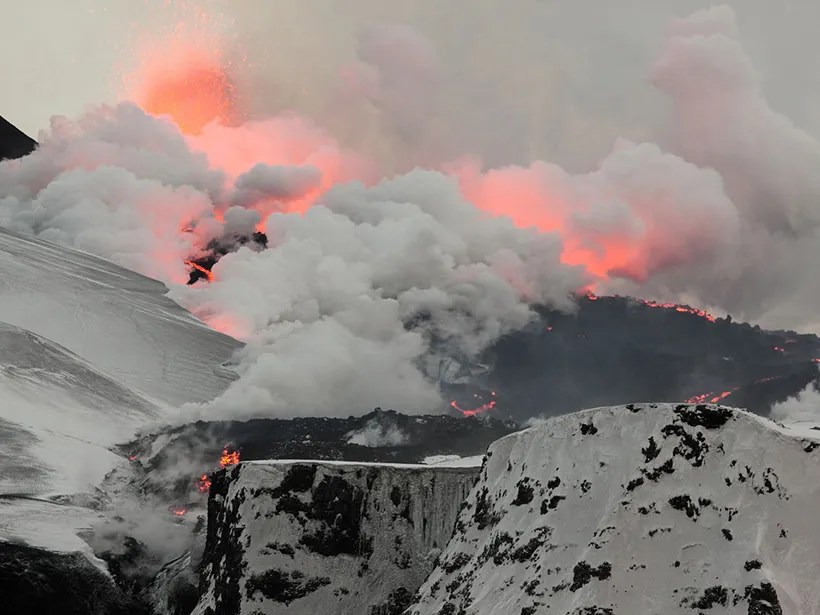
Scientists used white plumes of steam like these to track lava from the 2010 Eyjafjallajökull eruption as it melted the glacier. Credit: BoawormCC BY 3.0

——-

——-

What will happen when there is no ice left in our house? What will the warming Earth mean for humans and animals? Now, nearly twenty years from some of my most intense life experiences, travel, and living in Alaska, I finally realize that the difficulty with this moment of continuing glacial recession is that it is so very difficult for humans to push past their one-hundred-year lifespans to see beyond to the systems that shape not only our now, but our future.

I’m the first to raise my hand and express that this kind of complex information is difficult for the lay-person to process. So how do we make science, scientific facts, and continued scientific hypothesis and discovery on climate change more bite sized, more commonplace, more palatable. The ignorant me doesn’t have a ready answer for this.

Will we overheat and roast as the seas engulf us before we grasp the stunning reality that we need to move from believing that humans can harness Earth and her resources rather than humanity taking more careful notes on how Earth regulates her own systems?

Are we at the 911 phase of this journey? I scarcely think anyone knows. This summer, 2024, has felt hotter than ever. However, feelings don’t really translate into hard scientific evidence. But my “feeling” is backed up by science. July 21, 2024 was the hottest day ever recorded on planet Earth.1

——-

Fanning the yellowed pages under my thumb, the book fell open easily in my hands to the front inside cover. Plastered under a handwritten note was a sticker of a galaxy spiraling in a sea of black, and under its outstretched arms were printed the words, “Ex Libris Kenneth A. Farnsworth.” From the library of my father. He had been the one who scrawled the message above the sticker, “Mom, with love and gratitude for turning me on to this ‘good stuff’.”

Tenderly, I traced the edges of the sticker, and drew my fingers across the fading ink. This small volume was an important relic from my grandmother’s life, a testament to her love of the written word, to the way she not only relished poetry and prose but had also passed this love on to her children and grandchildren. I thought that the book looked centuries old, an age cracked spine and what looked like a hand stitched binding were beginning to peel apart leaving bits of cheese cloth, paste, and leather showing in between.  The worn leather exterior bore the title, stamped in gold ink, One Hundred and One Famous Poems.  The copyright read Riely & Lee 1958.  I guess relic, old, and antique were relative terms. 

For instance, I had mistakenly assumed that ideas surrounding the greenhouse effect, and global warming were part of “new science,” or discoveries made recently relative to my lifetime. The reverse is true. Some of these calculations dated back over a century which makes them almost archaic in my humble perspective. Some of the poets in Grandma’s book– Dickinson, Browing, Emerson, Whitman, Longfellow, Wordsworth– had lived during the time when the first scientific theories about what is now termed the “natural greenhouse effect” were being developed. Englishman John Tyndall is credited with the discovery of greenhouse gases in 1859. He drew a simple comparison, “Just as a dam causes a local deepening of the stream, so our atmosphere, thrown as a barrier across the terrestrial rays, produces a local heightening of the temperature at the earth’s surface.”  This wasn’t new science it was old news.

On page 81, Lucy Larcom’s poem titled, “Plant A Tree,” sounded like a worthy credo for an early American environmentalist. She had died just one year before Swedish chemist Svante Arrhenius began testing his theories that coal burning was changing the character of earth’s atmosphere. Larcom wrote, “He who plants a tree… Plants a hope.”  In 1894, a year after Larcom’s death, Arrhenius hoped to determine the effect on earth’s climate in the unlikely event that greenhouse gases like carbon dioxide emitted from coal burning ever doubled. His conclusion: if the greenhouse gases doubled, earth’s temperature would rise.

So if basic climate science isn’t new, why has it taken such a long time for humans to perceive, address, or pay attention to these warnings from scientists? The answers are certainly multi-layered: the relatively short time-span of human life, the heated politicization of climate change, the fact that scientific knowledge is not based on speed but on thoughtful interrogation, the fact that we know that Earth has experienced many climate epochs and mass extinctions in its deep past. Climate scientists including glaciologists, often ask very specific questions of climatic change in very narrow systems. Another reason may be that it can be very difficult to determine when humans should intervene in their environment.

In fact, an article in The Atlantic2 this July, offers some insight and ideas about human intervention into glacial preservation, in short, geoengineering. Ross Anderson interviews Slawek Tulaczyk about his projects on Thwaites glacier in Greenland and on the Western Antarctic ice sheet where he has come to believe that one of the only ways that ice, and perhaps Earth, can be saved from ‘catastrophic’ sea-level rise is to give humans more time to grapple with climate change; therefore, Tulaczyk proposes that humans attempt to stop ice sheet from floeing. His hypothesis and process go well beyond all geoengineering feats that have been attempted on Earth this far. In lay terms, Tulaczyk suggests that we pump water out from underneath large glacial ice sheets in hopes that they will readhere to the underlying bedrock. Tulaczyk believes that humans could keep massive ice shelves intact, and in essence, keep them from separating, melting, and causing sea-level rise.

There on my bed, a weird quantum meeting took place. I imagined Robert Frost listening to these glaciologists, then returning home to send the Intergovernmental Panel on Climate Change (IPCC), President Jim Skea, these famous lines,

Fire, ice, ice, fire. From first-hand Northern climate immersion, I would still have to go with the first. I’d say fire.

Geldingadalagos, Eruption at Geldingadalir Iceland, 2006, credit: Mangus Johannsson

——

Two days after my grandmother’s funeral, my fingers brushed the soft sheen of one silk square of quilt. Bright mauve lilacs, butter daffodils, and blush sweet peas undulated across the small cubes of fabric. I drew a cubed piece of leopard print fabric to my nose, hoping to catch even a faint breath of her. A gaudy half-moon of colorful Klein blue silk shone in front of me masking the neutral brown tones of the living room carpet in my parents’ home in Duchesne, Utah.

She would have worn any one of these silk creations anywhere. That was the best part. Sure grandma had the shirts that were reserved for church, but it was just as common to find her out behind the house in the garden sweating under a wide blue sky, a broad brimmed straw hat, and a silk shirt splashed with brazen colors clashing in contrast to the hue of her pants. Perfectly garish.

My sisters and I quietly continued our work. Grabbing a shirt from the silky mound behind me, this one a deep emerald green I remembered how at Christmas she had once worn it with a pair earrings stuck through the collar her idea of “jazzing up” an ensemble. Ostentatious octogenarian that she was, we were cutting all of her shirts into quilt squares, though no one in the family, children or grandchildren, had ever made a quilt.

There were plenty of decisions surrounding her death that caused familial disagreement– her obituary, her headstone, her viewing. Most of these squabbles came from the amalgam of contrasting beliefs, values, views, and lifestyles manifest in her posterity. But everyone seemed to want to hold on to these shirts and other articles of clothing sometimes so threadbare, frayed, unraveling that only a few small quilt squares could be saved.

*(This is the latest in a series of essays here on Refined + Rugged. They include: Hope (Alaska), Hope (and Ice), Hope (and Earth), Hope (and Loss), Hope (and Love). I’m exploring what it means to be human in a time of unprecedented climate change. As the world warms, and humans begin and continue to adapt to these massive climate changes in our lifetime, what will this mean for our environment, our Earth, our children, and our grandchildren. As always, thank you for reading, commenting, liking, sharing, and generally pondering these questions with me. Love, Megan)
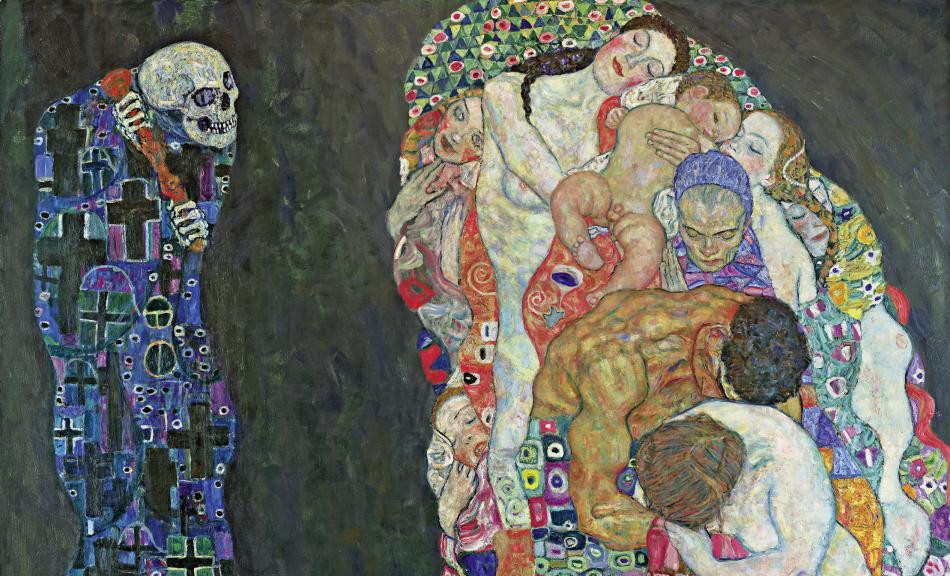
Death and Life, Gustav Klimt, 1910, Leopold Museum, Vienna, Austria. This “life” is comprised of all generations: every age group is represented, from the baby to the grandmother, in this depiction of the never-ending circle of life. The solitary, darkly dressed figure of death stands on the left.
  1. https://climate.copernicus.eu/new-record-daily-global-average-temperature-reached-july-2024#:~:text=The%20Earth%20has%20just%20experienced,C%20from%206%20July%202023. ↩︎
  2. https://www.theatlantic.com/magazine/archive/2024/07/nasa-nisar-mission-glaciers-sea-ice-thwaites/678522/ ↩︎

Hope (and Ice)

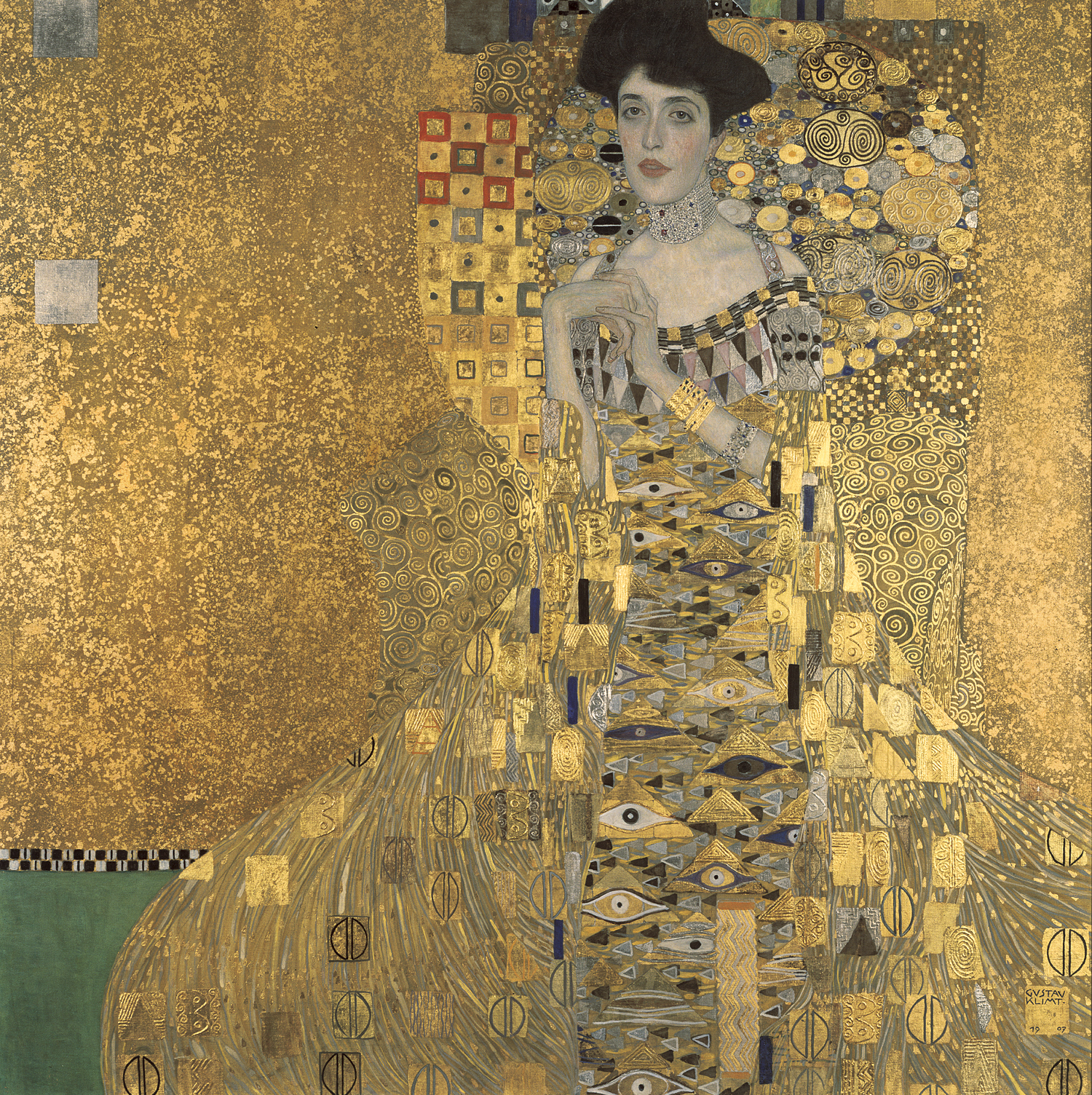
Portrait of Adele Bloch-Bauer I , 1907; Gustav Klimt; Oil, gold, and silver on canvas
Neue Galerie, New York

The Matriarch, Grandma Dorothy dressed in a gold lamé housecoat each year for Thanksgiving dinner. The table, set with rose china, was laid out long in her small basement apartment. Poised and gracious in her kingdom, she sat at the head of the table and smiled at each child and grandchild as we voiced gratitude for our blessings. She, in turn, gave thanks for “all of you.” 

Regal, despite the crippling arthritis which attacked her bony sylph of a body, she held herself with an aristocratic air. Her back stayed straight with practiced posture through two total knee replacements, three husbands, four births, and five decades of single motherhood. Her studied gait had slowed, but still kept its polished flow from her days at the Presbyterian Girls School in Missoula, Montana, where Bertha Harriett, her mother, had insisted her only daughter be enrolled.

Dorothy’s hands gave one clue to her impatient internal pace; slender, knuckley, and nubbed, they were never still whether fluttering in her lap, tapping the tabletop, or brushing out a rhythm on her thigh. Another clue to her core came from her eyes. Bright and clear, her hazel eyes couldn’t hide all her knowing. They blinked and batted, magnified behind her glasses which earned her the nickname Granny-Bird. Beyond the constant pain of fibromyalgia which inflamed all her soft tissue, my grandmother carried the wit and wisdom that only a lifetime of studied learning can teach and only a sage can repeat.

“I just ache all over,” she explained.

When I was twenty-three and she was seventy-nine, she was diagnosed with lupus. In near-constant pain, I drove her an hour to her primary care physician. She said to the doctor seriously, “Fix me.” Holding her hands outstretched as if in child’s pose, palms up, in release and submission to the pain, in hope for healing. Then looked him piercingly in the eye until he admitted with a stutter that none of her ailments had a cure, a salve.

There was no fix, no hope. Regaining his composure, he whispered to her quietly, “We are a horse and we are a rider. The horse grows old, tired and pained; the rider is young forever.” So, she continued to wince and sigh in her sleep and persisted in walking slowly, majestically enough so the burden wouldn’t show much.

—–

—–

No longer seven, Holland America Line Westours brought me back to Alaska in 2000 as a nineteen-year-old tour director. My job was to guide tour groups ranging in size from twenty to fifty people on nine-day land tours between Anchorage and Skagway, Alaska. The distance covered on each tour was somewhere around 812 miles, 1,624 round trip. 

During the second week in May, the tour director trainees converged on the Anchorage Hilton. I’d never been a room with so many extroverts. The uniform for that year was khakis and red shirts, and the majority of our training as tour directors consisted not of classroom instruction, but taking the actual tours that our guests would take when they arrived in Alaska.

A typical first day in a Holland America cruise-tour package included a stop at the Alaska Native Heritage Center, a brief city tour, followed by a trip out to Portage Glacier. Our fifty-five-passenger motor coach ferried the group the forty-five miles or so to the Visitor’s Center. There is no better way to see Alaska than from the windows of a motor coach. Greyline, Holland America, claimed the window had been engineered by Kodak, and I thrilled as I gazed on Alaska for the second time. 

Twelve years of nostalgia struck as we reached the Visitor’s Center, and I hurried off the bus into the building without a glance toward Portage Lake. Though I was now nineteen, it was as if I was there for the first time. With the other tour directors, I took a seat in the theater for Voices from the Ice. I was excited for my companions; I thought I knew the finale.

The movie ended, the screen rose, the curtain parted, and behold… a lake. There was no glacial face, no snout. No grand finale. No blue terminus of ice to awe at. Nothing but a dingy, mud-gray, motionless lake, dotted with giant melting ice cubes.

—–

—–

Skagway became Alaska’s first incorporated city on June 28, 1900, boasting 3,117 residents. The population has fallen steadily ever since, and the 862 year round residents remain set at sea level at the mouth of the Lynn Canal, the deepest fjord in North America. The “Gateway to the goldfields!” continues to be Skagway’s modern claim to renown. The famous picture of gold miners and fortune finders treacherously clambering over the “Golden Staircase”, grand piano included, is set right outside of Skagway in the now non-existent town of Dyea.

The land surrounding Skagway rises abruptly from the ocean with White Pass Summit hitting 3,292 feet just 37 miles North of town into sub-arctic alpine tundra, think scrawny, wind and ice-bitten trees and tiny kettle lakes. But Skagway City’s climate is temperate coastal rain forest, think lush top-soil and muskeg, thick fern foliage, and dense forests just outside city limits.

 I run. Chugging South down the Klondike Highway into the town of Skagway, I keep my eyes trained on Harding Glacier. This small hanging glacier, nestled in the armpit of Harding peak across Taiya Inlet from Skagway, has almost melted out of existence over my five summers in Alaska. Alarms sound off through my senses, as my feet scud over old glacial silt which lies alongside the road, “Fire!” Watching the midnight sun rise hotter and hotter in the Northern sky each summer has fueled my fear. 

Finishing my run, I stand sweating, in ninety-degree heat on Broadway’s boardwalk, the main drag in downtown Skagway. This heat just isn’t quite right. A mere four blocks wide twenty-three blocks long, tourists clog every artery of Skagway’s downtown district, weaving in and out of open store doors, gawking through shop windows. Down at the docks there’s only parallel parking for mammoth cruise ships that pull-in and drop their load of 3,200 passengers per boat, per day.

With five berths, the math is easy, these ships can release 16,000 people or more into town on any given summer day. None of them seem too concerned about the fate of Harding Glacier or the Juneau Ice Field. I see the signs of glacial recession everywhere. What should we do? Imagination plays a “what if” video clip: I turn to the man in the green fishing vest and dockers khaki shorts standing next to me on the boardwalk. He’s quickly licking the myriad of drips from a pecan praline double cone he just purchased from Kone Kompany, held tightly in his fist.

In my imagination, I unload, “Sir, I know you’re on vacation” I pull out my imaginary microphone, begin diplomatically, “but does this heat scare you? You know, we’re in Alaska, the North country? Do you believe in global warming? Does it look to you as if this blue ice is a bit uncomfortable in this unbearable heat? Look, everything is melting, you, me, your ice cream cone, the glacial ice. Which boat did you come in on, the Diamond Princess, Empress of the Seas, the Volendam, Carnival Spirit? Did you enjoy awing all the way up the Lynn Canal this morning from your deck chair at the blue ice hung across the shoulders of the Chilkat and Coast Mountains?  Nature dressed up just for you, sir. Do you want your grandchildren to be able to see what you saw? I really want my children to experience Alaska the way I did, glaciers and all. What should we do?” 

There it is.  Even though the scene played out in my mind instead of in real-time, I feel better. Sounding the global warming alarm. It’s not a him thing, or a me thing, it’s a we thing. Which doesn’t make the situation of Arctic warming any better, but it sure does make me feel a whole lot better to pass the blame on to the guy in the flop-backed fishing hat, or at least share it with him.

—–

Grandma was with me, lying on the purple silk bedspread in her room like a queen. I, her five-year-old courtier, heard the tiny tinkling tick of each bead hanging over her lavender pillows as my head parted them to rest on her shoulder. Opening a worn copy of The Tales of Old Mother West Wind, Grandma flipped to “The Tale of Johnny Fox.” We read for what seemed like days in a world where the wind had a name, and her animated baby breezes played tricks on the rabbits, beaver, and foxes who always seemed to get caught in the bluster.

At age six, I watched her morning routine. A garish multi-colored silk mu-mu, draped loosely over her small shoulders, got pinched under the little bulge of her belly then fell long to the floor. A tall glass of skim milk, burned buttered toast, bowl of soggy mini-wheats, all crumbed and dripped over a crossword puzzle. After breakfast, she’d shower and then stand naked and wrinkled, puffing loose folds of skin with talcum powder while listening to the tenor whine of the Bible on her old black tape recorder.

Even when I was eight, long after my parents were sleeping, I’d tip-toe into her bedroom and watch late-night reruns of MASH, The Love Boat, Star Trek the Next Generation, and eat bread-in-milk from mugs with spoons. She too was a night owl, and she’d sit next to me on her water bed, smelling of vitamin E oil and half-dry finger nail polish, her gray curls preserved for the night in a paisley scarf. I’m too young to understand that one day, I’ll lose her forever.

*(This is the second in a series of braided essays and poems about love, loss, ice, life, and what our world faces as we experience climate change at the human level. Here’s the first essay: Hope (Alaska). Thanks for reading!)

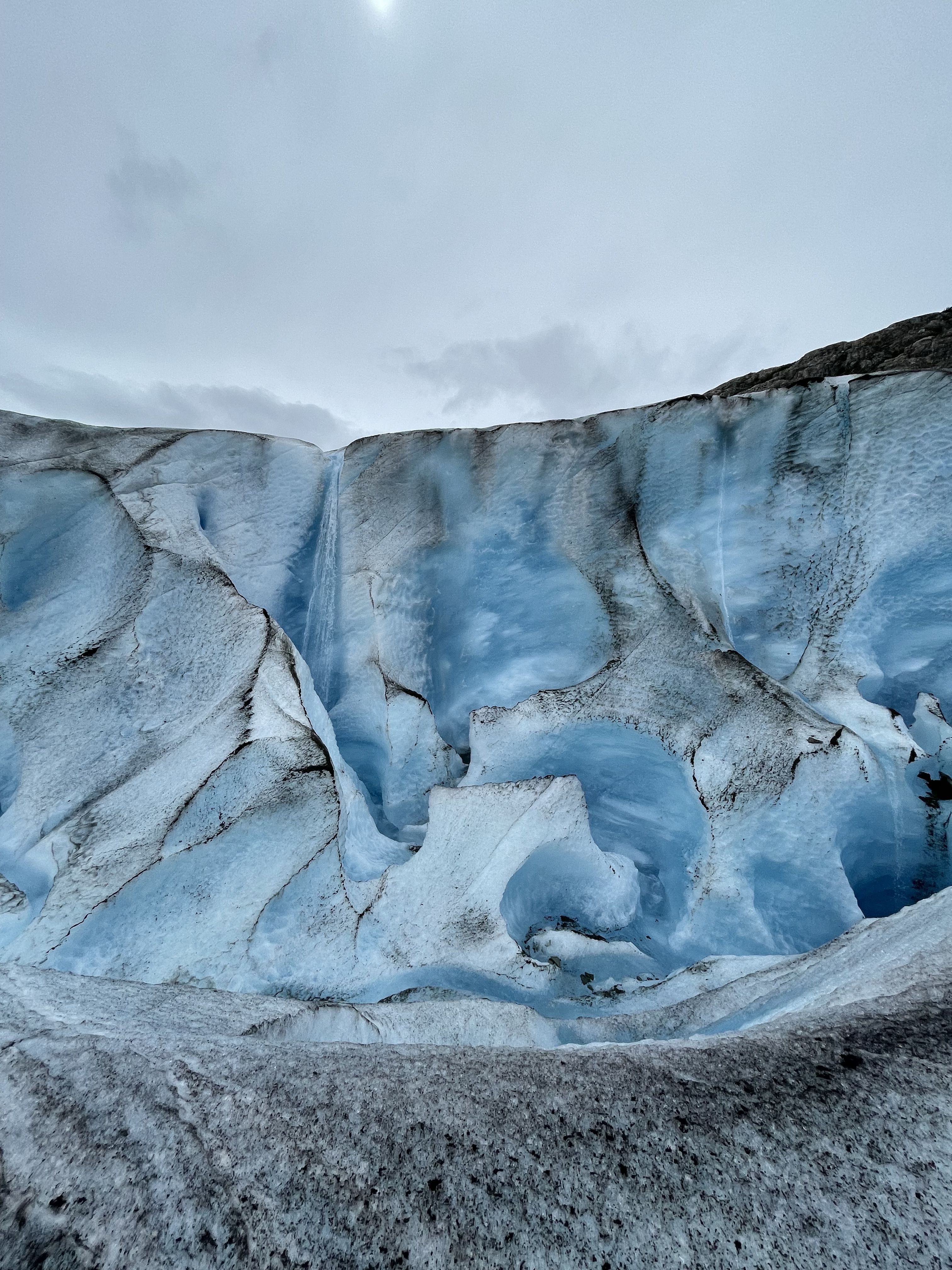
Terminus of the Meade Glacier, Juneau Ice Field, July 2022. Image, my own.

Hope (Alaska)

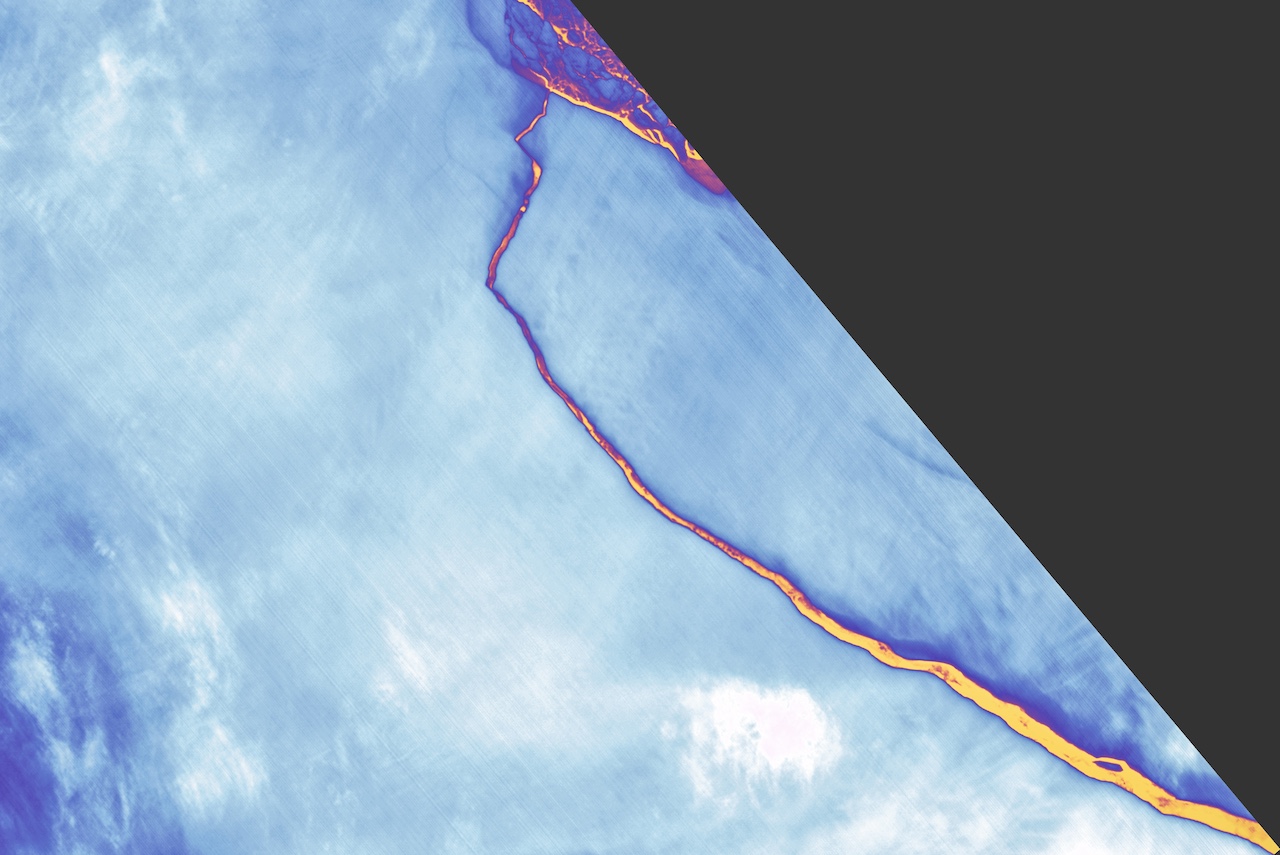
Satellite image of a massive iceberg breaking away from the Larsen C ice shelf in the eastern Antarctic Peninsula. The false-color image was captured by the Landsat 8 thermal infrared sensor in July 2017. Image credit: Joshua Stevens, NASA Earth Observatory, using Landsat data from the U.S. Geological Survey

I stand near Hope, the muskeg path falls steep and spongy to the rhythmic, slate waves of Turnagain Arm. Gold, not ice, is what originally situated the town’s two hundred residents at the Northern root of the Kenai mountains in 1896.  Now locals may be pondering which is more precious, or maybe the current answer is still ‘C’, “tourists.”

The first-green of fragile ferns springs up over dirt-peppered gobs of crusted snowmelt along either side of the trail.  In the still-frozen snap of early May, birch bark flakes paper-white against the greywacke sandstone and granodiorite. Black and white spruce limbs and needles twine, their winter-fixed dance now a spring still life. Farther up the mountainside, an unseen breath of cool air wavers through the dark boughs of Lutz spruce posts, scrawny and more solitary. 

Hope and the rest of the Kenai Peninsula are divided from mainland Alaska by this choppy spume of Turnagain Arm. The watery arm is bounded by towering mountain ranges on either side—Chugach and Kenai. Seward Highway, one of the most scenic in the world, scratches its route out of Chugach bedrock on Turnagain Arm’s northern side. Standing on Turnagain’s southern shore, at the base of the Kenai Mountains, I look across the inlet.

The Cretaceous bulk of the Chugach, the parallel mountain range, sketches dark crags and cliffs into the northern horizon line as the contrast meets the dewy green iris of my eyes. Tall against the cerulean arc of the sky, the mountain’s ancient rocks remind me that I am young, barely twenty-one. Yet, I watch the world being born before me. Behind these mountains, small peaks protruded from blankets of fresh snow and ice like the breasts of rock Eves, nunataks, carved clean by this glacial ice. Creation isn’t finished here. 

—–

Tenacious, tactless, and bursting with energy that can’t be contained in a somebody who’s seven, I was the kid who couldn’t be shut-down, shut-up, or put-out at a slumber party.  Sticking my tongue through the enormous gap between my front teeth, I’d lay plans to stay up all night.  First, I’d giggle raucously with my three other sleepover friends till ten. As the party started to die down, I’d begin the war if I could, two against two, two live-wires versus the two heavy-eyed and tired. Mercilessly I’d poke, prod, and pester our sleepy victims, sticking things up their noses and in their mouths, pelting them with jolly ranchers till midnight.

My co-terror would undoubtedly grow sleepy when I couldn’t dream up any more interesting battles to wage on the dreamers, and she’d drift off to dreamland herself.  The war would wind down, and I’d remain alone and awake, watching creepy alien shows on the Sci-fi Channel.  The living room floor seemed strewn with huge wriggling worms. Snoring seven-year-olds moaned and drooled and twisted into grotesque shapes which became part of the alien landscape all lit up by the TV’s fluorescent flicker. I’d be wide awake till dawn, and finally exhausted, fall asleep. 

It’s this very same seven-year-old that Grandma Dorothy trots off with to Alaska in August of ’88 to visit her youngest son Bruce, and his family.  Only Grandma didn’t just travel with one seven-year-old. That would have been too easy. Instead, she takes two. Flying on a jet-plane for the first time in our lives, my cousin Jenny and I can’t sit still for one moment of the five-hour flight. When we reach Anchorage, Alaska, we are reunited with a third cousin, seven-year-old Sarah. Grandma’s three babes. All girls, we were all born to Grandma in ’81 through her three sons—Ken, Floyd, Bruce.

It’s getting late, far past bedtime, probably nearing midnight Anchorage time. The three of us have been put to bed. I’m not tired. The black-out blinds in Sarah’s room, designed to keep out Alaska’s midnight sun, are framed in late summer light. To me, this isn’t night. 

“Look, it’s not even dark,” I say. 

“I know,” Jenny chimes. 

“Does it ever get dark?” I ask Sarah. 

“In the winter,” she replies. 

We’re reading Charlie Brown comic books with a flashlight, trying to stifle our laughs with a pillow. One short comic strip makes us giggle till we’re red from burying our heads in the nylon folds of our sleeping bags. Charlie Brown and the gang are playing football. Charlie fumbles again and again, a complete failure, but Sarah, Jenny, and I don’t care. Realizing in retrospect that anything can be funny to three girls at age seven, it’s the one-liners that get us. This time it’s Linus. Holding his blanket and stumbling toward the fifty-yard line, he wants Charlie to pass him the ball. His arms raised high, his blanket trailing at his side, Linus yells, “Pass me the pig-skin, Sir!” Laughter grips our sides and cinches our lungs tight as we try desperately to snort air through our pillows. A floor above us, Sarah’s baby-sister Sophie starts to cry. 

“Aw crap! We woke up Sophie,” I say. 

Grandma’s voice shoots down the stair well, “Girls, go to bed.” 

We’ve been caught, and our laughter dies. I settle into my sleeping bag, hoping for rest even though the light hasn’t died behind the blinds. The sun is still awake outside.

The next morning over breakfast, Uncle Bruce announces that we are all going to see Portage glacier. When the breakfast fiasco is done, we pile into their van and head out of Anchorage onto the Seward highway. We drive for a long child-time. Full-lunged, and over-dramatic, now we sing songs from all of our Broadway favorites. Then dissolve into rich peals of kid-laughter.

The incredible scenery passes unobserved by girls of seven who are content to chatter, giggle, and imagine with one another. Free from the van, we run headlong to the Visitor’s Center entrance in Portage Valley, unaware that with one glance toward the lake we could view the glacier face to face. 

Inside, we are ushered into a movie theatre. 

“What are we watching?” I whisper to Sarah. 

“I don’t know,” she replies.  The lights go dim. 

“Quiet,” whispers Grandma. 

The main screen cues and I read the title Voices from the Ice.  The voice of the narrator begins its drone, and my eyelids threaten to become too heavy to rise.  With a thundered, crumbling resound, an iceberg voices its descent from the glacier’s face and plunges toward the chunky melt water above the terminal moraine. I startle in my seat at the boom. Another massive chunk of ice calves off the front of the glacier and plummets into the lake. Now, fully awake, my senses are filled with wonder. 

I ignore the commentary as the narrator’s monotone voice continues. Instead, I’m intent on watching Portage, one of over 600 named glaciers in Alaska, 30,000 estimated in total. These gargantuan ice mammoths gouge striations into rock, churn up sediment in track-like moraine. The scars left by the glacier remind me of the deep notches that appear in black pavement as cars scrape in and out of a parking lot entrance. Only these scars are not formed on soft blacktop but in granite bedrock as glaciers’ miles-thick arms of ice drag debris of all different sizes ranging from sediment, to pebbles, to boulders, on up to erratics– boulders the size of cars or small houses which glaciers ice-belt down mountainsides and across valley floors.

The camera pans from the expanse of snow across the ice field to a close-up shot of mesenchytraeus solifugus, a tiny indigo ice worm, as it wriggles through the structural holes in an individual ice crystal. What seems like a sterile chub of ice reveals life in microcosm.

I sit silent and still as the movie ends and the lights come up. The screen rises slowly to the ceiling, and the red curtain behind it parts. Real and a deep raw blue, Portage glacier rises from Portage Lake. The crystalline blue ice incongruously toes through pillowy gray skies. My breath fled. Before I know that glaciers are dying, with clean seven-year-old eyes, I am awed by ice for the first time.

—–

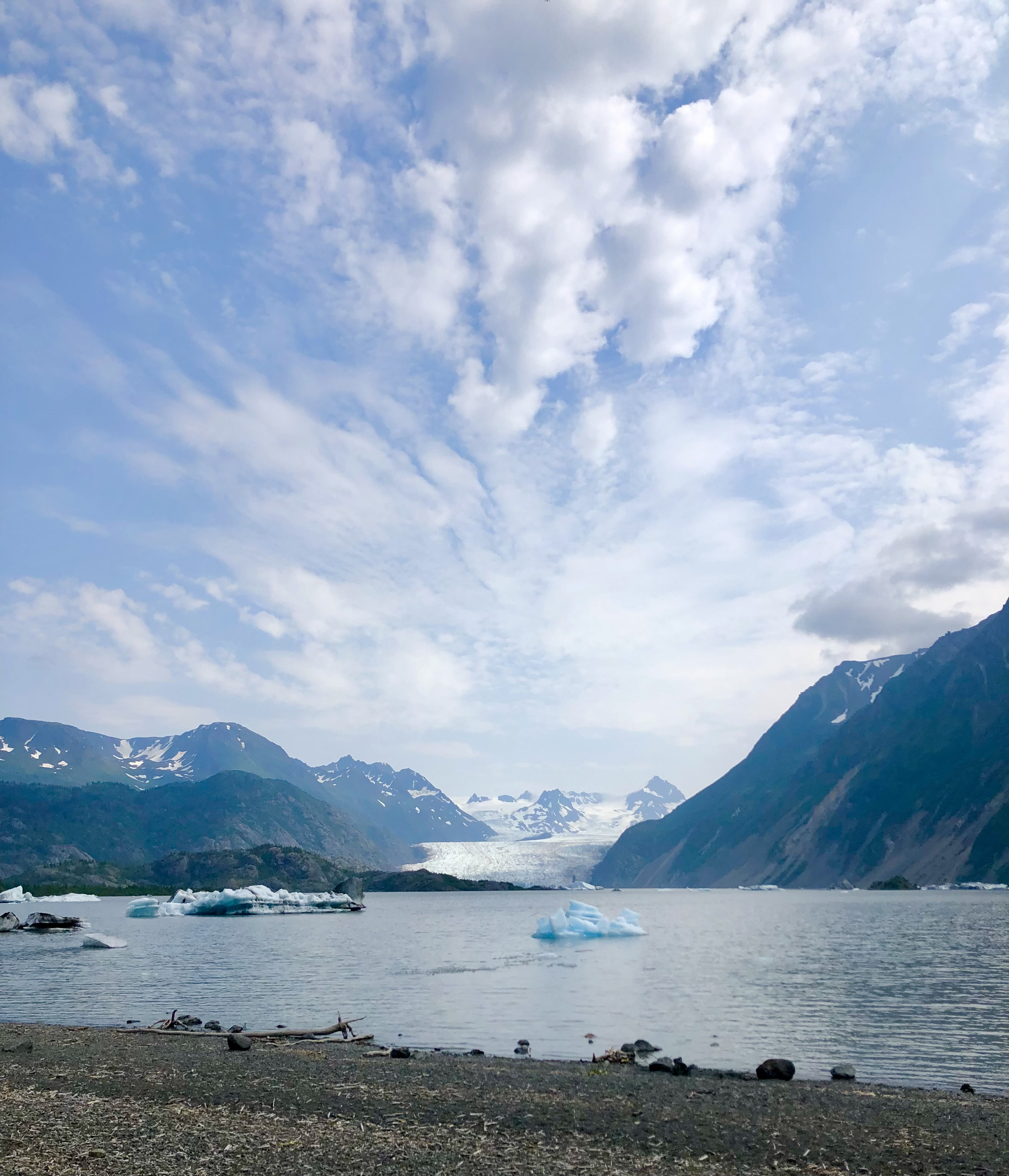
There my sons are, jumping into a glacial lake for the first time. Bodies all bare and ready for the shocking cold. Running down the rocky shore so as not to lose resolve, they squeal into the water like little seals, a little less lithely. It’s like an exclamation point inside me. Grewingk Glacier’s lake is the swimming hole today, in Kachemak Bay State Park, Kenai Peninsula.

I couldn’t have dreamed up a more exciting family adventure. We’re here to celebrate my cousin, Sophie’s wedding, and it’s the first of many firsts for my boys in the ways of ice. My seven-year-old son holds up a puppy-sized, crystal clear chunk of glacial ice. His expression, open-mouthed awe. Just like I felt thirty years ago. Everything in me feels dazzled, just utterly magiced. A day really can glow and glitter in memory forever. This is wild.

—–

*(This is the first in a set of braided essays about ice, glaciers, Alaska, love, loss, and what climate change looks like at human-level.)

Epiphany

Four little poems for your day.
Happy, Merry sweet humans.
xx MM

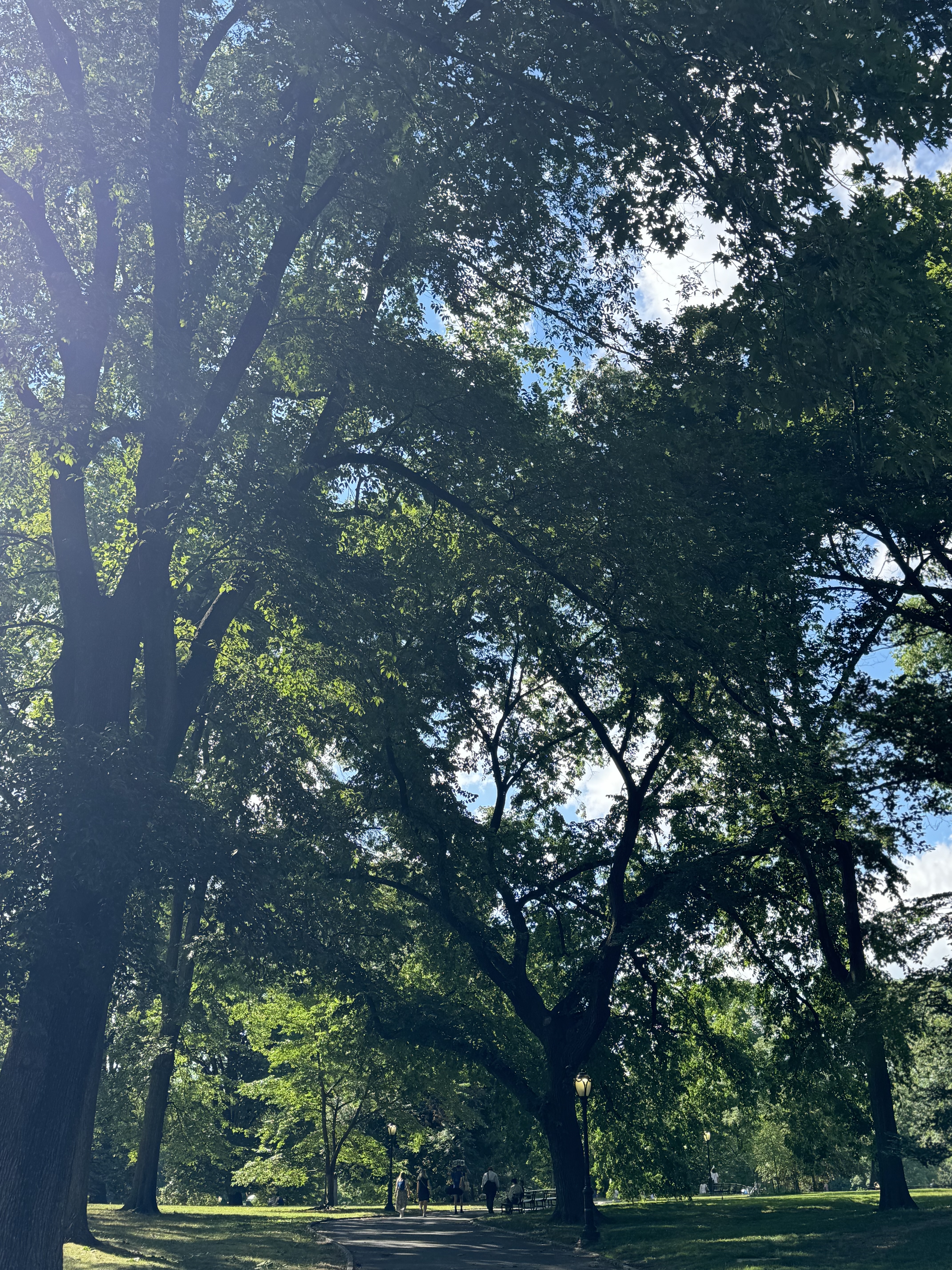
Central Park bathed in sunshine (June 2024).

….

Flow

flow can be the essence of knowing
the power of prescience
the smell of petrichor
the smooth surface of an ocean
tossed pebble, translucent amber
the great wave of goodness
but flow can also
be the tumultuous spume,
the glassy, wind-bereft waters,
the deep, dark, depths
the void, the unknowing
don’t forget that flow has
many ways and many waves

….

Into the Green

There are more words,
expressions, descriptions of green
in human language than
are intoned for any other chroma

when you are draped in green
golded and guilded in green
it is completely obvious
why this hue

green captures the eye
grounds the heart
breaths through the body
as you realize that you’re respirating

at the same rate as the statuary oak
next to you
the ash is breathing out a sigh
of joy, just as you do

The cottonwood leaves glittering
green, making a magical cacophony
of nearly silent whispers which
crescendo into a forte of breezy, winsome refrains

aspen, largest living organism,
holding ground in root and spear as they
shiver and rattle in green all their own
a sort of awe and wonder at once

alluring, regenerative, stable, steady,
cholrophyllic music, all love-mixed
whimsy and reality each leaf a hard-earned
medallion, sign of life

….

Reverberation

It’s impossible to feel alone soaking in the reverberation of humanity ringing through the great halls of civilization. The echo. The sound. The deconstructed interplay of all those expressions and explications bouncing and bounding around in the domed, arched architecture. Dancing over the simulacra, art, massive and tiny, representative of nothing and everything. The absolute alacrity the beatific joy of each repercussive utterance. Jazz. A fusion of improvisational auditory stimuli. The resounding transcendence of humanity in the envelope of a space. Astonishing.

….

Tuesday

On a Tuesday
in December
Life will eventually
present you with the
fact that you have
absolutely no answers
not one

I don’t use that word
lightly—fact

On a Tuesday
in December,
You’ll be opened
wide by the love
of the people
who have offered
you a life raft,

A golden, glittering
net—a light, a torch.

You’ll come to
the understanding,
the conclusion,
that life brings
you many endings,
many beginnings
to teach you

that life has no
end no beginning

it simply is
this beautiful imperative
this open, pulsing
opportunity at love
that you will never
receive again, this moment
this is it

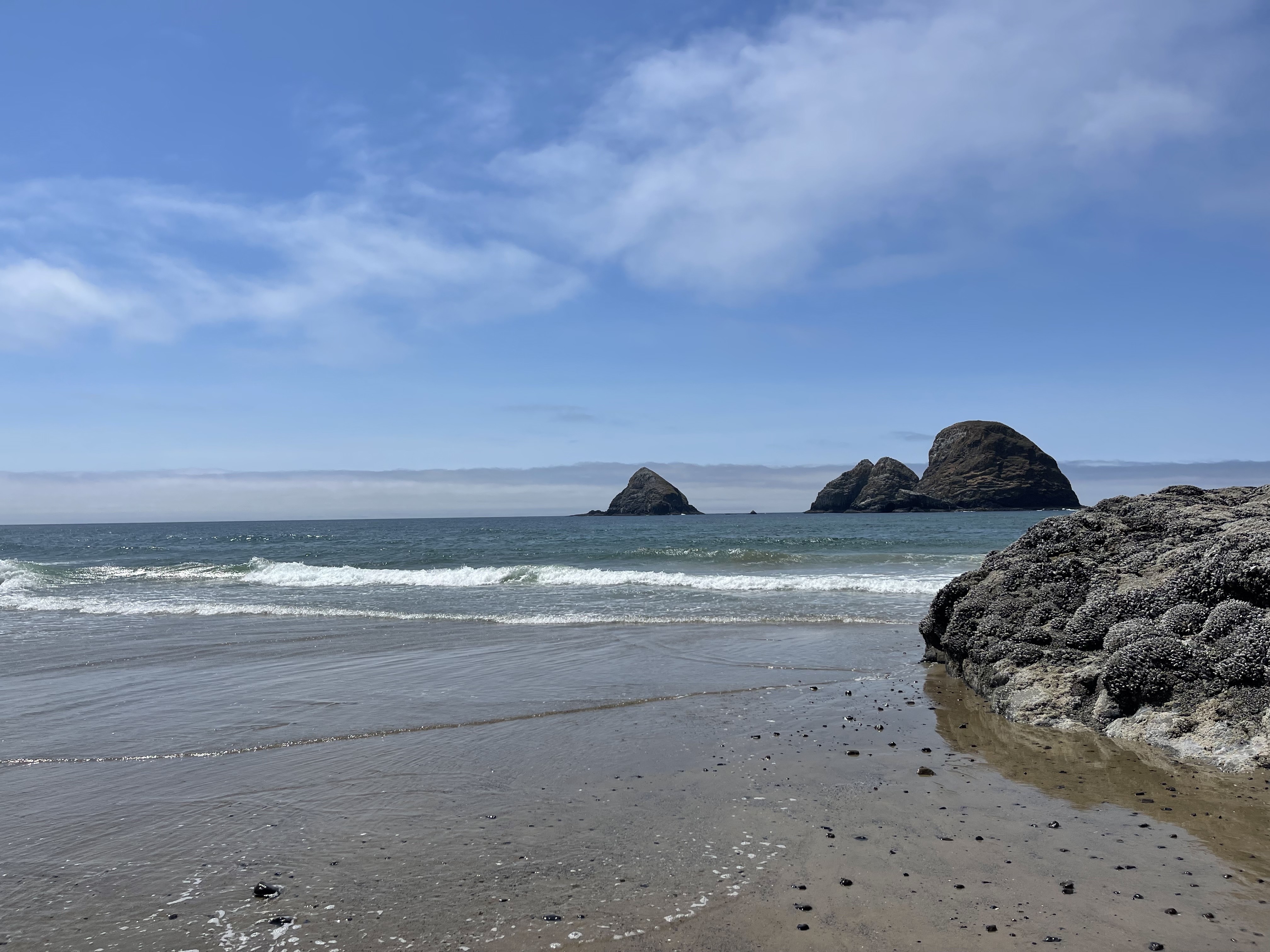
Oregon coast putting on a glorious show. (June 2023)

In the Eleventh Hour

In the eleventh hour,
your girlfriends come
to hang the final doors
in your soul.

They know it is your funeral,
your wake.
The death of so much you have built
and known.

You know that’s
how it will be when you die–literally–
or you pray, or wish it to be so,
women and men surrounding you.

Understanding you need
to build this one last thing before this death,
they come with drill bits,
and toolboxes,

and dirty jokes,
and Beyoncé ballads.
You’re *Drunk in Love*
together in the night.

They come with highly
absorbent towels
and borrowed vacuum cleaners
because they know

you need to laugh and cry
at the same time.
They do the same.
It’s no coincidence when

you look down at your watch,
it’s eleven twenty.
And then you clutch your heart
as if you could offer it beating

out of your chest
to show them
how much this grand act
of love matters.

In the eleventh hour,
you call your guy-friend
and desperately ask him for
a recommendation for a plumber.

The upstairs faucet won’t stop
leaking, like your eyes,
broken, and you call him again when
the plumber tells you the only fix

is to drill through the wall
behind the tub to replace
the valve. Your friend gives you the okay,
and the world is made right for that moment.

Another friend, a man, gifts
you a ring, a broken piece of turquoise
healed with gold, Kintsugi.
Mixing Urushi Laquier into your internal joinery.

Another tells you to drink the good wine
and offers you a bottle to catch
all the confusion, upset, anger, chaos,
tumult, of these tender days.

Another wraps you up
in Spring in Seattle.
God-parent to your sons
playing super-smash until dawn.

In the eleventh hour,
your friends, who are no longer young
spread the table with salmon
and homemade spice chutney

for a feast to last through the wind.
They don’t know you’ll go home
to silently sob at their magic
on the shower tiles.

Your girlfriend jumps on her bike
to ride with you through the
rainstorm, sunshine yellow cut-leaf balsam
root punctuating each meadow.

The rain, the sun, the rich
smell of the greening earth
make you laugh with joy,
woop with pleasure over the berms

Revel in the living of it as
they’ve each given their day, their night,
precious moments of their one precious life,
to be with you, to cradle you,

to eat *Thunder Cake** and salty tears together.
It will never be final or forgotten,
this Gift.
The fact that they knew

and understood the challenge
and all stepped in
with Windex and mops
with arms outstretced

Ready to hold you
as your once-life died
and you were made anew.
You, free entirely

-MM

“In the Eleventh Hour” has to do with ambiguous grief and the power of others to help heal us in our deepest darkness and pain. You see, our society honors and marks certain types of grief, specifically the death of a loved one. The death of a partner, parent, child, sibling, or close friend presents the mourner with its own unique fire, dragons, daemons, and oceans of grief. 🌊 But some griefs in our culture do not have specific metrics or physical markers. These bereavements may be losing someone to dementia, substance abuse disorders, divorce, familial estrangement, watching someone slip away in mental illness, or leaving our religion or faith origin. When someone dies, we generally mark their grave. But when someone miscarries a baby, we often don’t have ritual to mark that grief event. The same goes for things like childhood abuse. When you grow into an adult after this abuse, who is there to mark the unimaginable path you have trod out of the way you were treated by those who were meant to be your protectors not perpetrator(s) of your worst nightmare?

I’ve found that grief is holy, sacred even. Whether you experienced an ambiguous or more direct loss through death. Human opportunities to walk through the circles ⭕️ of life and death can both teach and strain the body, heart, and soul.

When I got divorced, I sat down with Google to see if a human really could die of a broken heart. 💔 That is how bereft, how torn and sad I was. And it turns out, yes, sure enough, you can die of a broken heart. Takotsubo cardiomyopathy syndrome is the term for this condition. Your heart, in essence, cannot withstand the excess adrenaline caused by a stressful grief-induced event.

All grief has the potential to break our hearts. But, in fact, not a lot of people literally die from this condition which means that a whole lot of people who have experienced deep, great, wide grief live to tell about it. One thing that saved me in my grief was the net of love, care, catching that my family and friends spread out under me and my family. “In the Eleventh Hour” details that love.

*So worth a read. Thunder Cake, by Patricia Polacco.

The Thunder Cake Challenge! – Natascha's Palace

*Also important in this conversation, On Earth We’re Briefly Gorgeous, by Ocean Vuong.