What is the Earth? It depends on who you ask. A geologist might tick off a list of minerals and talk of earth’s molten core and crusty mantle. An astronomer might explain that earth is a heavenly body orbiting around a G class star embedded deep in a spiral arm of the Milky Way Galaxy. A farmer might tip back his hat, squat, and scoop up a measure of fertile brown soil in his calloused hand, “Dirt.” A child might reply, “My home.” Earth.
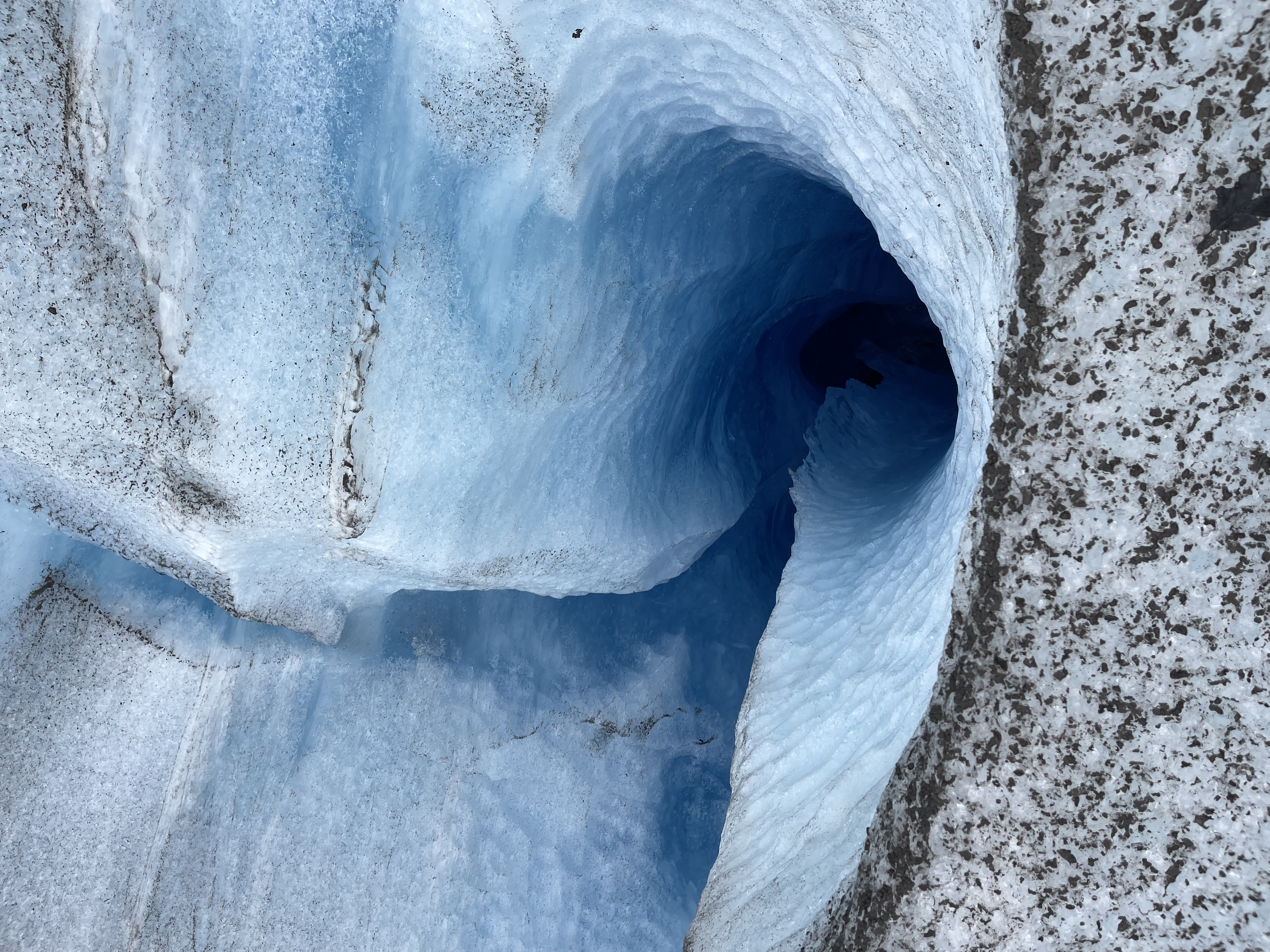
One answer comes from those who inhabit the second largest ice sheet on earth in Greenland. Greenland Eskimo lore tells of three inquisitive friends who wanted to discover the size, shape, and character of the earth. Setting off, they traveled for several days when they came to a huge ice-house. After some debate they decided to go inside, and to ensure that they didn’t become lost in its cavernous recesses they held on to one another and ran their hands along the seemingly endless stretch of wall.
On and on they walked, now searching to find the entrance through which they had come. Time passed–days, months, years– and they grew weary. Strength waned and they all began to crawl on and on into the ice. Eventually, the last of their strength spent, no longer able to crawl, two of the friends sat down and died. The last boy continued on, and finally found the entrance. He stumbled out of the frozen house and made his way back to the village of his birth. He was now a very old man. He told his people, “The earth is simply a very big ice-house.”
——
Melt
by Megan Dicksonthings melt like banana
popsicles on hot sidewalks
hearts at the cuddle of
a tender puppy’s nuzzle
sun as it sherberts into sunset,
dreamy scoops of carnelian, fuchsia, crimson
water being sublimated into
sediment, becoming sludgy mud
metal silver when heated to one thou-
sand seven hundred and sixty-three degrees
falsity as you live in truth in the world
as it is, not as you wish it to be
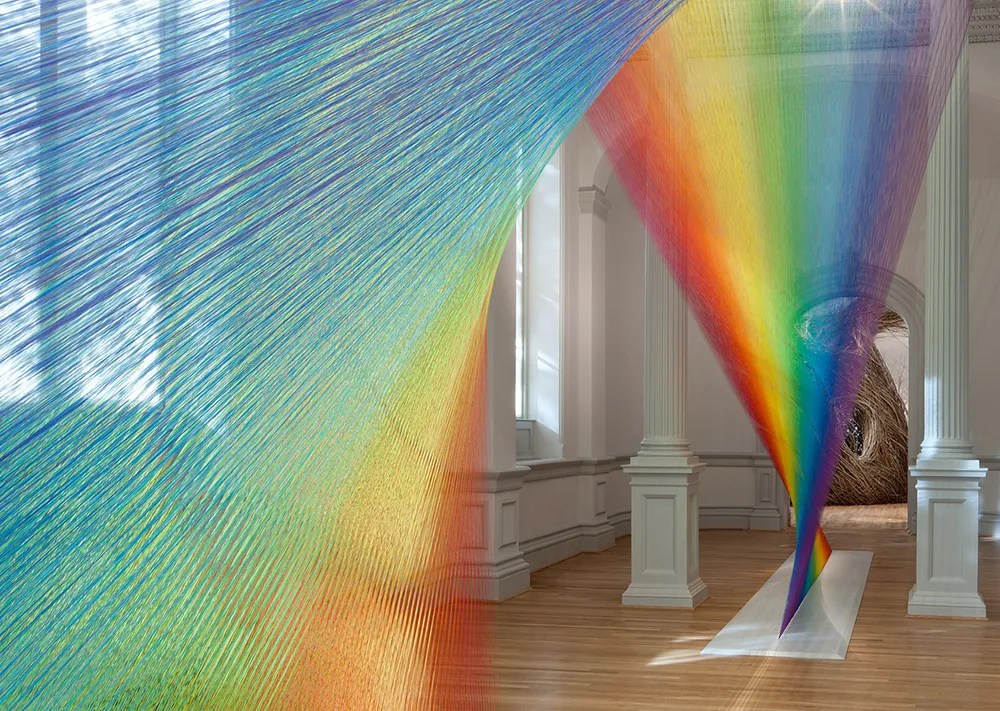
light refracted and gloriously dispersed
through water into the entire color spectrum
butter bubbling, sizzling in the fry
pan in anticipation of the next repast
bodies into one another, warm
with the savior-vivre of desire
——
Gerwingk was the first glacier my children ever touched, but I hoped it wouldn’t be their last. Three years later, summer 2022, we drove up through Canada across the Alcan and down into Southeast Alaska. It felt like an in-depth glaciology lesson. “Ways of glaciers 1010 CRN 9110297.” If you had looked at the area from a topographic map that highlighted the icefields we drove through it was clear the route was stippled with thousands of glaciers; consequently, glacial history and present glacial phenomenon were visible from every vantage point– ice sawn peaks, razor-spined arêtes, gorgeous blue and green high lakes, U-shaped valleys, hanging glaciers, mountain glaciers, and larger long sloping glacial plains from epochs of time gone by in Earth’s climate, glacial, and geologic history.
Our destination was once again, Skagway, Alaska. The same tiny town where I’d spent five of my seven summer seasons in AK. Cruising down White Pass in our Sprinter was surreal. It was a cold, spitting, foggy, wind-whipped afternoon. We pulled on our rain jackets and stopped at the Alaska sign as we entered the U.S. again from British Columbia. Entering town an hour later, we set up camp at Pullen Creek Park, a beautiful little camp and RV spot next to Skagway’s small boat harbor. That night, in true Northern fashion we feasted on fresh Lynn Canal shrimp, wild caught crab and halibut at Fish Co. right next to the harbor. Of all the places on Earth I’ve known and loved, Skagway still felt like home.
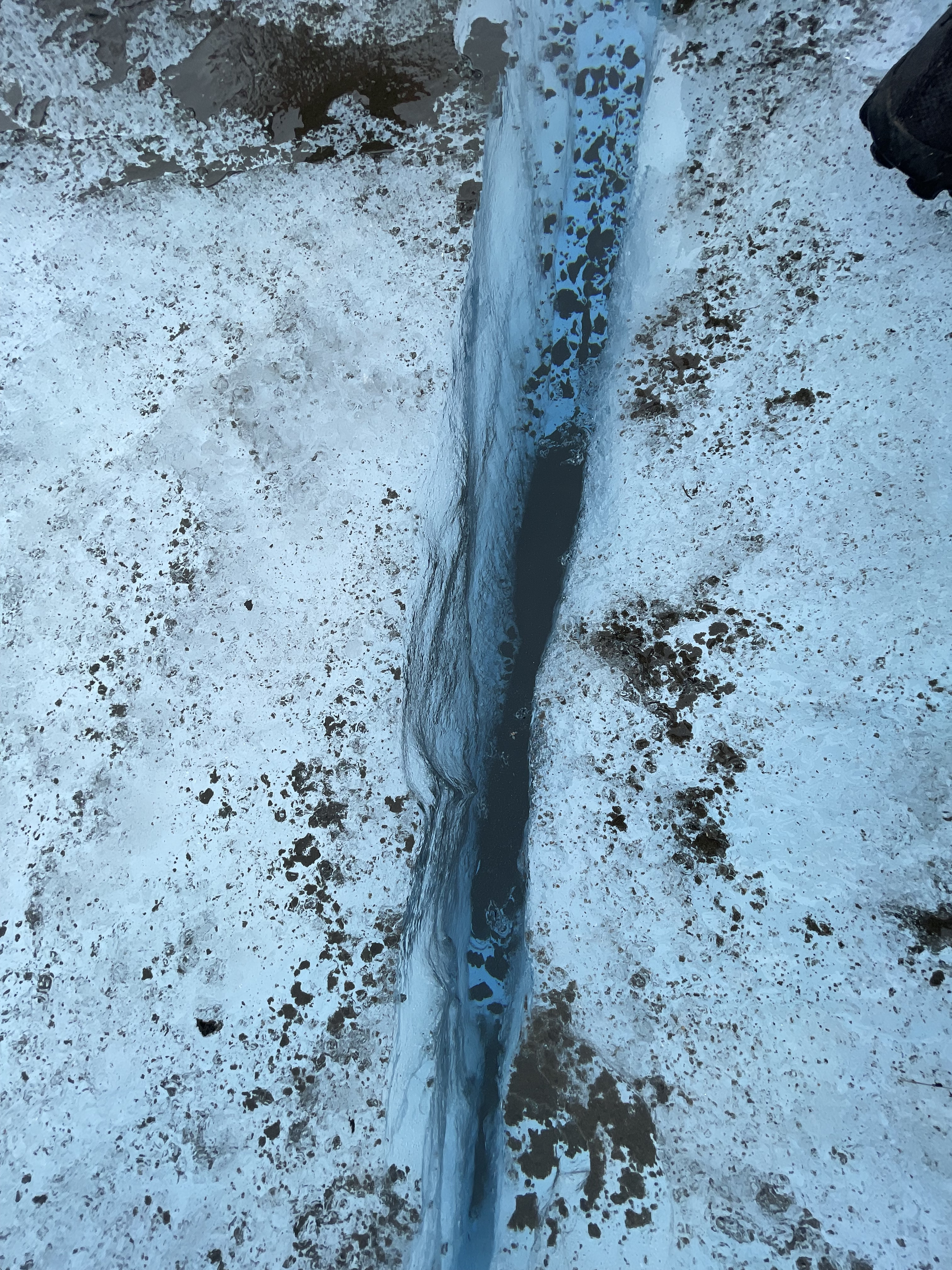
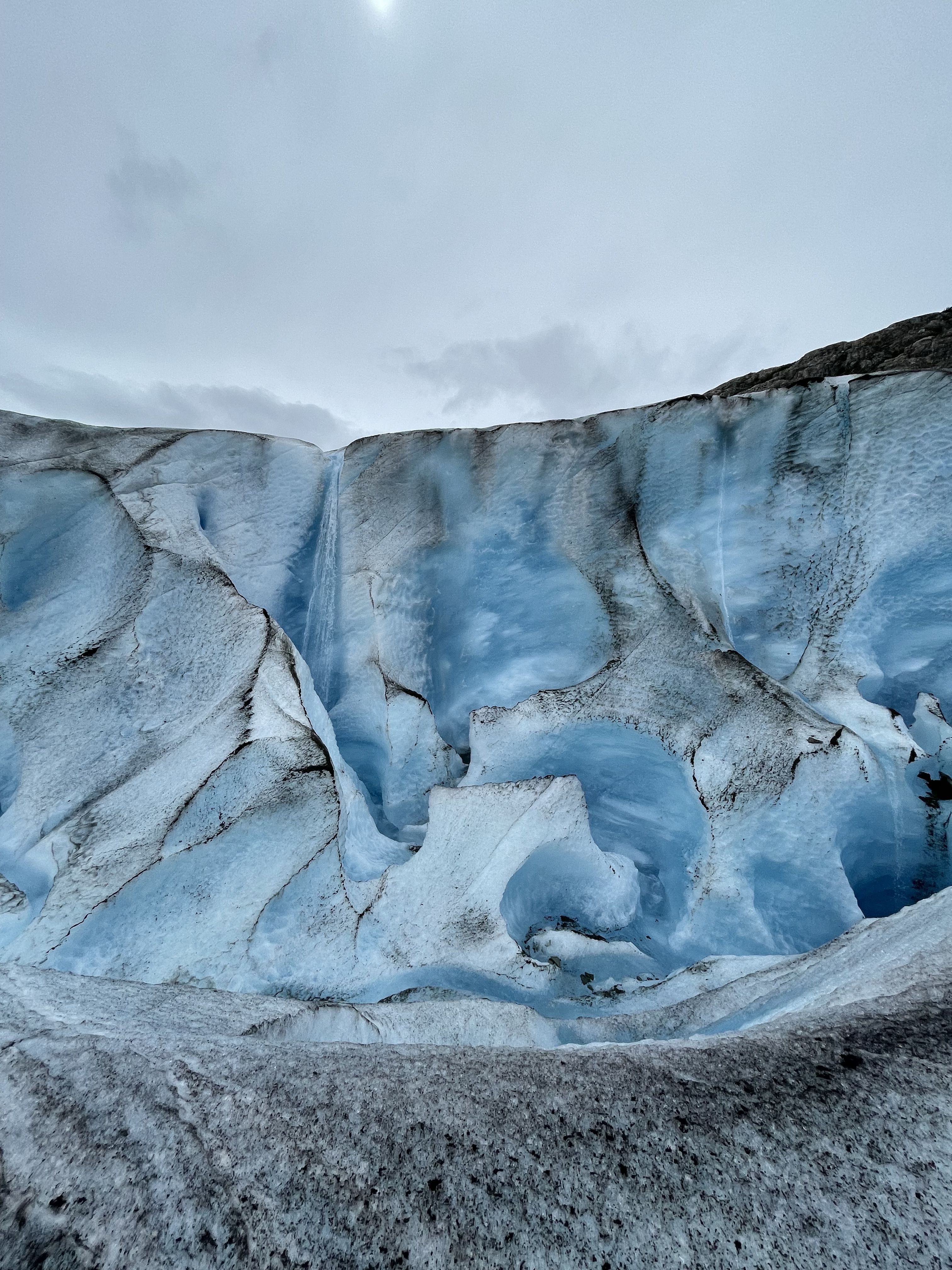
The next morning, we went in search of adventure. Alaskans do many things well, including subsist in a perpetually harsh environment, and air and water travel are among their specialties. When half of your state population lives in rural communities only accessible by flight or ferry, you get really robust systems for both. So up we went with TEMSCO helicopters to take a walk on the Juneau Ice Field the day after we arrived. The sun shone bright, the ice was blue, and watching my children drinking from a stream straight off the face of a glacier was sublime.
We landed that morning on the Meade glacier. One of 13 outlet glaciers from the interconnected plateau of ice that makes up the Juneau Ice Field. According to researcher Bethan Davies, and her associates, in an article published July 2, 2024 in the science journal, Nature Communications, the Juneau Ice Field boasted 1050 glaciers in 2019 with, “40 topographically confined outlet glaciers, which drain directly from the main plateau. Separate to this plateau are smaller ice bodies; 145 valley glaciers, 584 mountain glaciers, and 281 glacierets.”1 That sounds like a staggering number of glaciers suggesting an incredible volume of ice.
However, the question for Davies and other glaciologists is how long will glacial ice persist as global temperatures rise? What are the implications of accelerated glacial ice melt? Hypothesis aside, these are questions that no one has firm or easy answer for yet. What researchers like Bethan Davies and Mattia Poinelli2 do know is that the changes that have occurred in Arctic and Antarctic ice in the last ten years have been the most substantive positive melt outputs for glacial ice melt than in the previous 100 years combined.
Davies explains, “Work like this is crucial as the world’s glaciers are melting fast – all together they are currently losing more mass than the Greenland or Antarctic ice sheets, and thinning rates of these glaciers worldwide has doubled over the past two decades.”3 This melting has the potential to change many of Earth’s systems including raising sea levels, shifting ocean currents, displacement of animal species, and other changes to the cryosphere that threaten to destabilize earth’s weather patterns, ecology, physical and human geography.
On this warm, July day, standing on the back of the Meade Glacier, none of these realities feel very pertinent. But it’s these kinds of questions which will undoubtedly be passed on to my boys and their children. Generations of humans who will have to work out complex climate shifts if we are unwilling to thoughtfully approach questions of climate change while we, too, are residents of Earth. Truly, we may not have started the fire, to give Billy Joel a worthy nod. Earth’s climate systems have shifted many multiple times before the first humans evolved into the sentient creatures we are today. But running, hiding, and choosing an apathete’s approach to our environment doesn’t strike me as very efficacious, either.
——
——
Locals in Hope are fond of asking, “What’s the best thing about Portage Valley?” Quickly they’ll reply, “Anchorage in your rear-view mirror.” If you happen to leave Anchorage safely behind, you won’t have trouble figuring out which way to go. Just take The Road. The Road runs northeast along Knik Arm of Cook Inlet toward The Great One, Denali, and also escapes to the southeast, along Turnagain Arm of Cook Inlet.
Ironically, the Hope Highway dead ends just past the quaint little restored mining town. This little town has known its share of cataclysmic events. The 1964 earthquake created a tsunami that engulfed part of the town, sloughing it powerfully into an extended tidal basin. Now the still-tiny town really does live by the tourist season boasting a “gold panning experience,” salmon fishing in Resurrection Creek, and during some summers a glass blowing class. Most of the residents live there only part-time or work in Anchorage to make ends meet.
Not only do Alaskans in Hope, and elsewhere, know a thing or two about cataclysmic natural disasters and severe weather, their history is peppered with feats of conquest. Originating in the Bering Sea, the Cook inlet is named for the famous explorer Captain Cook. Not the nemesis of Peter Pan, Captain James Cook FRS, of Hawaiian infamy, had no hook. But like many great explorers of his time, he tirelessly sought the Northwest Passage, which drove him past Hope, not yet a dot on any map in 1778.
Traveling up the inlet toward Portage Valley, Cook and his crew navigated the narrow stretch of sea in dangerously shallow waters. Rather than finding a passage of any kind, the crew quickly realized that Turnagain arm had no outlet. Strange tides, now known to have the second greatest range in the world, caused the stalwart seafarer, Cook, to allegedly yell to his mates, “Turn again! Turn again!” Tacking back and forth out of the waterway, zig-zagging as quickly as they could to return to the larger Gulf of Alaska and back to meet the Bearing Sea, and safety. Can you imagine? Some of the greatest explorers in the world came so close, but they never discovered Hope. And just like the Turnagain arm of Cook Inlet, the road to Hope ends. It dead ends.
*(This is the third essay in a selection of essays, poems, and reflections on ice, glaciers, family, love, loss, and the stunning power of the natural world as it is and also as it functions to support human life. Previous essays include Hope (Alaska), and Hope (and Ice). All words and images unless otherwise noted are my own.)
- Accelerating glacier volume loss on Juneau Icefield driven by hypsometry and melt-accelerating feedbacks http://Accelerating glacier volume loss on Juneau Icefield driven by hypsometry and melt-accelerating feedbacks ↩︎
- “Ice-Front Retreat Controls on Ocean Dynamics Under Larsen C Ice Shelf, Antarctica” https://agupubs.onlinelibrary.wiley.com/doi/10.1029/2023GL104588 ↩︎
- “Alaska’s top-heavy glaciers are approaching an irreversible tipping point” https://theconversation.com/alaskas-top-heavy-glaciers-are-approaching-an-irreversible-tipping-point-233811?utm_source=linkedin&utm_medium=bylinelinkedinbutton ↩︎

 Refined + Rugged