In my line of work, I get to see things And hear things That many people do not, Will not, see and hear Personal narrative: a genre Used to tell one’s story To put your truth into The World, tell your Life to the Universe Of all living things To say, to see, To be seen To listen These are very tender Moments—actions, braveries Moves—today a young man Quietly said to his classmates Boys want to be Beautiful Too, boys want to be Given flowers and trust And the opportunity, To be Vulnerable Boys want to Be seen and soft And before you scoff Please know that to put Eyes on this young man He was “normal” Which doesn’t exit But he wasn’t some standout He wasn’t crying to be Noticed in a needy, cloying Way he was sincere Brown eyes shining And serious, he said again, Boys want to break down Boys want to be treasured And saved, and tendered Boys are complex and Layered, multi-faceted And so easily shattered So easily loved Beautiful boy
Lacrosse. Image, my own.
Melt: for the hottest October on record
things melt like banana popsicles on hot sidewalks
hearts at the cuddle of a tender puppy’s nuzzle
sun as it sherberts into sunset, dreamy scoops of carnelian, fuchsia, crimson
water being sublimated into sediment, becoming sludgy mud
metal silver when heated to one thou- sand seven hundred and sixty-three degrees
falsity as you live in truth in the world as it is, not as you wish it to be
light refracted and gloriously dispersed through water into the entire color spectrum
butter bubbling, sizzling in the fry pan in anticipation of the next repast
bodies into one another, warm with the savior-vivre of desire
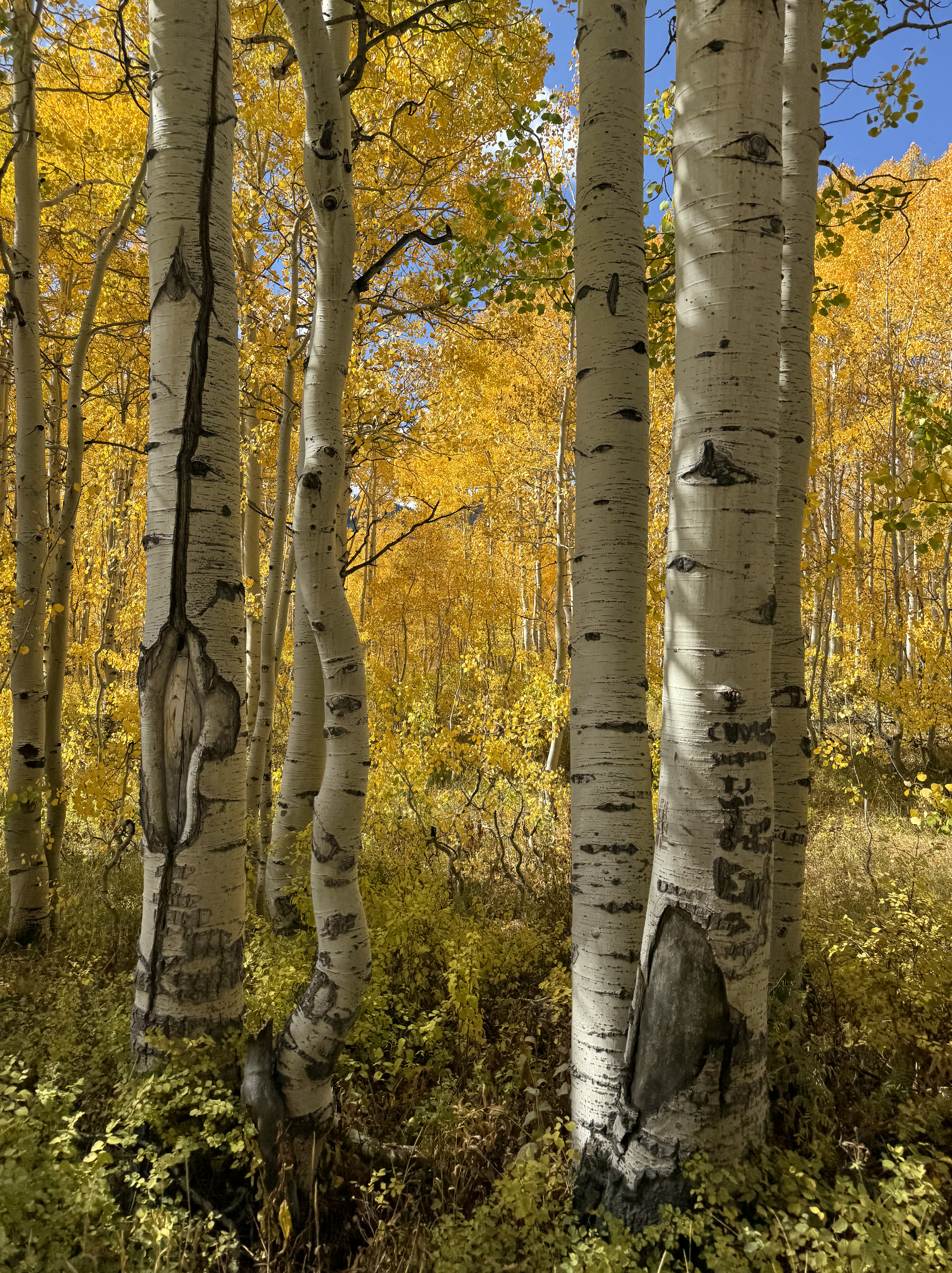
Aspen in October. Image, my own.
Sitting in Cars with Moms
Listening to music with abandon, shake it Hearing a favorite podcast in a vacuum, rapt Slumping over the steering wheel, emergency Crying, tears pouring down cheeks, salty Praying as if there is no tomorrow, apocalypse Laughing raucously with a friend on the line Changing the ka-billgionth diaper on the seat Resting the eyes at the thought of dinner, cook Wanting for a touch a hug a support, embrace Kicking back the seat for a true nap, snooze Reading a book while a child is at music lessons Waiting for babies in the carpool line, patient Scanning a prescription before returning to sickness Sipping a drink in silence while ruminating, Pondering the existential crises of humankind Yodeling to an Oktoberfest hit, hot 100 Brushing back the hair, mustering a smile, love
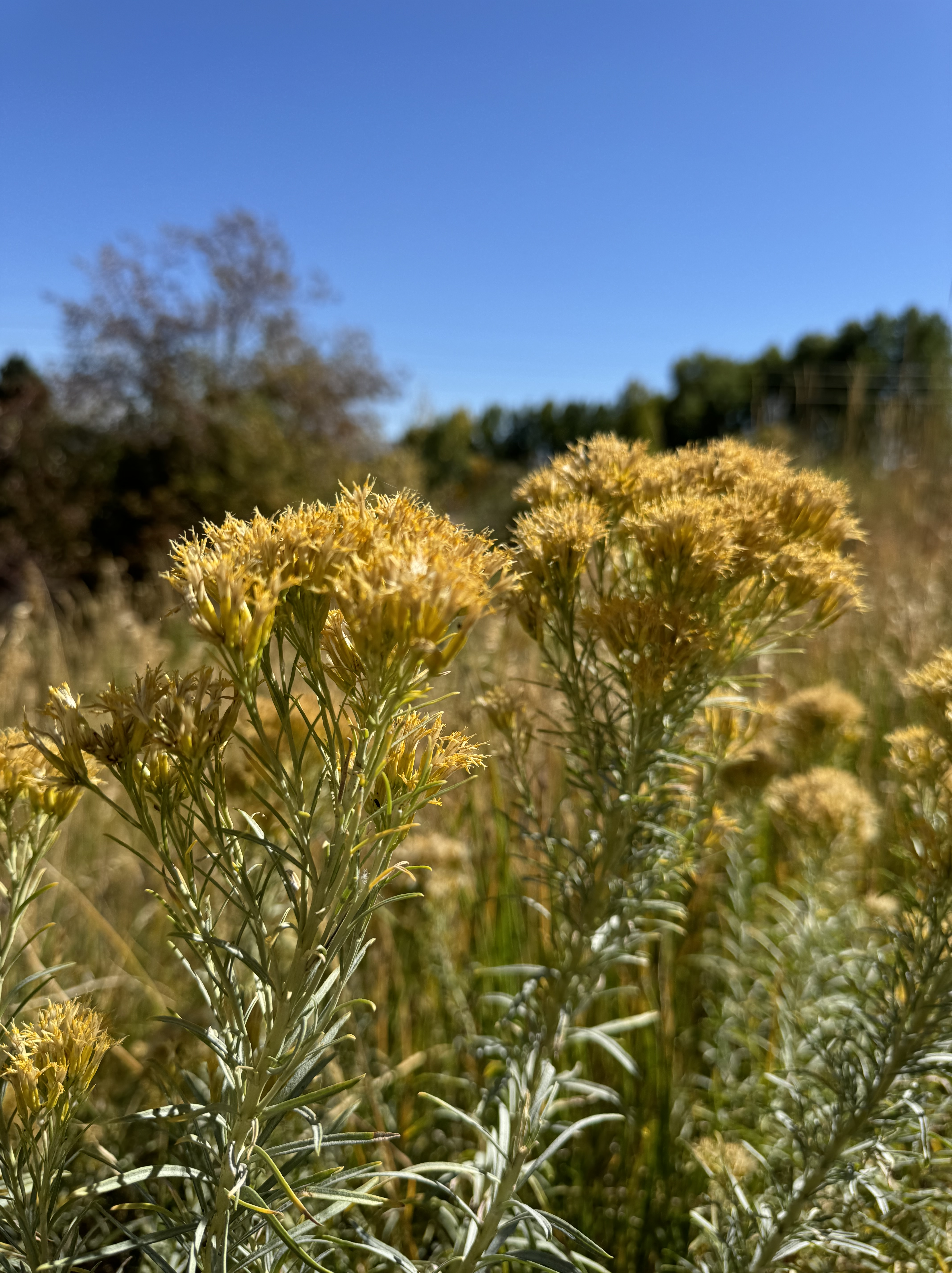
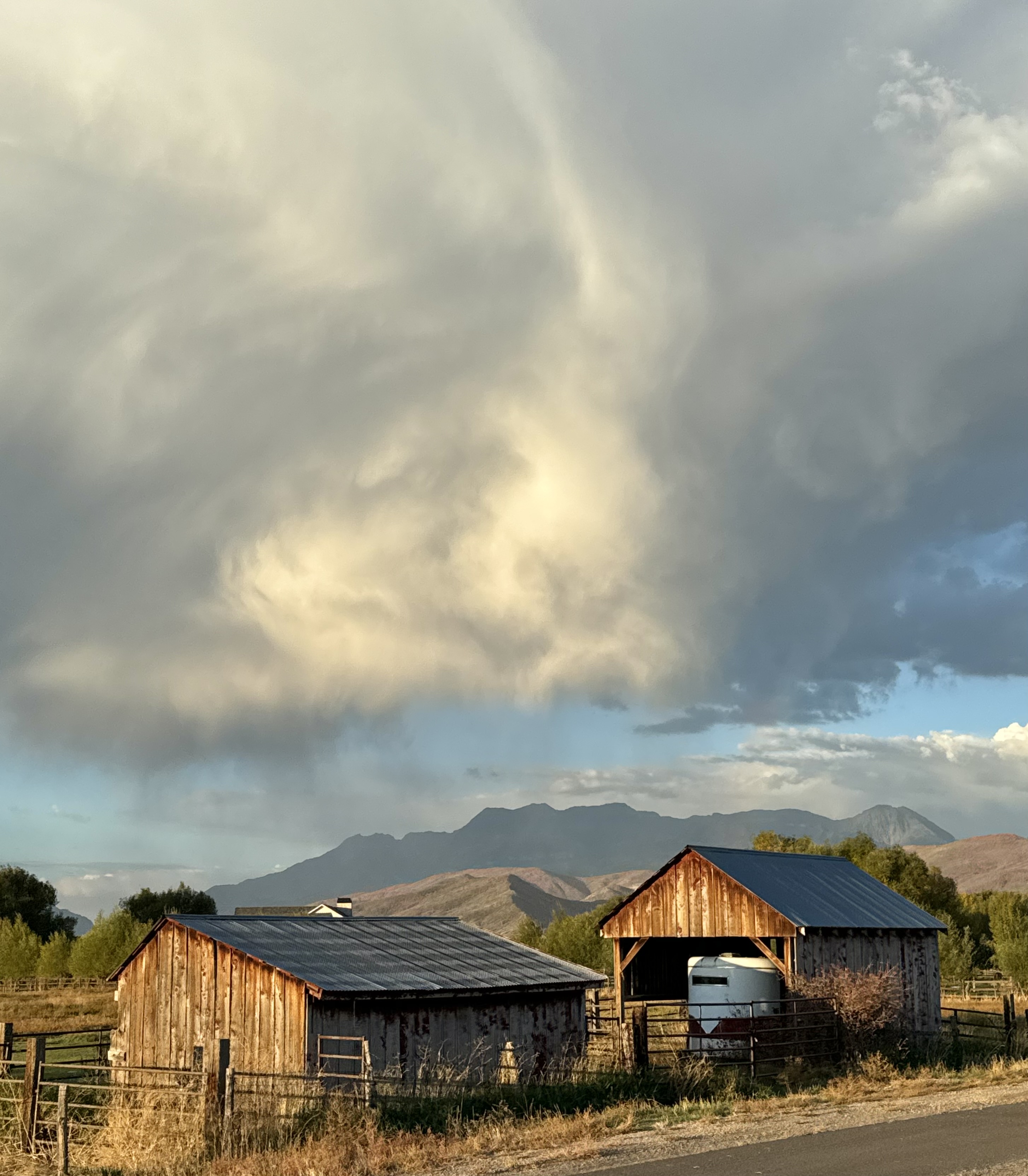
Rabbit Brush. Image, my own.
Hope Feathered in Me Today
Rose like an owl in the dark of night. Off on an important measure. A simple key into what is Take no more than you give.
On this day we celebrate The now— the moment— what is As it is what we have to celebrate Looking into the moon-face of our children
Listening to their dreams. Holding a lover after a frozen lamp-lit tramp Into the pitch-dark night Drawing lines across a page,
A stone, a landscape to remember Each leaf outlined, sepia veins, Each intricate brace of existence a Falling into one another– hope
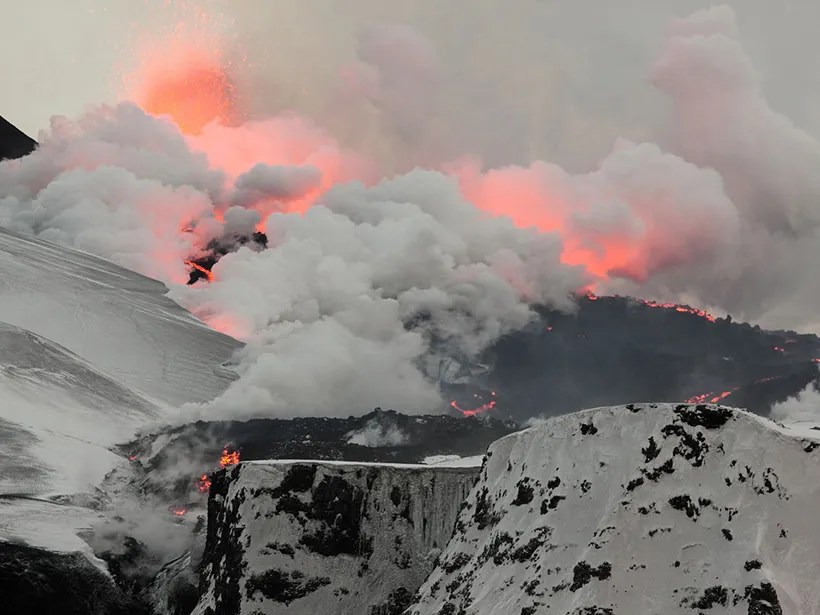
Scientists used white plumes of steam like these to track lava from the 2010 Eyjafjallajökull eruption as it melted the glacier. Credit: Boaworm, CC BY 3.0
——-
Eschatology by Megan Dickson
Life took us to the edge of the known universe
this brink, this precipice, on a red dirt plateau, all rust-verged and jagged, like a tear in heart tissue, like broken bone projecting through soft skin.
skin, bone, sinew often don’t break cleanly so there, on that terrifying cliff, we looked out into the blackness and saw that it was our own
dotted with infinite, swirling stars, nebulous arms of our galaxy, folded across that night, that nothing. we realized the instant we stepped to the fathomless limit
all the light we carried in our core could somehow save us, from this end. So into the starry, inky ebony we leapt, being careful to be sure that we crossed over the boundary between
everything we’d known, into every night we’d ever feverishly dreamed. this jump, this real act of self-preservation flung us into
the heart of the unknown cosmos and there we were to greet ourselves at the gates of our unknowing. we opened the tiny, golden latch on the
impossibly large, swinging metalwork gate, stepped slowly, quietly over the threshold of revelation, everything open and waiting for us in that pitchy gloam still had
to be sensed– felt, touched, tasted, smelled– not physically, but by the fingers of the formerly known soul that now bore this greater knowing. this
was not the end but the beginning. a larger excursus on the limitless infinite than we had previously known. we’ll never know if there
was only one way to this beginning– the ledge, the leap, the jump– our tiny, finite, blink of a guess gives us the idea that, no, there are
many precipices, many pinnacles, many paths to the infinite edges of the unknown into new reaches of galactic consciousness– seeing and knowing more than we
could possibly have imagined yesterday
——-
What will happen when there is no ice left in our house? What will the warming Earth mean for humans and animals? Now, nearly twenty years from some of my most intense life experiences, travel, and living in Alaska, I finally realize that the difficulty with this moment of continuing glacial recession is that it is so very difficult for humans to push past their one-hundred-year lifespans to see beyond to the systems that shape not only our now, but our future.
I’m the first to raise my hand and express that this kind of complex information is difficult for the lay-person to process. So how do we make science, scientific facts, and continued scientific hypothesis and discovery on climate change more bite sized, more commonplace, more palatable. The ignorant me doesn’t have a ready answer for this.
Will we overheat and roast as the seas engulf us before we grasp the stunning reality that we need to move from believing that humans can harness Earth and her resources rather than humanity taking more careful notes on how Earth regulates her own systems?
Are we at the 911 phase of this journey? I scarcely think anyone knows. This summer, 2024, has felt hotter than ever. However, feelings don’t really translate into hard scientific evidence. But my “feeling” is backed up by science. July 21, 2024 was the hottest day ever recorded on planet Earth.1
——-
Fanning the yellowed pages under my thumb, the book fell open easily in my hands to the front inside cover. Plastered under a handwritten note was a sticker of a galaxy spiraling in a sea of black, and under its outstretched arms were printed the words, “Ex Libris Kenneth A. Farnsworth.” From the library of my father. He had been the one who scrawled the message above the sticker, “Mom, with love and gratitude for turning me on to this ‘good stuff’.”
Tenderly, I traced the edges of the sticker, and drew my fingers across the fading ink. This small volume was an important relic from my grandmother’s life, a testament to her love of the written word, to the way she not only relished poetry and prose but had also passed this love on to her children and grandchildren. I thought that the book looked centuries old, an age cracked spine and what looked like a hand stitched binding were beginning to peel apart leaving bits of cheese cloth, paste, and leather showing in between. The worn leather exterior bore the title, stamped in gold ink, One Hundred and One Famous Poems. The copyright read Riely & Lee 1958. I guess relic, old, and antique were relative terms.
For instance, I had mistakenly assumed that ideas surrounding the greenhouse effect, and global warming were part of “new science,” or discoveries made recently relative to my lifetime. The reverse is true. Some of these calculations dated back over a century which makes them almost archaic in my humble perspective. Some of the poets in Grandma’s book– Dickinson, Browing, Emerson, Whitman, Longfellow, Wordsworth– had lived during the time when the first scientific theories about what is now termed the “natural greenhouse effect” were being developed. Englishman John Tyndall is credited with the discovery of greenhouse gases in 1859. He drew a simple comparison, “Just as a dam causes a local deepening of the stream, so our atmosphere, thrown as a barrier across the terrestrial rays, produces a local heightening of the temperature at the earth’s surface.” This wasn’t new science it was old news.
On page 81, Lucy Larcom’s poem titled, “Plant A Tree,” sounded like a worthy credo for an early American environmentalist. She had died just one year before Swedish chemist Svante Arrhenius began testing his theories that coal burning was changing the character of earth’s atmosphere. Larcom wrote, “He who plants a tree… Plants a hope.” In 1894, a year after Larcom’s death, Arrhenius hoped to determine the effect on earth’s climate in the unlikely event that greenhouse gases like carbon dioxide emitted from coal burning ever doubled. His conclusion: if the greenhouse gases doubled, earth’s temperature would rise.
So if basic climate science isn’t new, why has it taken such a long time for humans to perceive, address, or pay attention to these warnings from scientists? The answers are certainly multi-layered: the relatively short time-span of human life, the heated politicization of climate change, the fact that scientific knowledge is not based on speed but on thoughtful interrogation, the fact that we know that Earth has experienced many climate epochs and mass extinctions in its deep past. Climate scientists including glaciologists, often ask very specific questions of climatic change in very narrow systems. Another reason may be that it can be very difficult to determine when humans should intervene in their environment.
In fact, an article in The Atlantic2 this July, offers some insight and ideas about human intervention into glacial preservation, in short, geoengineering. Ross Anderson interviews Slawek Tulaczyk about his projects on Thwaites glacier in Greenland and on the Western Antarctic ice sheet where he has come to believe that one of the only ways that ice, and perhaps Earth, can be saved from ‘catastrophic’ sea-level rise is to give humans more time to grapple with climate change; therefore, Tulaczyk proposes that humans attempt to stop ice sheet from floeing. His hypothesis and process go well beyond all geoengineering feats that have been attempted on Earth this far. In lay terms, Tulaczyk suggests that we pump water out from underneath large glacial ice sheets in hopes that they will readhere to the underlying bedrock. Tulaczyk believes that humans could keep massive ice shelves intact, and in essence, keep them from separating, melting, and causing sea-level rise.
There on my bed, a weird quantum meeting took place. I imagined Robert Frost listening to these glaciologists, then returning home to send the Intergovernmental Panel on Climate Change (IPCC), President Jim Skea, these famous lines,
SOME say the world will end in fire,
Some say in Ice.
From what I’ve tasted of desire
I hold with those who favor fire.
But if it had to perish twice,
I think I know enough of hate
To know that for destruction ice
Is also great
And would suffice.
Fire, ice, ice, fire. From first-hand Northern climate immersion, I would still have to go with the first. I’d say fire.
Geldingadalagos, Eruption at Geldingadalir Iceland, 2006, credit: Mangus Johannsson
——
Two days after my grandmother’s funeral, my fingers brushed the soft sheen of one silk square of quilt. Bright mauve lilacs, butter daffodils, and blush sweet peas undulated across the small cubes of fabric. I drew a cubed piece of leopard print fabric to my nose, hoping to catch even a faint breath of her. A gaudy half-moon of colorful Klein blue silk shone in front of me masking the neutral brown tones of the living room carpet in my parents’ home in Duchesne, Utah.
She would have worn any one of these silk creations anywhere. That was the best part. Sure grandma had the shirts that were reserved for church, but it was just as common to find her out behind the house in the garden sweating under a wide blue sky, a broad brimmed straw hat, and a silk shirt splashed with brazen colors clashing in contrast to the hue of her pants. Perfectly garish.
My sisters and I quietly continued our work. Grabbing a shirt from the silky mound behind me, this one a deep emerald green I remembered how at Christmas she had once worn it with a pair earrings stuck through the collar her idea of “jazzing up” an ensemble. Ostentatious octogenarian that she was, we were cutting all of her shirts into quilt squares, though no one in the family, children or grandchildren, had ever made a quilt.
There were plenty of decisions surrounding her death that caused familial disagreement– her obituary, her headstone, her viewing. Most of these squabbles came from the amalgam of contrasting beliefs, values, views, and lifestyles manifest in her posterity. But everyone seemed to want to hold on to these shirts and other articles of clothing sometimes so threadbare, frayed, unraveling that only a few small quilt squares could be saved.
*(This is the latest in a series of essays here on Refined + Rugged. They include: Hope (Alaska), Hope (and Ice), Hope (and Earth), Hope (and Loss), Hope (and Love). I’m exploring what it means to be human in a time of unprecedented climate change. As the world warms, and humans begin and continue to adapt to these massive climate changes in our lifetime, what will this mean for our environment, our Earth, our children, and our grandchildren. As always, thank you for reading, commenting, liking, sharing, and generally pondering these questions with me. Love, Megan)
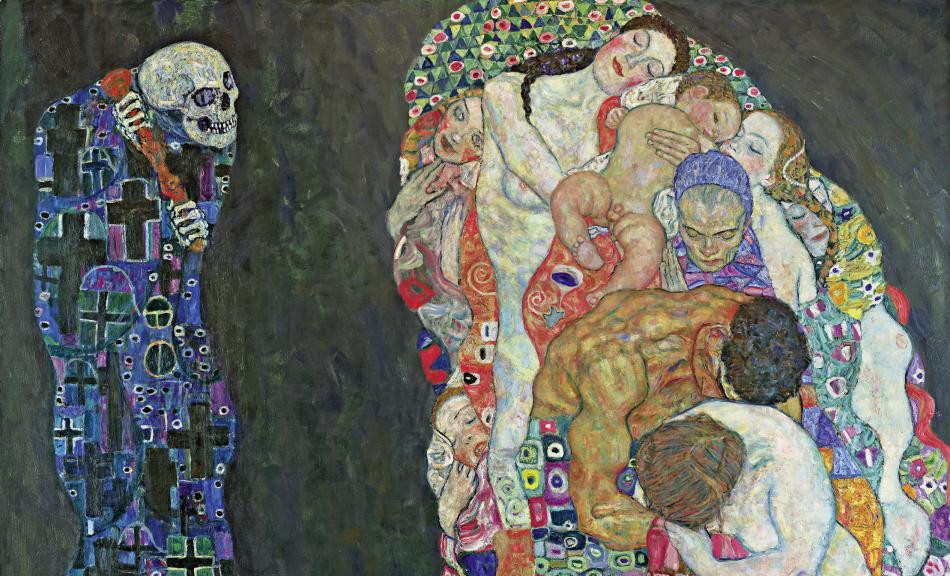
Death and Life, Gustav Klimt, 1910, Leopold Museum, Vienna, Austria. This “life” is comprised of all generations: every age group is represented, from the baby to the grandmother, in this depiction of the never-ending circle of life. The solitary, darkly dressed figure of death stands on the left.
Meade Glacier + Moraine, above terminus, July 2022. Image, my own.
What is the Earth? It depends on who you ask. A geologist might tick off a list of minerals and talk of earth’s molten core and crusty mantle. An astronomer might explain that earth is a heavenly body orbiting around a G class star embedded deep in a spiral arm of the Milky Way Galaxy. A farmer might tip back his hat, squat, and scoop up a measure of fertile brown soil in his calloused hand, “Dirt.” A child might reply, “My home.” Earth.
One answer comes from those who inhabit the second largest ice sheet on earth in Greenland. Greenland Eskimo lore tells of three inquisitive friends who wanted to discover the size, shape, and character of the earth. Setting off, they traveled for several days when they came to a huge ice-house. After some debate they decided to go inside, and to ensure that they didn’t become lost in its cavernous recesses they held on to one another and ran their hands along the seemingly endless stretch of wall.
On and on they walked, now searching to find the entrance through which they had come. Time passed–days, months, years– and they grew weary. Strength waned and they all began to crawl on and on into the ice. Eventually, the last of their strength spent, no longer able to crawl, two of the friends sat down and died. The last boy continued on, and finally found the entrance. He stumbled out of the frozen house and made his way back to the village of his birth. He was now a very old man. He told his people, “The earth is simply a very big ice-house.”
——
Melt by Megan Dickson
things melt like banana popsicles on hot sidewalks
hearts at the cuddle of a tender puppy’s nuzzle
sun as it sherberts into sunset, dreamy scoops of carnelian, fuchsia, crimson
water being sublimated into sediment, becoming sludgy mud
metal silver when heated to one thou- sand seven hundred and sixty-three degrees
falsity as you live in truth in the world as it is, not as you wish it to be
light refracted and gloriously dispersed through water into the entire color spectrum
butter bubbling, sizzling in the fry pan in anticipation of the next repast
bodies into one another, warm with the savior-vivre of desire
——
Gerwingk was the first glacier my children ever touched, but I hoped it wouldn’t be their last. Three years later, summer 2022, we drove up through Canada across the Alcan and down into Southeast Alaska. It felt like an in-depth glaciology lesson. “Ways of glaciers 1010 CRN 9110297.” If you had looked at the area from a topographic map that highlighted the icefields we drove through it was clear the route was stippled with thousands of glaciers; consequently, glacial history and present glacial phenomenon were visible from every vantage point– ice sawn peaks, razor-spined arêtes, gorgeous blue and green high lakes, U-shaped valleys, hanging glaciers, mountain glaciers, and larger long sloping glacial plains from epochs of time gone by in Earth’s climate, glacial, and geologic history.
Our destination was once again, Skagway, Alaska. The same tiny town where I’d spent five of my seven summer seasons in AK. Cruising down White Pass in our Sprinter was surreal. It was a cold, spitting, foggy, wind-whipped afternoon. We pulled on our rain jackets and stopped at the Alaska sign as we entered the U.S. again from British Columbia. Entering town an hour later, we set up camp at Pullen Creek Park, a beautiful little camp and RV spot next to Skagway’s small boat harbor. That night, in true Northern fashion we feasted on fresh Lynn Canal shrimp, wild caught crab and halibut at Fish Co. right next to the harbor. Of all the places on Earth I’ve known and loved, Skagway still felt like home.
The next morning, we went in search of adventure. Alaskans do many things well, including subsist in a perpetually harsh environment, and air and water travel are among their specialties. When half of your state population lives in rural communities only accessible by flight or ferry, you get really robust systems for both. So up we went with TEMSCO helicopters to take a walk on the Juneau Ice Field the day after we arrived. The sun shone bright, the ice was blue, and watching my children drinking from a stream straight off the face of a glacier was sublime.
We landed that morning on the Meade glacier. One of 13 outlet glaciers from the interconnected plateau of ice that makes up the Juneau Ice Field. According to researcher Bethan Davies, and her associates, in an article published July 2, 2024 in the science journal, Nature Communications, the Juneau Ice Field boasted 1050 glaciers in 2019 with, “40 topographically confined outlet glaciers, which drain directly from the main plateau. Separate to this plateau are smaller ice bodies; 145 valley glaciers, 584 mountain glaciers, and 281 glacierets.”1 That sounds like a staggering number of glaciers suggesting an incredible volume of ice.
However, the question for Davies and other glaciologists is how long will glacial ice persist as global temperatures rise? What are the implications of accelerated glacial ice melt? Hypothesis aside, these are questions that no one has firm or easy answer for yet. What researchers like Bethan Davies and Mattia Poinelli2 do know is that the changes that have occurred in Arctic and Antarctic ice in the last ten years have been the most substantive positive melt outputs for glacial ice melt than in the previous 100 years combined.
Davies explains, “Work like this is crucial as the world’s glaciers are melting fast – all together they are currently losing more mass than the Greenland or Antarctic ice sheets, and thinning rates of these glaciers worldwide has doubled over the past two decades.”3 This melting has the potential to change many of Earth’s systems including raising sea levels, shifting ocean currents, displacement of animal species, and other changes to the cryosphere that threaten to destabilize earth’s weather patterns, ecology, physical and human geography.
On this warm, July day, standing on the back of the Meade Glacier, none of these realities feel very pertinent. But it’s these kinds of questions which will undoubtedly be passed on to my boys and their children. Generations of humans who will have to work out complex climate shifts if we are unwilling to thoughtfully approach questions of climate change while we, too, are residents of Earth. Truly, we may not have started the fire, to give Billy Joel a worthy nod. Earth’s climate systems have shifted many multiple times before the first humans evolved into the sentient creatures we are today. But running, hiding, and choosing an apathete’s approach to our environment doesn’t strike me as very efficacious, either.
——
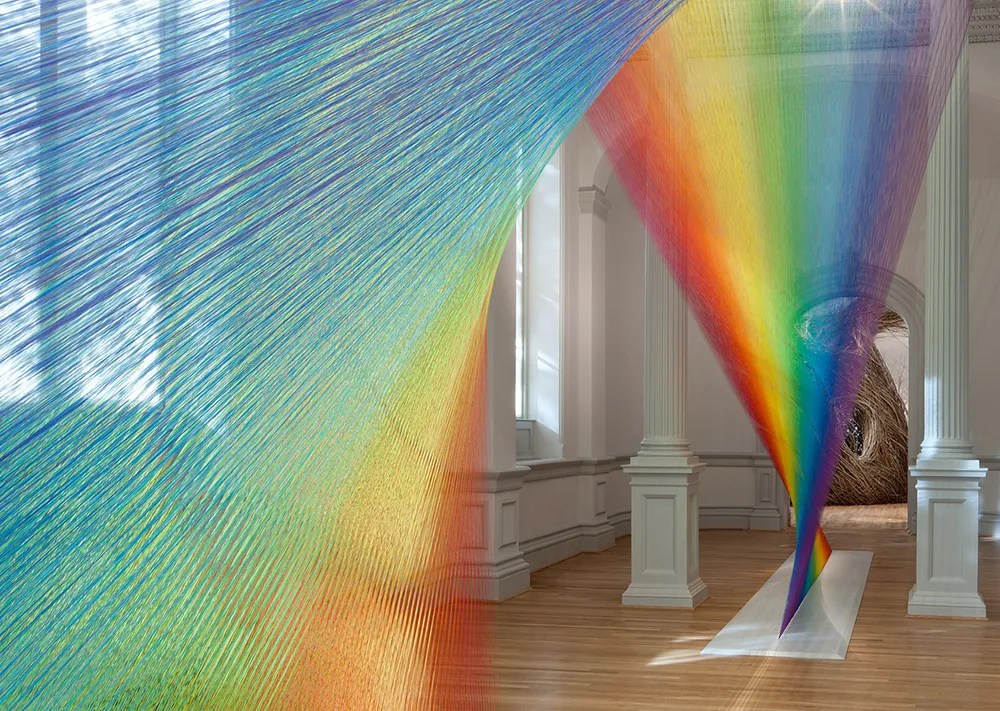
Gabriel Dawe’s work on display at the Renwick with the building’s 19th-century architectural details as a backdrop. Ron Blunt/ Renwick Gallery/ SAAM, Washington, D.C., 2015
——
Locals in Hope are fond of asking, “What’s the best thing about Portage Valley?” Quickly they’ll reply, “Anchorage in your rear-view mirror.” If you happen to leave Anchorage safely behind, you won’t have trouble figuring out which way to go. Just take The Road. The Road runs northeast along Knik Arm of Cook Inlet toward The Great One, Denali, and also escapes to the southeast, along Turnagain Arm of Cook Inlet.
Ironically, the Hope Highway dead ends just past the quaint little restored mining town. This little town has known its share of cataclysmic events. The 1964 earthquake created a tsunami that engulfed part of the town, sloughing it powerfully into an extended tidal basin. Now the still-tiny town really does live by the tourist season boasting a “gold panning experience,” salmon fishing in Resurrection Creek, and during some summers a glass blowing class. Most of the residents live there only part-time or work in Anchorage to make ends meet.
Not only do Alaskans in Hope, and elsewhere, know a thing or two about cataclysmic natural disasters and severe weather, their history is peppered with feats of conquest. Originating in the Bering Sea, the Cook inlet is named for the famous explorer Captain Cook. Not the nemesis of Peter Pan, Captain James Cook FRS, of Hawaiian infamy, had no hook. But like many great explorers of his time, he tirelessly sought the Northwest Passage, which drove him past Hope, not yet a dot on any map in 1778.
Traveling up the inlet toward Portage Valley, Cook and his crew navigated the narrow stretch of sea in dangerously shallow waters. Rather than finding a passage of any kind, the crew quickly realized that Turnagain arm had no outlet. Strange tides, now known to have the second greatest range in the world, caused the stalwart seafarer, Cook, to allegedly yell to his mates, “Turn again! Turn again!” Tacking back and forth out of the waterway, zig-zagging as quickly as they could to return to the larger Gulf of Alaska and back to meet the Bearing Sea, and safety. Can you imagine? Some of the greatest explorers in the world came so close, but they never discovered Hope. And just like the Turnagain arm of Cook Inlet, the road to Hope ends. It dead ends.
*(This is the third essay in a selection of essays, poems, and reflections on ice, glaciers, family, love, loss, and the stunning power of the natural world as it is and also as it functions to support human life. Previous essays include Hope (Alaska), and Hope (and Ice). All words and images unless otherwise noted are my own.)
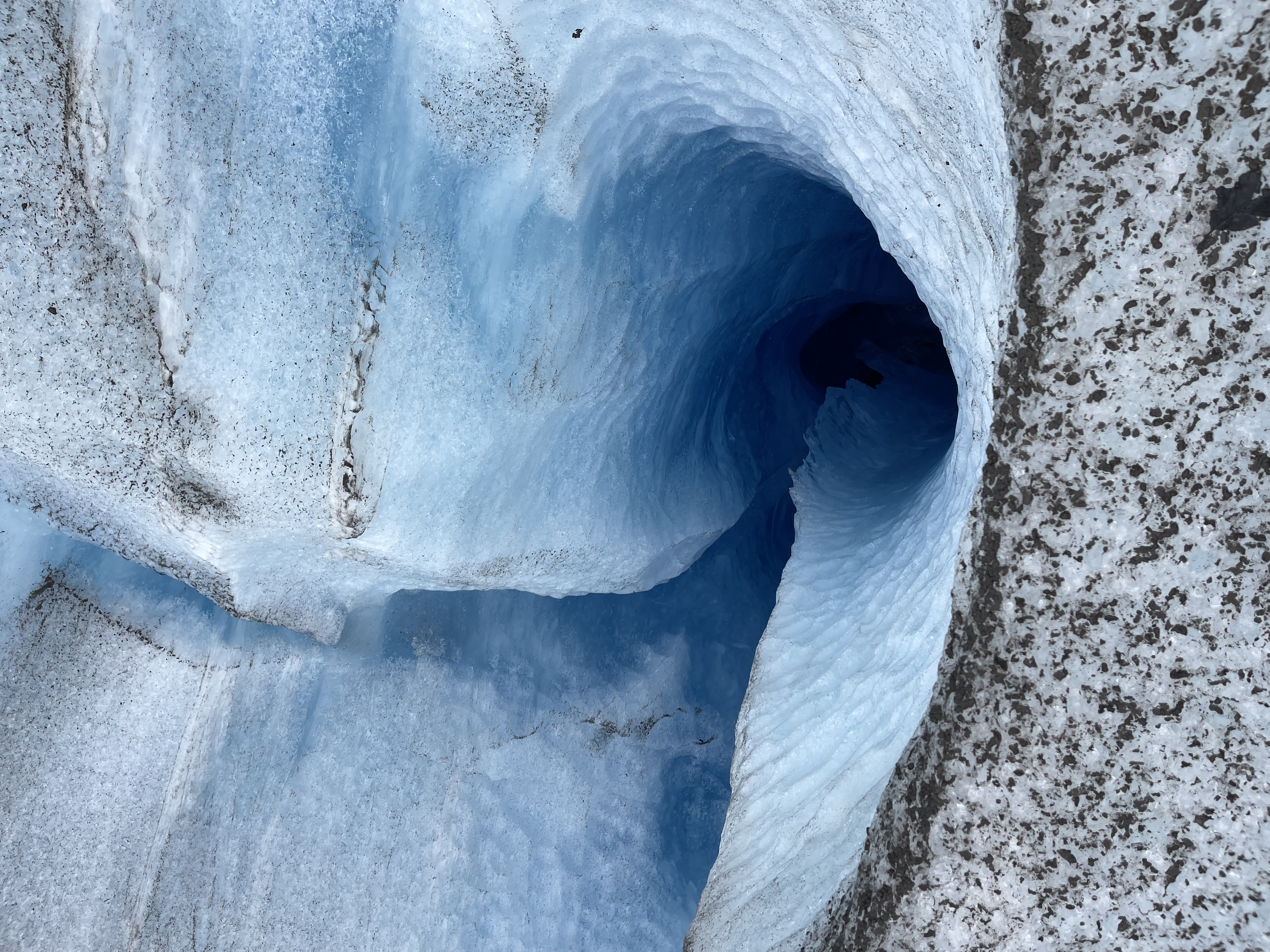
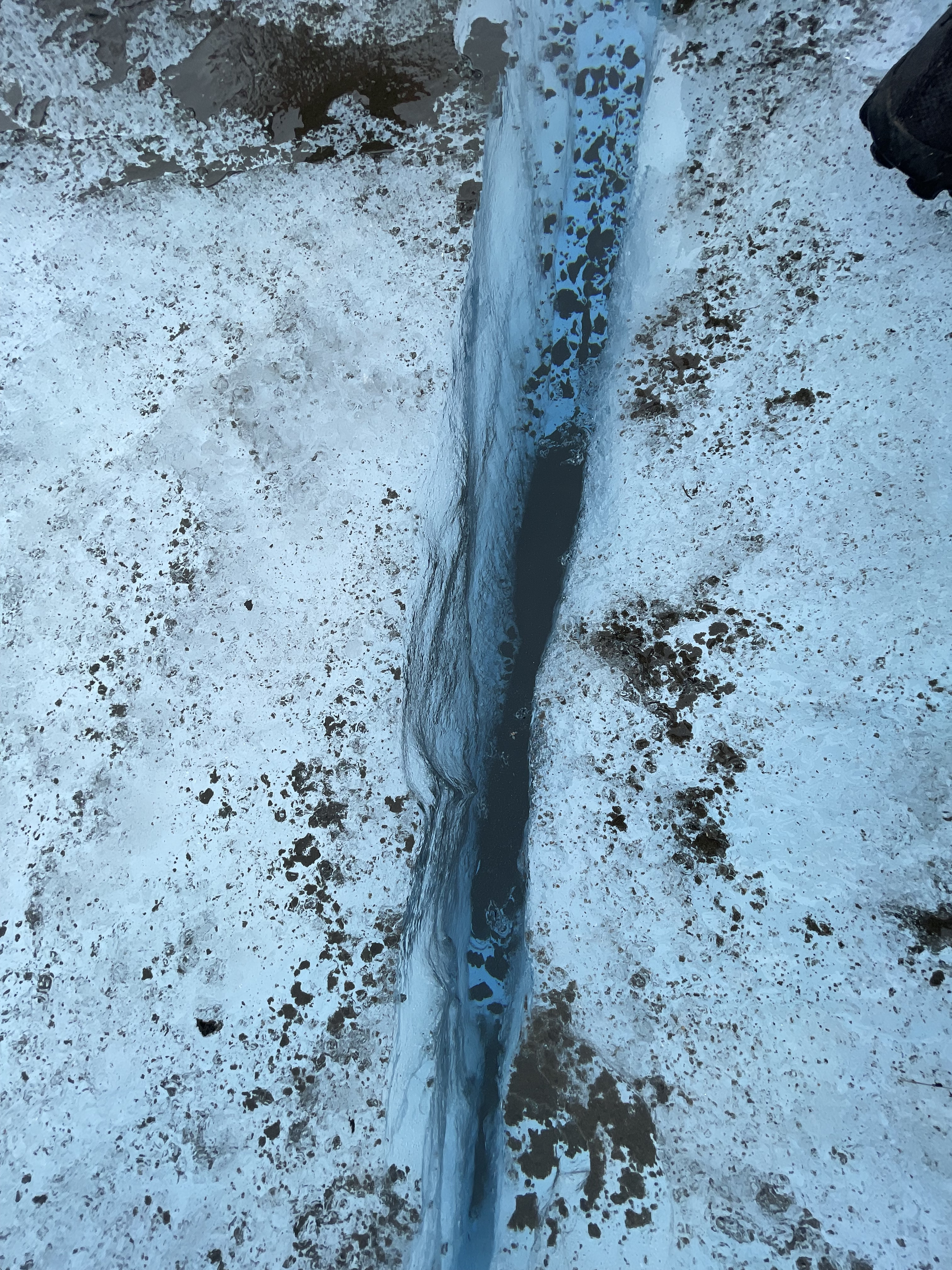
Crevasse on the Meade Glacier, Juneau Ice Field, July 2022. Image, my own.


 Refined + Rugged