
I let the receiver drop onto the cradle with a clatter. 2,642 miles from home, I was working in Skagway, Alaska, my fourth summer up North. The bright smell of May air mingled with the reality of Dorothy’s near-end. Silence engulfed me, swallowed me whole. Memory overcame me, overflowed me. I lay fetal on the hotel bed, waiting for tears to stop running over the bridge of my nose. The universe forgot me.
The phone conversation had yielded spare details. Grandma had been in the bathroom, when she had passed out. Aunt Jan heard her moan as she sunk onto the floor. Finding Grandma unconscious in the bathroom, Jan and my youngest brother Alex had helped to carry her into her bedroom and tried to revive her. After a 911 call, she had been taken to Ashley Valley Medical clinic in Vernal, Utah. Discovering she’d had a stroke, her doctor recommended that she be transported one hundred and seventy-two miles west to the University of Utah Medical Center, in Salt Lake City. She was there now in intensive care.
——-
Dying
by Megan Dickson
it was the time of dying
yet color still held,
sunflowers paused
grass, variegated green
rest was coming
the fall,
the browning leaves and roots
stems bore that truth
the mountain, dusty gray yesterday
was dressed in snow again today
pinking wreaths of clouds
and icy indigo striations
of oncoming dusk
some death is good
the power of it real
and raw, and magic
turning over seasons
the smell of fires, newly burning
——
The retreat of Portage Glacier is not an isolated event as anyone who follows climate science know. But it feels different when you are a first-hand witness as I have been witness to it all over Alaska and Canada. I rattle off a list of the names of retreating glaciers I can remember in my head: Exit Glacier- Seward; Portage Glacier, Goodwin Glacier- Anchorage; Matanuska Glacier- Palmer; Harding Glacier, Denver Glacier- Skagway; Douglas Glacier- Haines; Mendenhall Glacier- Juneau; Hubbard Glacier- Glacier Bay; Grewingk Glacier- Homer. All of them melting at an increasingly alarming rate, some as much as fifty-five feet per year. I want them to stop, halt, pause.
The scene in Alaska is not simply a norm, it is the global glacial rule– melt, recede, retreat. To reach the face of Portage Glacier now, versus the literal “Nature in Situ: A Still Life Display” that I saw at the Visitor’s center in 1988 when I was seven, guests of the park must take a boat around the far side of Portage Lake. Piles of natural gravel called push moraine often stagnate the gray glacial melt water, apostrophized with small bergs and the shrinking face of a rapidly receding glacier. Elizabeth Kolbert, in her article for the New Yorker, 2005, “The Climate Of Man”, in three parts, details a similar experience in Iceland.
Kolbert writes of seeing Svinafellsjökull, in southern Iceland, for the first time, “In the gloomy light, the glacier looked forlorn. Much of it was gray– covered in a film of dark grit.” I could picture Kolbert’s lone form, a small human staccato on the dark sweep of the barren silt field. Her body bent before the ice wall of Svinafellsjökull trying shelter her face from gusts of rain driven by the railing, merciless wind. She continued, “If I returned in another decade, the glacier would probably no longer even be visible from the ridge where I was standing. I climbed back up to take a second look.” Her heaviness met and mixed with my own.
The scientists that Kolbert interviewed regarding climate change don’t simply survey glacial surface ice, they study its core. She synthesizes, “Ice cores from Antarctica contain a record of the atmosphere stretching back more than four glacial cycles—minute samples of air get trapped in tiny bubbles—and researchers who have studied these cores have concluded that fully half the temperature differences between cold periods and warm ones can be attributed to changes in the concentrations of greenhouse gases. Antarctic ice cores also show that carbon-dioxide levels today are significantly higher than they have been at any other point in the last four hundred and twenty thousand years.” Kolbert details that evidence of the climate crisis is irrefutable.
Hope left me. Portage Glacier continued to melt, retreating into the seam in the valley it created between the Chugach and Kenai mountains. If earth’s glaciers continue to melt away at their current rate, roughly half of them could be gone worldwide by 2100. As ice melts, sea levels will rise and Hope, Alaska, may swim and then be swallowed up in the rising tide. Alaska, indeed the whole world, is emerging from the ice.
——-
The last week of May 2005 dragged by. Waiting, waiting, waiting. I listened to hear the phone call of her death. Each day her retreating spirit pressed more heavily on my reality. I couldn’t breathe. I felt like an extra in a cheesy episode of one of her favorite science fiction television shows. I could see myself turning to Star Trek’s Data, the emotionless android and saying, “Her life-force is ebbing away.” Deadpan and emotionless, he would look back at me without reply and blink twice.
I could understand Data’s blank stare. The actuality that she was dying drew a disconnect between the picture in my head and the reports that I heard over the phone from family members, Mom and Dad mostly. Mom related to how Uncle Bob sat quietly playing hymns on his harmonica on a chair next to her bed, and when he had stopped for several seconds Grandma’s hand had shot out to touch his knee. Startled, he asked, “Do you want me to keep playing?” Her fingers had lightly pressed again against his leg. He picked up the harmonica and continued on with renewed vibrato.
But the next phone call, the family would be planning the funeral service as if she were already dead. “We picked out the casket.” “We got a copy of her will.” “We talked to the funeral home.” Those weren’t things you did for the living. I could picture her body-shell lying peaked, motionless on the all-white hospital sheets, could hear the blips of monitors and her shallow, rasping breath, could smell the faint odor of purchased-in-bulk antiseptic cleanser vainly trying to cover the stench of urine and bile– dying. My stomach churned as my mother described the care center that they were planning to move her body to so that she could live out her final days in “peace.”
I desperately wanted to know what was going on in my Grandmother’s core. Was she in pain? Did she need help? Did she feel peace? Though they were with her every minute, my family had no answers for these questions. I became angry, exploded, “What the hell! Why does everyone talk about her as if she is already dead if she is still alive?! It’s gotta be one or the other. She’s either dead, or she’s alive. Which is it?” The words fell too fast for thought and traveled dead-weight across the wire. “Here. Talk to your father,” Mom said.
——-
One Art
by Elizabeth BishopThe art of losing isn’t hard to master;
so many things seem filled with the intent
to be lost that their loss is no disaster.Lose something every day. Accept the fluster
of lost door keys, the hour badly spent.
The art of losing isn’t hard to master.Then practice losing farther, losing faster:
places, and names, and where it was you meant
to travel. None of these will bring disaster.I lost my mother’s watch. And look! my last, or
next-to-last, of three loved houses went.
The art of losing isn’t hard to master.I lost two cities, lovely ones. And, vaster,
some realms I owned, two rivers, a continent.
I miss them, but it wasn’t a disaster.—Even losing you (the joking voice, a gesture
I love) I shan’t have lied. It’s evident
the art of losing’s not too hard to master
though it may look like (Write it!) like disaster.
——-
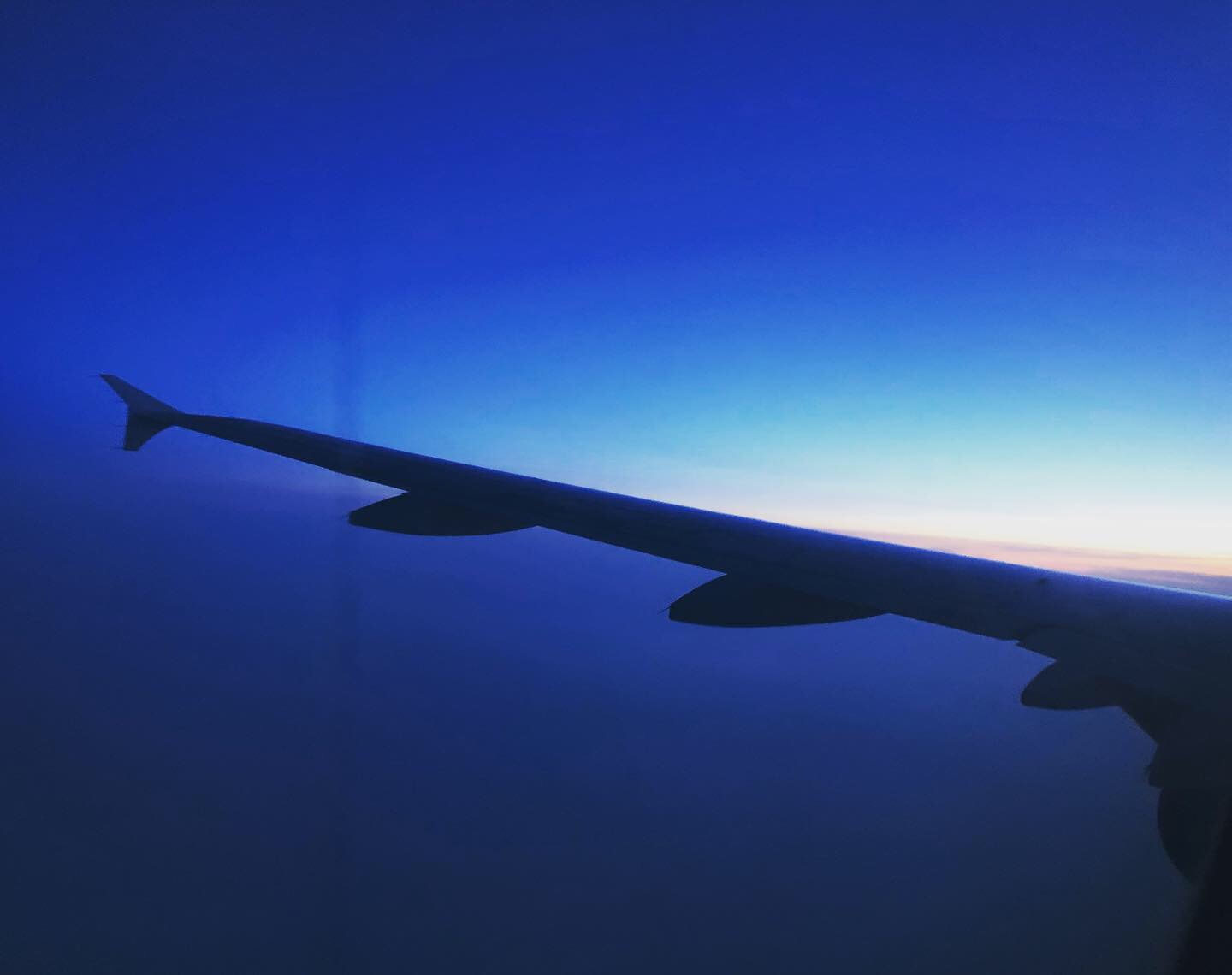
And then she was gone. I caught the red-eye, departing Ted Stevens International Airport, Anchorage, Alaska at 12:30 am, May 31, 2005. Destination, Salt Lake City, Utah. My small window framed a cobalt crown of deepening blue sky. Underscored by dying red the sunset bled into arms of outstretched orange, the purple horizon blurred the line between land and sky. The light died as I flew home to say goodbye.
*(This essay is part of a series of essay about love, loss, climate change, and what shape those experiences take on the human level. You can read my previous essays, poems, and reflections here: Hope (Alaska), Hope (and Ice), Hope (and Earth). Thank you for reading, commenting, liking, and sharing.)


 Refined + Rugged