Exit Glacier was the first to meet my lips. On a late summer day in August of 2002 my friend Jordan and I jumped into the little white 1970s Honda Accord I had purchased for six hundred dollars and headed down the Seward Highway. Leaving Anchorage, the White Rabbit skimmed and scampered over mats of thick fog arriving in Seward two hours later.
The glacier wasn’t hard to find. The directions my Aunt Martha had given me were something like, “Five miles outside of Seward, start looking off to your right. You can’t miss it, big chunk of blue ice. The turn will come up after a brown sign. You can park there and walk right up and touch the face.” So we did just that. I turned the wheel hard to the right. The little car lacked power steering, and we careered into the parking lot. Skipping to a stop, we hopped out of the car, and walked up a paved path which was at most 500 feet long.
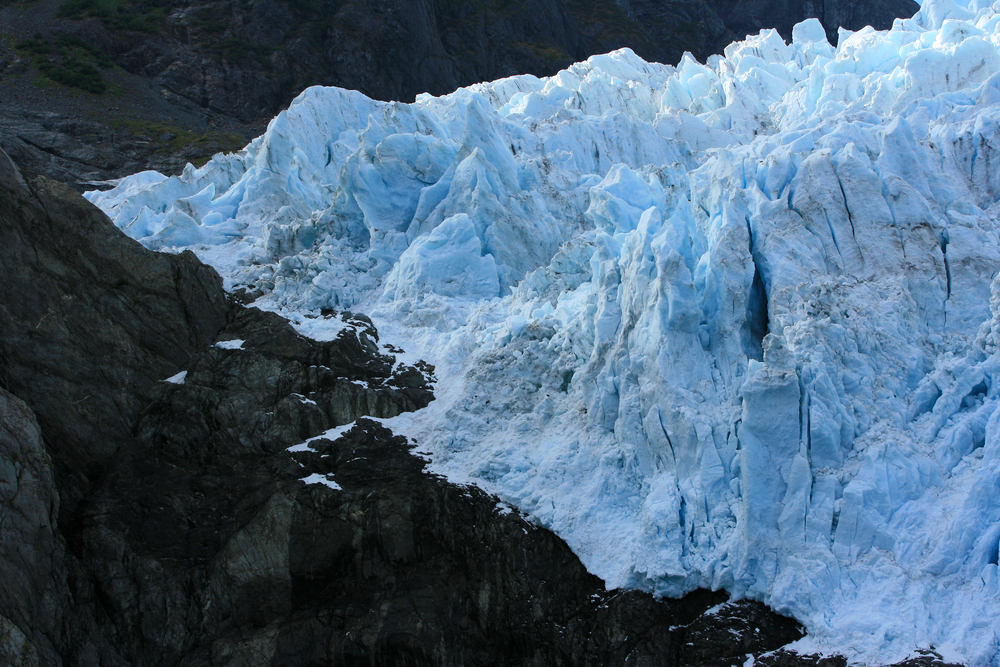
Standing in front of the enormous wall of ice, I was awe struck all over again. Time passed, seconds, minutes, maybe more, as we starred at the face of Exit’s massive ice floe. After the seemingly interminable pause, we slowly began to move closer to the glacier. I was close enough to touch it but didn’t raise my arm to do so. Motionless, I let the cool waves of air riffing off the ice caress my face. Jordan gingerly touched a polyp of blue, then pressed her whole hand against the ice.
“Kiss it,” she challenged, smiling.
I looked for a moment from the ice to Jordan, and then back at the frozen wall. I had walked across a glacier the year before, 2001, when Era helicopters in Skagway, AK, offered Holland America Tour Director’s a promo tour package which included the helicopter flight, and dog mushing on Denver glacier. I remembered squinting behind sunglasses at the incredible glare of the sun’s rays glancing off miles and miles of snow as the helicopter hovered then touched down on the glacier.
According to scientists John and Mary Gribbin, authors of the book Ice Age, I was experiencing first-hand a phenomenon known as positive feedback. The shiny white snow covering Denver glacier, the rest of the Juneau Ice Field, and the entire polar cap was reflecting the solar rays of that bright day, helping to keep earth cool. Stepping out of the helicopter, I stood atop the snow of the latest arctic winter.
One hundred plus Millenia of snowpack adding to the weight of the accumulating ice itself, this is nature’s icy version of compound interest from the Wisconsin Ice Age and the additional Little Ice Age, and it felt deceptively firm beneath my feet. This particular glacial savings account in the Juneau Ice Field had accumulated over the course of 70,000 years. Due to climate changes around 10,000 years ago the ice beneath me had ceased to compound and had begun to recede into the interglacial period the earth was now experiencing.
Later that afternoon, my musher-guide, Sarah, had taken me to the edge of their camp to see an ice fissure that had opened up just the day before. Pulling a tawny strand of hair behind her ear and peering into the dark slit, Sarah explained that they had to probe the area around and through the dog camp twice daily to make sure the ice they were camped on was relatively stable, no cracks. Sarah told me that she hadn’t ever fallen into a crevasse, but she had talked to people that had, and survived.
If I crouched down right here in front of Exit glacier, I could slip myself into the gapping crevasse which was forming between the ice and bedrock at the glacier’s base. Rather than being still and immovable, glaciers actually act more like rivers of ice than humongous stationary ice cubes. What would my journey up through the bowels of the glacier be like? Eventually, if I lay there long enough, I supposed that Exit’s fused ice would freeze me solid and carry me deep into the heart of the glacier.
In another thousand years maybe I would surface, minus a few limbs, in the medial moraine, a dark ribbon of sediment of all sizes, which flowed in a black current through the center of the glacier. I smiled at the absurdity of my fantastically imagined journey. Puckering, leaning in, the frozen tingle on my lips didn’t take me by surprise. I thought I could taste the refracted blue light.
——
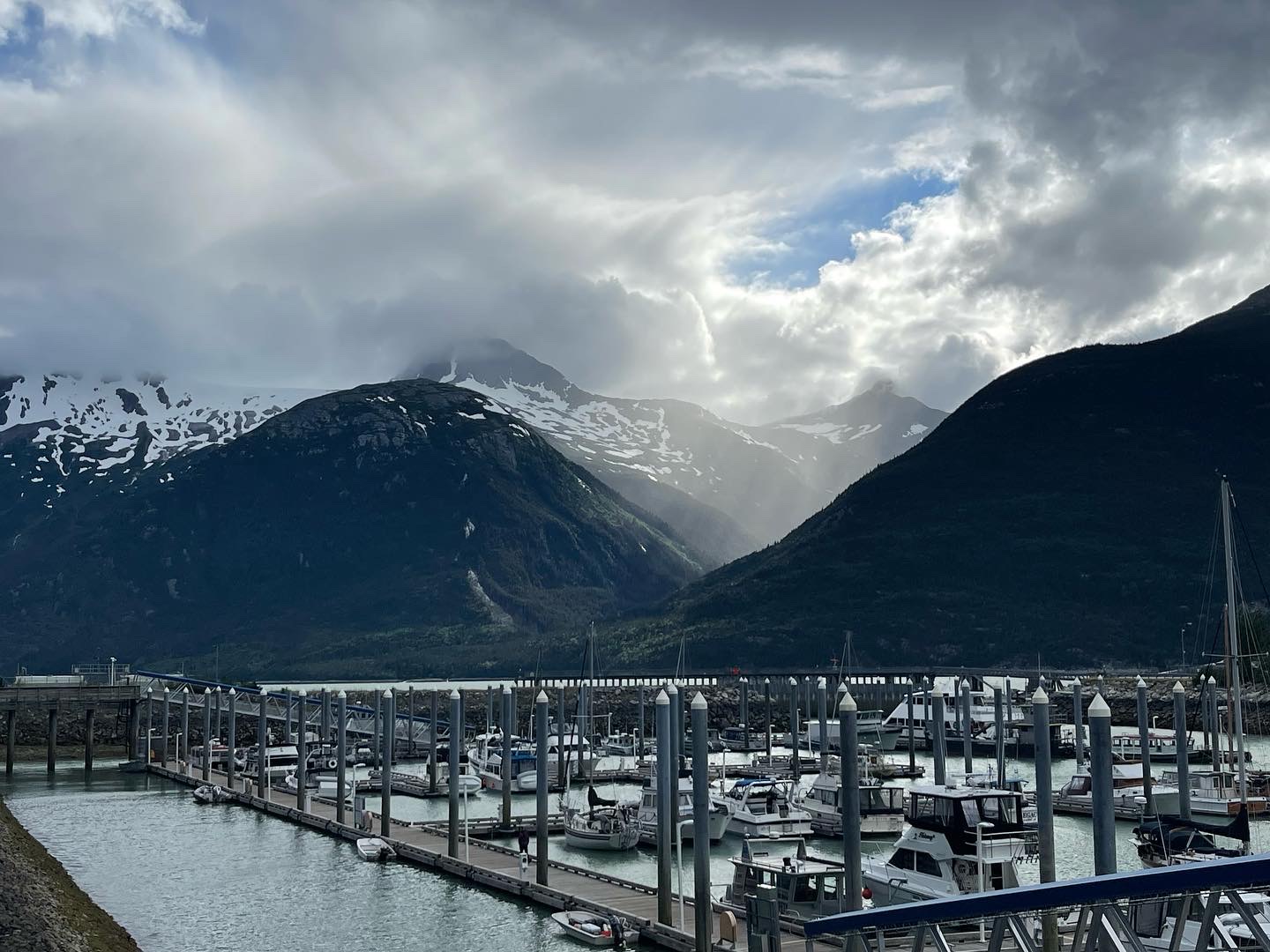
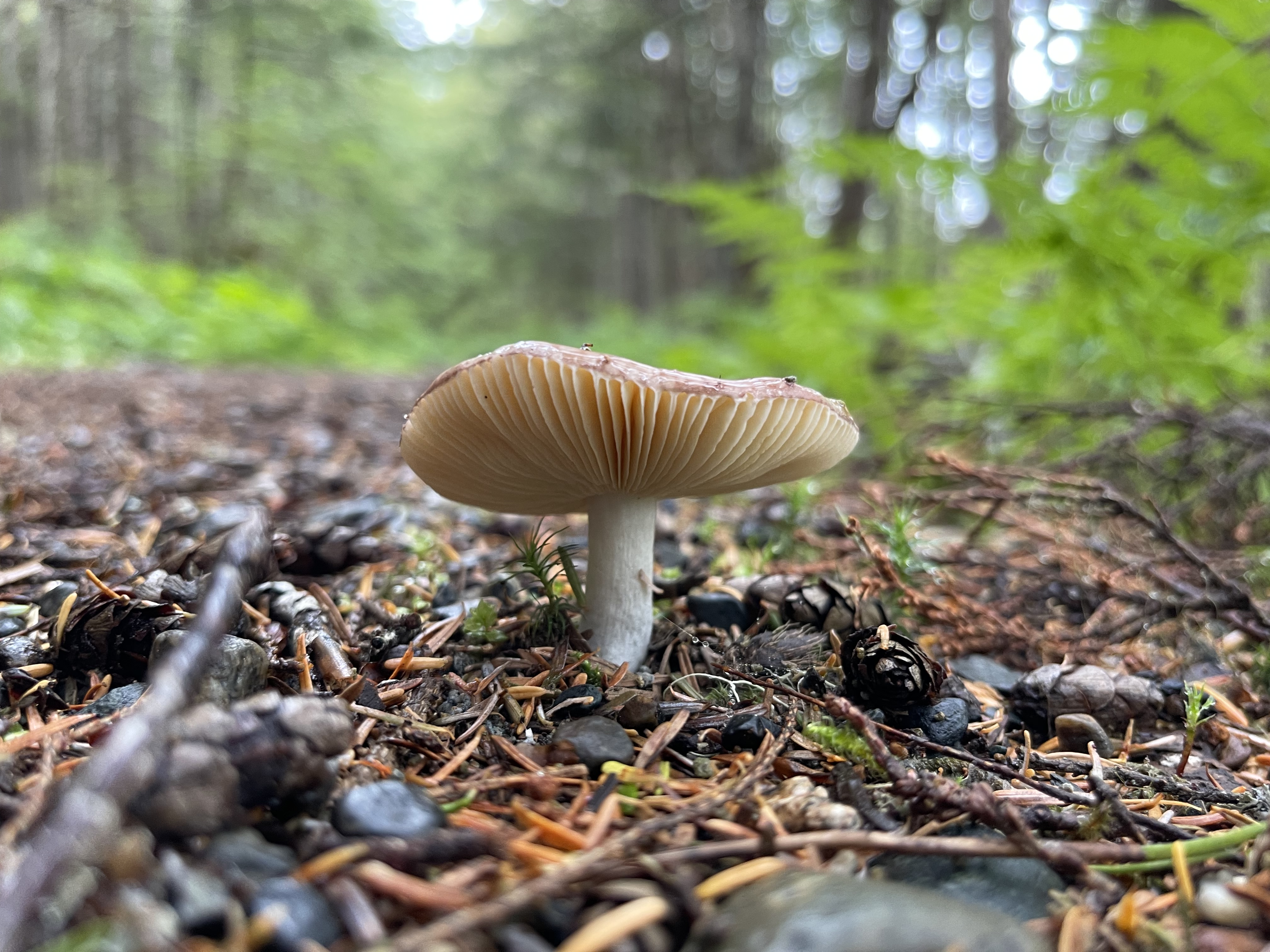
For my grandmother’s funeral, I refused to wear black. Death, grief, pain, loss, sorrow, sobs all bowed to black. Most of all, black meant forgetting. Oblivion is black. Sleek black like the raven wings of an eternal night, eternal sleep. I would not forget her. Perhaps she would not always sleep. I wore white. White like her temple dress. White like the snow tipped mountains that looked down on her grave. White for her faith in a loving God. White like stem under the soft gills on the belly of a mushroom. White for resurrection and the promises of her heaven.
One long pew, in the center of the Church held the entire immediate family of Dorothy Adelaide Muchmore Crisp Mickelson Farnsworth. Seventeen all told, four children, two in-laws, and eleven grandchildren. The Church then filled with her friends, neighbors, co-workers, and extended relatives. Words spoken, hymns sung, tears shed in the Mormon chapel in Duchesne, Utah. We packed into cars and drove in a strange June rain toward Mountain Home, Utah, and her grave.
——-
Scire (ski:re) to know. Latin.
for Starr
by Megan DicksonTo know Time
is to begin to
understand the mortal
drum of the UniverseThe thrum of blood
coursing through your veins,
narrative in your head,
bringing you closer
to Death,
but to know Life
is to know the
thousand Drums
cacuophonizing consciousness
Beating,
to know
to see
to love
to joy
to song
to peaceYes, to tragedy
but, to know the
Infinite is to know
that a star is birthed
in an unfathomably
incandescent act of fusionBed of a nebula
beginning of Everything,
Creation– calamitous, cataclysmic
formidable, entropic
where one star died,
another rebornIn the End,
we’ll remember this
bead to celebrate
one life, it returns us
to our original scire–
to know– all love
——-
There are pictures of Earth that give us some idea of how precious, how miraculous our planet really is and what it might be like to look out on our own home from the window of a space shuttle or planetary lander. Bill Anders from NASA’s Apollo 8 Mission, 1968, took the famous photo “Earthrise.” He explains, “My photo “Earthrise” points out the beauty of Earth – and its fragility. That little atmospheric thing you and I are enjoying now is nothing more than the skin on an apple around the core.” That’s the funny thing about this whole accidental miracle, in all the cosmos we exist. Just that fact alone is part of a probability that is so far beyond my perception that my eyes blur and my head dizzies.
Sometimes I still imagine being an astronaut. Alan Lightman and Tom Wolfe advocated that instead of sending airmen and women or folks who were formally trained by the military into space, we should prioritize sending artists, poets, musicians, and more scientists of every description because they would be able to communicate the awe, the beauty, the wonder, and the utter incredulity when faced with looking at our very own blue and green oasis–Earth– from off-planet.
I remember seeing another photo of Earth from a satellite camera trained at the center of the pacific ocean. From that perspective Earth looked much more like a water born planet with two tiny, almost wispy ice caps floating on one vast sea. Water and ice. That was it. How might human perspective be changed if we all got a chance to look at our planet from outer space? Would we be more compelled to find ways to stabilize our planet’s climate?
It feels as if sending a lot more Earthlings into space would achieve the same result as I was hoping to achieve by introducing my children to ice. To have our human perspectives opened wide, our understanding of what we thought we knew about Earth thrust away from us just like 7.2 million pounds of thrust that rocket a space shuttle to reach terminal velocity and escape Earth’s gravitational force. Sometimes that’s the force it feels like it takes to get folks care about Earth, 7.2 million pounds of thrust. I hope the care we continue to need to take care of Earth seems to grow as humans continue to populate our only home.
Climate activists and advocates in New York City and elsewhere have been heating up this summer– literally and figuratively. They are calling on companies and corporations to limit their use of fossil fuels and begin phasing these fuels out entirely. This message is not new, but the heat wave in the past few weeks, July 2024, has reenergized some of these groups. A longstanding group called Third Act was co-founded by Bill McKibben. Last week, McKibben and others marched around Citigroup’s headquarters downtown NYC in burlap sacks labeled with climate changes that have been the cause of the most loss of human life. Some of the hazards were “heat waves,” “bleached coral,” “tsunami,” “ocean acidification.”1
This group wants American corporations and large oil interests to be held accountable for their slow response to phasing out fossil fuel usage in industry, auto production, and the investment portfolios that reflect the fact that many of the companies have slothed or re-negged on their original climate goals.
If Greta Thunberg has proven nothing else, she has shown us how long, how fraught, how tiresome and relentless the calling of Earth Advocate can be. Perhaps if we shuttled Citigroup’s CEO, Jane Frazier with a batch of us climate egotists and apologists into space that would change. Maybe we’d all return with fresh eyes for how beautiful, how delicate, how balanced, and how worthy of our utmost care and love Earth really is. All love.
*(This is the fifth essay in a braid that runs back over thirty years in my lifetime, but the story is hundreds of thousands of years old, and continues as we face climate change at the human level more than perhaps ever before in Earth’s history. Previous essays and poems include: Hope (Alaska), Hope (and Ice), Hope (and Earth), Hope (and Loss). Thank you for reading, liking, commenting, and sharing.)


Wow, wow, wow. Another great masterpiece of writing from the depths of your heart. Thank you for sharing. I had no idea of your connection to Alaska and glaciers. (I’m glad you wore white.)
LikeLiked by 1 person