Letter to the Graduating Class of 2024: The Teacher-y Missive you were(n’t) Missing

The first rays of an orbital sunrise break through the Earth’s horizon. NASA iss066e099389 (Dec. 30, 2021)

Friends,

It’s certainly a gift that I feel I can use this moniker to describe each and every one of you. If you don’t feel like I’m your friend, will you please reserve that judgement for hallway talk? Or see me after class so that I can assure you of my care.

Here’s the thing, when you stepped through the doors of this classroom, somewhere around August 17th, 2023, I was already determined and committed to create a space where we can and could all safely explore concepts that require a fair amount of nuance and maturity.

But here is the other secret I happen to already have known: you have the prerequisites to be successful in this kind of open, thoughtful, argument-based inquiry and exploration. You see, everything, at its core, is an argument. Some arguments are petty—not worth engaging in. Some arguments are about cleaning toilets—your choice. But most arguments simply surround the differences of perspective, experience, and ways in which we’d like to control the world around us.

Now beyond argument, there is a field, and I’d like to call this field TRUTH. Many of the arguments we engage in as humans can be extrapolated into our desire to discover, uncover, find, know, and live in Truth. (Something I think is innate to our species.) And truth has taken a real beating in our society and culture as of late. As the information age and technological age have chaotically clashed and melded together, not unlike the birth of a new star, we have a constant stream of data that is both driven our way and so effortlessly accessible at the click of one key stroke or touch digit that we forget how far humanity has come on this examination of truth before you were even a gleam in your parent’s eyes. (You can google that idiom after class if you don’t know what I’m talking about.)

But if there is one thing I am certain of, it is that Truth with a capital T still exists. There is truth to be had and found in the world, and I hope that your research, your writing, your thinking and pondering on the subjects you have chosen this year (including your “self” in your personal narratives) have caused you to invest in this examination of the world with the intent to find truth. Don’t let the algorithm and the horrific car-crash videos you watch take that quest away from you. Don’t let AI rob you of the opportunity to figuratively bend the squishy matter we recognize as brain in coruscating synapses and ever-more lovely electrical exchanges of action-potential through your very own neurotransmitters. Use your sublime brain for your and humanity’s betterment. Promise me.

Things I have learned that don’t matter: being swoll or the hottest person in the room, being cool like above all comment because your persona gives off such a vibe or drip-and-smack that you are inaccessible (most of the time I’ve found that those who are “cool” often remain inaccessible to themselves); being “right”, this one is huge, and there is absolutely no honor in it. There isn’t one correct way to do things, and once you free yourself of this constraint you’ll live much more happily. And living too much in either retrospection—the nostalgia and glow of the past; or prospection—the lust and thirst for a future that hasn’t happened yet.

Live, my beautiful friends, with your eyes wide open in wonder. Live with your arms thrown apart ready to receive both the pain and the joy that life will bring you. Live so that you are constantly, even doggedly, learning more and evolving as a human every. single. day. Live the questions. (That’s Rilke. You can look it up, too.)

Now it’s all well and fine for me to offer you this “advice” but please don’t think I can even live the half of it myself. However, I’ve also learned that the more you practice these modes of living right here, right now, being present, sitting in the packet of time you’re fixed to and watching the experience unfold as you settle in– allowing you to determine how you can love more, reciprocate better, and evolve with grace, and seek that capital T truth– the better off you’ll be. In fact, the some of the best advice I’ve ever received comes from Lori McKenna’s song “Humble and Kind” from her album The Bird and the Riffle. (Also covered by Tim McGraw who is a little more famous.) She reminds, “When you get where you’re going, turn right back around. And help the next one in line. Always be humble and kind.” And then, just like that (snap), it’s gone. And you are moving on to the next moment, episode, or lesson that life offers.

Nothing can make a human feel more small and insignificant that taking just a moment to ponder on the infinite. Or the eventual dissolution of the infinite into entropy (still infinite, I believe). As the physicist and writer Alan Lightman, in his book, The Transcendent Brain, describes, “I believe that the spiritual experiences we have can arise from atoms and molecules. At the same time, some of these experiences, and certainly their very personal and subjective nature, cannot be fully understood in terms of atoms and molecules. I believe in the laws of chemistry and biology and physics — in fact, as a scientist I much admire those laws — but I don’t think they capture, or can capture, the first-person experience of making eye contact with wild animals and similar transcendent moments. Some human experiences are simply not reducible to zeros and ones.” There simply isn’t an algorithm that can capture the human experience.

One day this will all be gone, we will all be gone. Just like Macklemore says in his song (“Excavate”, Gemini). And there will be some kid in the hallways of Wasatch High School, like L. Daines who is looking for herself or himself in the sound of her/his music (also Macklemore), “Because music is a mirror…” Let’s not make our eventual death the reason we live. Instead, let’s live between these two great mysteries within whatever searing, glittering moments we’re presented with. And then turn and give our help, our hands, our brains, and our hearts to those other humans around us who make OUR world go round. That’s it. I think.

Once upon a time, I sat at the California Academy of Sciences in their astronomy hall underneath a false sky filled with tiny pin-prick light bulbs made to resemble stars, and listened to the smooth baritone of Tom Hanks narrate something like the advent of the Universe as though it was a nighttime story. Goodnight Moon, but better. When the camera moved from focus on our Milky Way Galaxy to an increasingly anamorphic lens, I, and the rest of the audience, could see that galaxy after galaxy after galaxy after galaxy… it really did appear to go on forever, infinitely.

Just like those galaxies, star upon infinite star, there are so many things that go into making up one single human person. The innumerable number of atoms, the constantly functioning systems. Just breathing, for heaven sakes, takes… do we know how many systems are engaged in one human breath? None of this has to matter to you. But I do hope that you’ll continue to put your best brain forward in every moment, every breath you are part of.

Today is one ending. You’re leaving, you’re out of here. But tomorrow, a new day will dawn. You’ll have the chance to gaze upon another sunrise. And if you’re not into that, to watch the death of another day as dusk moves us into night. Beautiful, either way. A new moment will rise, and you’ll be given opportunity after opportunity to make the most of your life. I hope you’ll take and treasure each one.

And when you realize that you’re rushing on, your attention is whacky and divided, or you’ve gotten trapped outside yourself and the road is dark and the path is winding, and you don’t know the way home, I hope you’ll consider thinking about the way/ways you can share your gifts with others to reorient your true heart. So I’m going to leave you with this poem. A gift from my true heart to yours. Don’t forget that for each end, there certainly is a new now. A gift of beginning.

The End From the Beginning

Endings, they definitely aren’t my favorite.
A bird in the hand… they claim.
I’m better if some things never change.
A feather in a vacuum, only acted on by gravity
Falls as fast as anything.
This fundamental of physics makes my head spin.
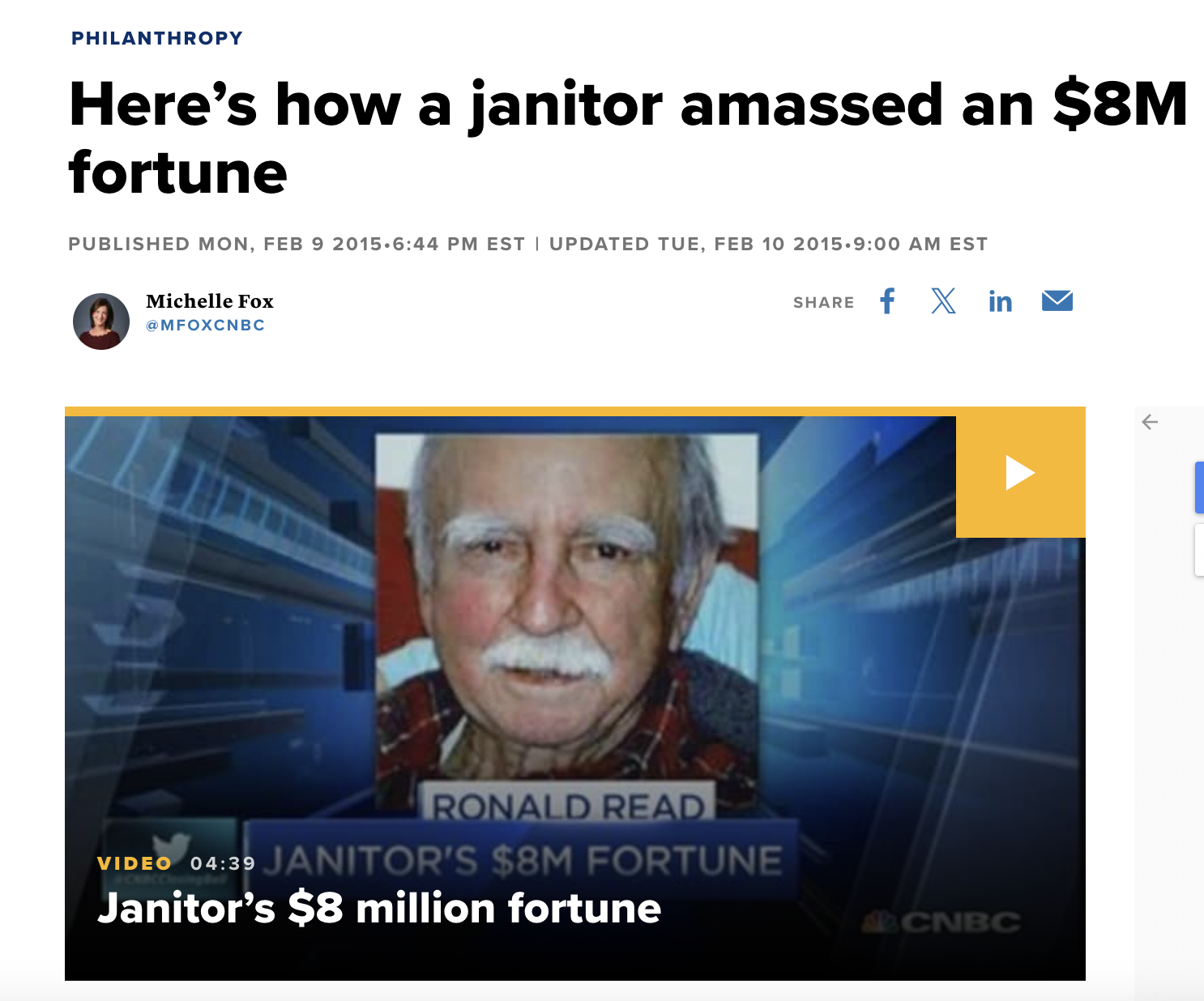
Like that janitor who left all of his fortune to the library where he shined the broken tiles day-in and day-out.
Here. Now.

Maybe this gift is just the beginning.

-MM
My Turn: Student Safety and Gun Safety

unnamed

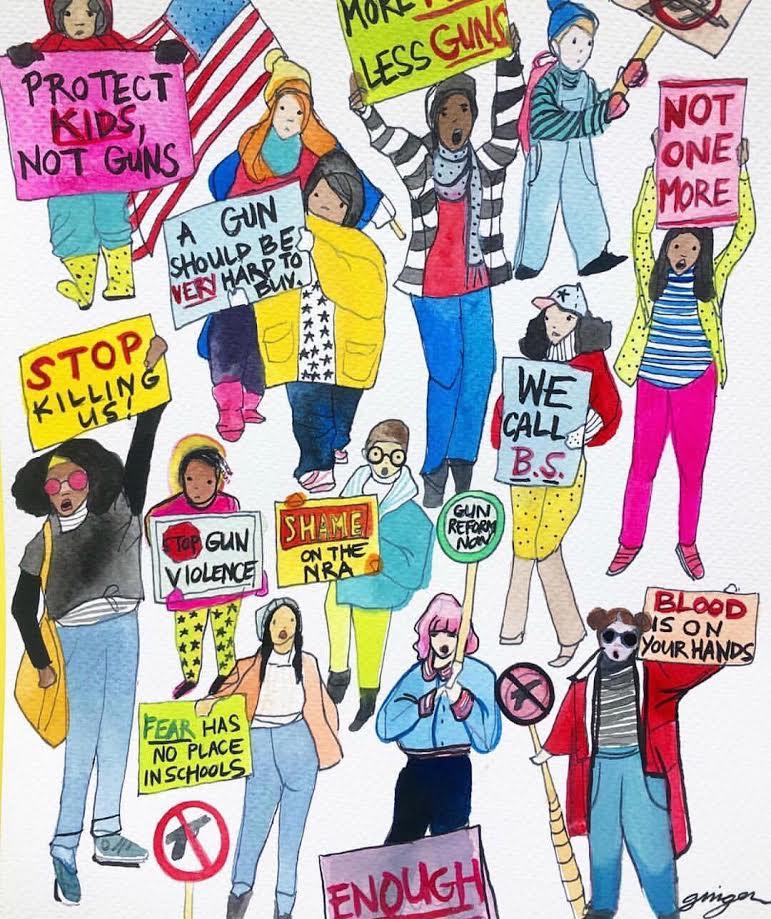
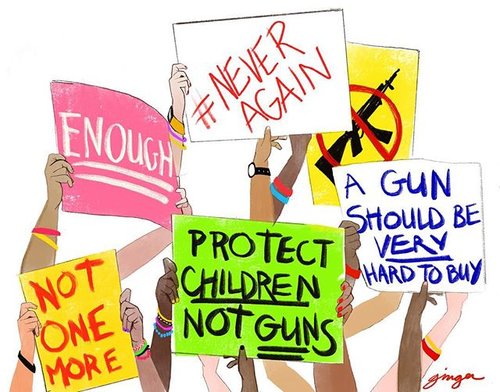
Image: Ginger Williams Cook

I want to take you all with me on my journey last week. It is a road that I should have foreseen when I took a job as a teacher, when I turned my education into educating. But I have to be frank, and tell you that I did not clearly see that I would one day be communicating a classroom plan to each and every one of my students as to how we would “Run, Hide, Fight”– the mantra of school shooting safety.

I want you as fellow parents, and grandparents, and citizens, and teachers, and administrators, and police officers, and lobbyists, and politicians to know what it felt like to stand in front of a classroom of students and tell them that what I want most for them when they come to school is their safety and their continued ability to earn an education that will carry them into the world as thoughtful, hard-working, problem-solving, critical reasoning, readers, writers, thinkers, and speakers who are career and college ready.

I want you to know that I saw both depth of understanding and depth of fear, both depth of care and depth of concern, both the need to be loved and the need to show love, both the desire to be safe and the desire to ensure the safety of others in my students’ eyes as we spoke. If you were standing next to me in my classroom this week, your faith in humanity would have grown three sizes those days.

I hope it won’t surprise you that not one of my students rolled their eyes when we talked about our classroom safety plan. Not one of them asked why we had to engage in such a boring assignment, or if they could take a nap, or if we could talk about something else. None of the usual millennial stereotypes we place on this generation of youth. Yes, I get all of these non-plused reactions to the daily English concepts, learning assignments, creative activities, and formative assessments I give in my classroom. I’m not offended by this in the least. I teach high school English. It’s not everyone’s favorite subject, and six hours in a school desk could put anyone on the verge of a needing a nap. But not one mention of an out, an alternative, an apathetic reply shows you how important this topic is to our youth.

My students were keenly listening, hyper aware, compellingly conversational, profoundly questioning, solution creating, statistic gathering. I know one thing for sure– after this week-and-a-half spent discussing the ways we could best hide in silence, with cell-phones off, not a word uttered, backpacks filled with computers and books placed over our hearts as a best defense against bullets– my students want to live.

But listening to the rhetoric and the maligning of the essential questions about gun control, mental health, and school safety in our country I really have had to ask myself, “Do we want the same thing for them? Do we want my students to live?” Your faith in humanity may have shrunk a bit too at the apathetic responses from representatives, politicians, and spokespersons who upheld the status quo so unmoved by the honest expressions and questions of grief from our youth and their parents.

Why can my students see that the conversation does not logically need go to the extreme of revoking the Second Amendment, but that it would be reasonable for us to speak about universal background checks, and cooling-off periods, and training for the opportunity to buy a firearm? Why does the conversation become the fact that more people die in cars than by gun-shot wounds before we talk about banning assault weapons and making bump stocks illegal?

Why does the conversation become the idea that if guns are regulated they will no longer be available to citizens but only to criminals rather than discussing common sense methods of mental health screenings for those who want to purchase firearms? Why does the conversation become arming teachers and other militant policies that include more guns rather than examining societal support of those who struggle with conditions of mental illness? Do we worship the Second Amendment and its economic and political gains more than the principles of life, liberty, and the pursuit of happiness? Because from my vantage point this week, we do.

Because if all I have in my tool-kit is to continue to train students to duck low and move swiftly to the back of the room. That I will look out into the hall to bring passing students into our classroom the way Scott Beigel did when he was shot. That I will lock and barricade the door with a tall wooden pallet that ironically bears a peace sign. That we will break the glass in the window, hurling desks at it if need be, and exit out as swiftly as we can toward the street. That they need to run as fast as they can to the road without stopping. It feels akin to telling students to “duck and cover” in the event of an atomic bomb, with the full knowledge that all that will be left is their nuclear shadow as a reminder of their existence.

I want you to know these details because I want you to know that I want each and every child in my classroom to live. We talked in specifics. But are we as a society going to work together to ensure that safety? Now is the time that will tell. “Would you carry a gun, Mrs. Dickson?” my students asked, his hazel eyes serious, his mouth poised in a firm straight line once the question exited his mouth. He wanted to know if I would carry a weapon at school, if I would get a concealed carry permit to bring a weapon into my classroom. He didn’t ask in rancor or in pleading. He simply wanted to know what I would do to save him and his classmates in the event of a mass shooting.

What would I do? I had already asked myself this question many, many, many times from the day that the massacre happened at Marjory Stoneman Douglas High School in Parkland, Florida to the day that a student threatened the school I teach in on social media. What would I do to keep my students safe?

It was one of those moments where time took on an eternal quality– still, gaping, telescoping toward my need to answer him. “I didn’t take this job to be in law enforcement, or to carry a gun,” I replied. “You have asked me a deep and philosophical question. I do not believe in guns for the taking of human life. You want to know if I would carry a gun to protect you, but I want to know why [a teacher] carrying a gun would be our first line of defense on your behalf?”

Perhaps it felt like a dodging, ducking, pivot, a non-answer like the many politicians and spokespersons we’ve heard from this week.  Maybe it felt to him like I fractured that student’s trust. My students, who will have to trust in my coping mechanisms in the event that a deleterious person plans our death, deserve answers. But I do know my answer to his question. “No.” No, I will not carry a weapon on a high school campus.

The words Alfonso Calderon, survivor of Parkland’s school shooting, rang in my ears, “That’s a terrible idea… As far as I am aware, teachers are meant to be educators. They are meant to teach young minds how to work in the real world. They are not meant to know how to carry AR 15s, they are not meant to know how to put on kevlar vests for other students or for themselves. This is not what we stand for. We stand for small policy changes, and possibly big ones in the future. Because right now I am pretty sick of talking about teachers being armed. That is not even a possibility in my mind. I would never want to see that and neither do they want to do that.”

I care about each and every one of my students deeply. Yet when an administrator asks me “How are your kids?” like Rebecca Berlin Field, I immediately jump into my role as mother to two young boys at an elementary school that seems impossibly far, and feels unpredictably vulnerable and reply, “I was so grateful for the Principal and over thirty staff and faculty who welcomed each and every student to school today. They were standing on the curb in six degree weather when my husband dropped my boys off.” Then realizing my mistake, I quickly say, “Oh, you mean my students. They are scared.” Because this question reaches further than the doors of my high school onto elementary campuses where tiny humans go to learn and to be safe, too.

How will we protect those young students like those in Sandy Hook? I realized this week that it is my turn. If I believe that laws should change, or that monies should be appropriated in a different or particular way, or that students should be protected it is my turn to step up and voice these opinions.

It is my turn to stand beside these brave students from my high school who are looking for real and actionable change to come from the debates surrounding the Parkland, FL shooting. Small changes in national policy can lead to big changes in the safety that exists (or doesn’t) in our schools. It is my turn to be part of solutions that keep my children safe every day at school. The debate doesn’t need to be mutually exclusive, citizens can and do have the right to bear arms, alongside more reasonable regulation of these weapons. We can allocate funds for more sustained support of the mentally ill. We don’t have to throw our hands up in defeat simply because we’ve been asked to do something difficult. If I tell my students every day that they can do hard things, then I should be able to do hard things too. I hope as a parent, a grandparent, a teacher, an administrator or a concerned citizen you’ll consider speaking out on these matters.

static1.squarespace

001-Peace-Sign-Hand